Jack O’Connor Would Have Loved the 6.5 Creedmoor

Jack O’Connor died in 1978, nearly 30 years before the 6.5 Creedmoor appeared, but judged by the standards he championed in The Hunting Rifle and decades of Outdoor Life writing, he probably would have loved it—even if it never displaced his beloved .270 Winchester. O’Connor valued accuracy, moderate recoil, flat-enough trajectory, high sectional density, efficient bullets, penetration, and above all the hunter’s ability to put a bullet precisely where it belonged. The Creedmoor checks virtually every box: a 140-grain 6.5mm bullet has excellent sectional density, modern high-BC bullets retain velocity remarkably well, recoil is lighter than the .270, and the cartridge is famously easy to shoot accurately. Where O’Connor would still favor the .270 is raw velocity and its flatter trajectory at ordinary hunting distances—especially important in his era, when hunters estimated range rather than pushing a button on a laser rangefinder. Ironically, O’Connor also admired cartridges such as the mild-mannered 7×57 Mauser and repeatedly argued that shot placement mattered more than horsepower. The funniest conclusion, then, is that the old-school hunters who dismiss the 6.5 Creedmoor as some newfangled fad might be surprised by their own patron saint: the Creedmoor is essentially an O’Connor hunting cartridge designed 30 years too late—accurate, efficient, mild to shoot, and powerful enough to kill what you’re hunting if you quit arguing about caliber and put the damned bullet where it belongs.


MOA vs. Mils: No, Mils Aren’t More Accurate

MOA vs. mils: no, mils aren’t “more accurate.” Math is math. They’re just beautifully idiot-resistant.

Tell Private Snuffy to add ½ and ¼ and you can smell the electrical fire. Tell him to add .3 and .5 and he can probably do it on his fingers. Suddenly the military’s love affair with mils makes perfect sense.

PRS speaks decimals. Traditional American riflemen speak fractions. Different dialects, same X-ring.

The Original Deer-Camp MRE: The Lost Art of Canning Venison

Before freezers and generators, Michigan hunters had another way to make November’s deer feed the family all winter: the Mason jar. Pressure-canned venison may be the original deer-camp MRE—simple, shelf-stable, already cooked, and requiring no refrigeration. It’s a nearly forgotten skill worth bringing back.

The Hunt for Ink and Paper

It was a small town. Somewhere in the Southeast. Big shopping complex, off the interstate. Best Buy, Red Lobster, Ulta, Olive Garden, Outback Steakhouse, Target, and all other franchises that transform American towns into carbon copies, from Oil Slick to Shining Oil Slick. 

The Infantry: The Guys Who Get the Dust While Everyone Else Gets the Glory

The cavalry gets the glory. The infantry gets the dust. For thousands of years, warfare has invented faster horses, bigger guns, tanks, aircraft, drones, and now cyber warriors—but eventually somebody still has to walk onto the objective with a rifle and take the ground. Call them ground pounders, earth pigs, grunts, soldiers, or Marines: they are the infantry. Not everyone should be one, and thank God for that. But every army needs them, because wars may be shaped by technology, artillery, armor, and airpower—but ground is still won by the poor bastard standing on it.

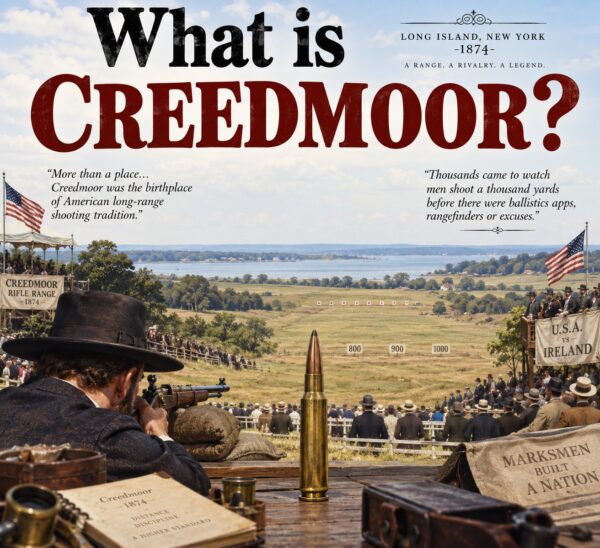
Before You Mock the 6.5 Creedmoor, Learn What “Creedmoor” Means

The 6.5 Creedmoor has been around for 19 years, and apparently that still hasn’t been enough time for some gun enthusiasts to learn what the word Creedmoor actually means.

Before you utter “6.5 Man Bun” again, try Google.

Michigan Adds Another Felony Because You Used an iPhone

I learned something while sitting on a Michigan jury that sent me down one hell of a rabbit hole: Michigan can separately criminalize using a computer to commit a crime. In 2026, when your phone, truck, watch, bank, doorbell and possibly your toaster are computers, that starts sounding suspiciously like an enhancement for breathing oxygen while committing a crime.

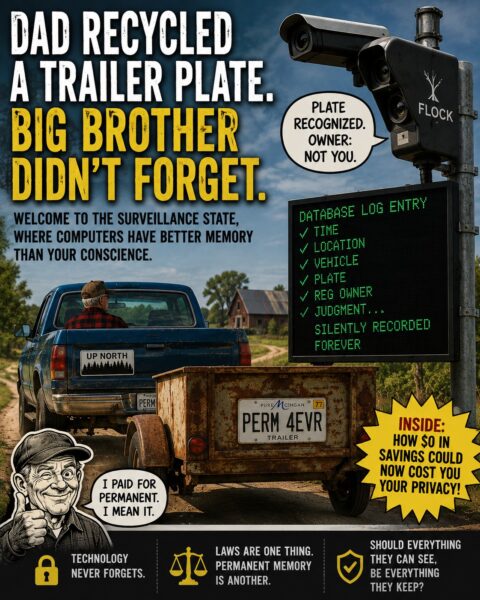
Dad’s Permanent Trailer Plate Has Entered the Surveillance State

Dad thought “permanent trailer plate” meant permanent. Government apparently meant, “until you buy another trailer, peasant.” For generations, recycling an old trailer plate was the kind of technically-wrong rural economics nobody noticed unless a cop had an actual reason to look. Today, cameras, databases, and algorithms potentially can notice—and remember—things no human officer ever would have bothered with.

That raises a bigger question than Dad’s Great Trailer Plate Crime Spree: **When technology makes it possible for government to notice nearly everything, should it?**

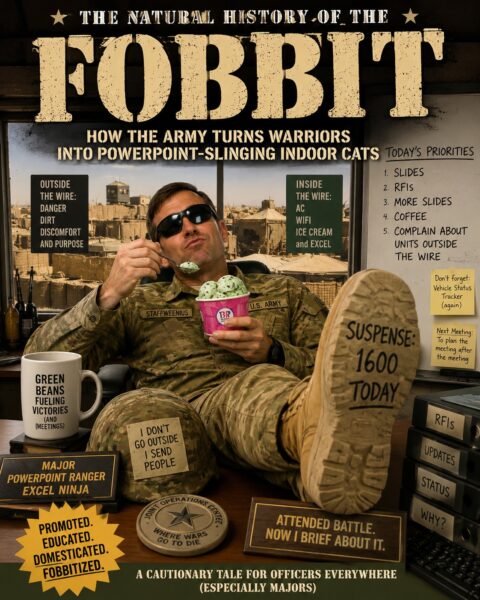
The FOBbit: How the Army Turns Warriors Into PowerPoint-Slinging Indoor Cats

The Army has a remarkable ability to take a perfectly functional warrior, promote him a few times, hand him three computer monitors, and turn him into a PowerPoint-slinging indoor cat. Thus begins the evolution of the FOBbit: that mysterious creature who once went outside the wire but now survives on RFIs, synchronization meetings, Green Beans coffee, and Baskin-Robbins. The real horror comes when you finally look down at your ice cream, look at your clean uniform, hit “Send” on another 1600 suspense, and realize the terrible truth: Oh, $h!tt! I’m the FOBbit.

I Don’t Believe in Miracles, Says the Miracle

Modern man says he doesn’t believe in miracles while standing on a wet rock hurtling through space, made of stardust, possessing consciousness nobody can fully explain, pondering a universe nobody can explain why exists. God? Ridiculous. Ancient aliens? Now you have his attention. Maybe we didn’t stop believing—we just changed the vocabulary and became selectively skeptical about which mysteries are socially acceptable. Watch for AFNN next week as we ask the uncomfortable question: “I Don’t Believe in Miracles,” Says the Miracle.

Bad Gramer

I get a lot of comments about grammar. And after having studied the subject for years—mainly by reading thousands of critically acclaimed cereal boxes—I’ve decided to answer questions from readers who inquire about various errors in my work.

Welcome to the Pentagon Wars: The National Guard Still Hates Me

The Pentagon doesn’t fight just one kind of war. Some are fought with tanks and rifles; others with spreadsheets, PowerPoint, and somebody quietly asking, “Where haven’t they spent their money yet?” Born from Robert McNamara’s 1960s-era attempt to bring rational analysis to defense spending, the POM process evolved into an institutionalized food fight where the Active Army, National Guard, and Army Reserve defend their rice bowls while hunting for everyone else’s leftovers. I happened to be pretty good at looking under the fiscal seat cushions—and somewhere, I suspect, a retired National Guard programmer still mutters my name. Welcome to the Pentagon Wars.

The Greatest Generation Didn’t Have A Port Call Scheduled

The Greatest Generation didn’t have Wi-Fi, DoorDash, FaceTime, scheduled port calls—or an expected return date. They had a war to win. Today’s sailors aren’t the problem; they’re products of a culture that has become extraordinarily good at eliminating discomfort. The question isn’t whether young Americans are “soft.” It’s whether America still teaches resilience before history demands it the hard way.

The Pacific Ocean doesn’t have an HR department, and the enemy doesn’t care about your deployment schedule.

Flock You: The Fourth Amendment Would Like a Word

America has built a surveillance network King George III could only dream about. License-plate cameras may help catch criminals, but when government can potentially turn millions of innocent motorists into searchable dots on a map, the Fourth Amendment deserves a seat at the table. Catch the car thief. Find the missing child. But when the government wants to reconstruct where ordinary citizens have been, Americans should remember two beautiful words our Founders would appreciate: Flock you.

Feeding the Beast: And Lo, We Built It a Data Center

What if the Beast of Revelation didn’t rise from the sea—but arrived in a server rack? This fictional, extra-biblical excursion imagines AI as the Beast, data centers as its temples, and humanity enthusiastically feeding it electricity, water, privacy, knowledge, and eventually perhaps our autonomy. The disturbing part isn’t that the machine might conquer us. It’s that we may build it ourselves, connect everything to it, put it in our pockets—and stand in line for the upgrade.