What if our ancestors really did survive a global catastrophe?
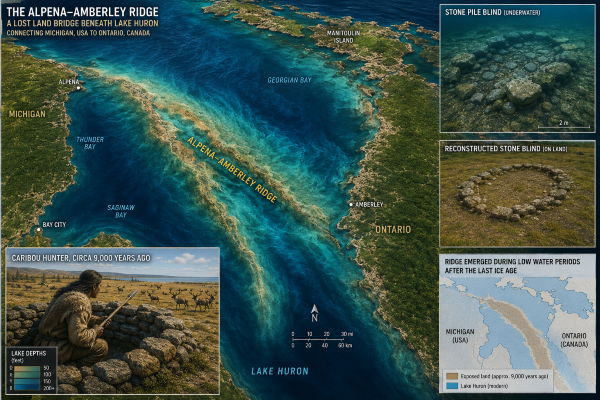
Beneath the waters of Lake Huron lies the Alpena–Amberley Ridge, a prehistoric hunting landscape that once connected Michigan and Ontario. Today it sits submerged and largely forgotten. To some researchers, it is evidence of sophisticated hunters tracking migrating caribou 9,000 years ago. To others, it raises a far bigger question: how much of humanity’s ancient story now lies underwater?
The Younger Dryas Impact Hypothesis remains controversial, but the idea is difficult to ignore. If a cosmic event helped trigger dramatic climate shifts, floods, and environmental upheaval near the end of the Ice Age, what would the world have looked like a few thousand years later? Perhaps not a world of lost super-civilizations, but one of survivors rebuilding, adapting, and passing down memories of a world forever changed.
The Alpena–Amberley Ridge doesn’t prove the theory. What it does prove is that entire landscapes, ecosystems, and chapters of human history can disappear beneath the waves. The real mystery may not be what we’ve found, but what remains hidden.