When Things Go Right, It’s the Boss. When Things Go Wrong, It’s Everybody Else.
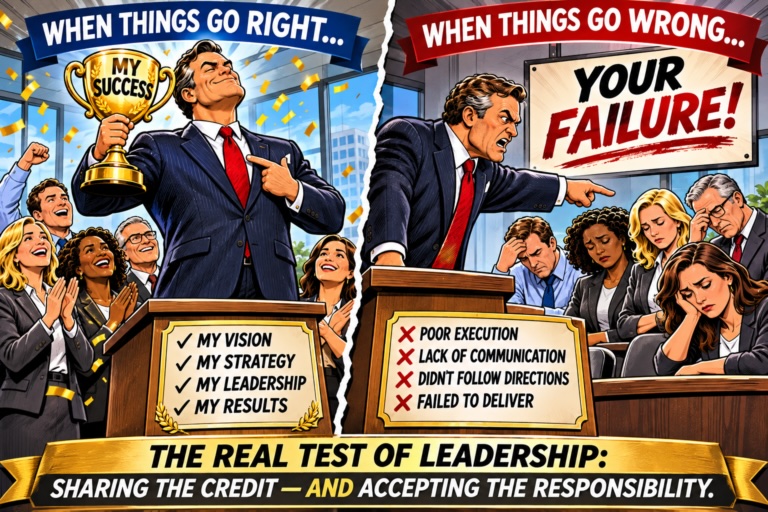
Have you ever noticed how some leaders have an amazing ability to take credit for success while avoiding responsibility for failure?
Citizen Writers Fighting Censorship by Helping Americans Understand Issues Affecting the Republic.
Have you ever noticed how some leaders have an amazing ability to take credit for success while avoiding responsibility for failure?

It’s easy for a leader to demand results, establish standards, and point out where others have fallen short. It’s considerably harder to look in the mirror when something goes wrong and ask a much more uncomfortable question:
What part of this belongs to me?
That’s where leadership begins.

People learn quickly what happens when they bring the boss bad news. They notice when someone is interrupted, embarrassed, dismissed, or punished for disagreeing. They remember the meeting where the boss asked for opinions but became defensive the moment someone offered one.

Throughout America in states-counties-cities known to disregard federal laws in general such as immigration law and the like mentioned above, the federal government-in collaboration with state governments-must undertake steps to monitor the conduct of elections and to enforce best practice documentation procedures.

Our judicial system has become deeply misguided – with too many judges more interested in social engineering than blind application of the laws passed by the people’s representatives. Their behavior is an affront to our self-governance.

Our “public servants” clearly don’t understand something about employment that people in the private sector have always known. Unless you’re a judge or an Ivy League communist professor, a job isn’t a lifetime appointment.

Afghanistan was such a disaster not only due to the preventable loss of thirteen brave Americans at the Abbey Gate but also because of the message of weakness heard around the world.

The big question is, under what circumstances can we hold party leaders responsible for the actions of their agents, and how do we do so?

We know what ethical legal behavior looks like. And yet Alvin Bragg and Juan Merchan violated their oaths, the Constitution, and New York ethical standards with complete impunity. The system created to regulate their behavior failed – not from a lack of oversight – but from a lack of accountability.

This is Part 5 of a series on accountability and responsibility. This part looks at the voters and to whom they are accountable. As the graphic from My Comic Shop shows, voters are accountable to themselves.

This is Part 4 of a series on accountability and responsibility. As the graphic shows, the two should work together, but can but can get jammed. But often the two are divorced, or at least separated, in this case, by Judicial Review and life-time appointments.

This is Part 2 of a series on accountability and responsibility. As the graphic shows, the two should work together, but can get jammed.

This is Part 1 of a series on accountability and responsibility. As the graphic shows, the two should work together. But often the two are divorced, or at least separated.

In Part 2 we examined how accountability has failed for the federal government. In this part we will address a path forward.

This is Part 2 of a three part series on lost federal Government accountability.

This is Part 1 of a three part series on lost federal Government accountability and what we as Americans need to do to get it back.
Conducting an Article V convention, and obtaining ratification of proposals, would be a herculean effort. But getting 38 states to agree with the necessity of imposing accountability on Washington, seems much more achievable than attempting to use the federal government to take corrective action on the federal government.
Our constitutional republic cannot survive with a federal police force which targets political opponents, applies the laws for its convenience, creates crimes to solve them, and lies with impunity to its masters.

When a dog can’t be trusted among the vulnerable, there are only three options: train it, restrain it, or put it down.

There’s one thing that hasn’t changed in our Department of Defense. Good ole “Don’t ask, Don’t tell” is still a thing. But it isn’t a sexual preference thing anymore. Now it’s a political preferences thing.