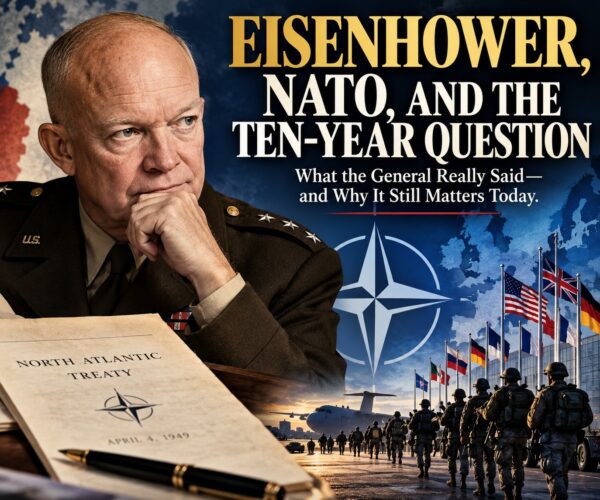
It’s a wonderful story. Unfortunately, it’s not quite true. The actual history is considerably more interesting.
President Harry Truman signed the North Atlantic Treaty in 1949. Eisenhower became NATO’s first Supreme Allied Commander Europe in 1951, inheriting the rather unpleasant responsibility of organizing Western Europe’s defense against a Soviet Union that had just demonstrated its appetite for real estate.
Europe was devastated. Its economies were recovering, its armies were rebuilding, and Stalin wasn’t exactly sending Christmas cards.
American military assistance made sense. Eisenhower understood that. What he apparently didn’t envision was American troops becoming a permanent substitute for European military responsibility.
Eisenhower explained that he had expected an Englishman or a Frenchman to take command of NATO within eight years of his original appointment. Instead, the Americans were still running the show, supplying much of the military muscle and paying an enormous share of the bill.
He believed the United States was carrying too much of the burden. Europe needed to accept its responsibilities. And this wasn’t some sudden revelation. Eisenhower said he’d been pressing the issue for five years, only to have another crisis emerge every time somebody suggested discussing it.
Sound familiar?
Now, here’s where that ten-year story gets interesting.
Article 12 of the original NATO treaty explicitly permitted a review after ten years. Article 13 allowed individual members to withdraw after twenty years, provided they gave one year’s notice.
There was no automatic expiration date. Nobody installed a self-destruct mechanism under NATO headquarters. But the founding nations did include a provision for reconsidering their arrangement as circumstances changed.
And circumstances certainly changed.
In 1951, Europe was still recovering from World War II. Germany was divided, Soviet forces occupied Eastern Europe, and another major European war was a genuine concern.
By 1959, Western Europe was rebuilding its economic strength. Eisenhower wanted its governments to translate some of that recovery into military capability.
He wasn’t demanding that America abandon Europe. Quite the opposite. When Spaak asked whether American troops would someday withdraw entirely, Eisenhower said they absolutely would not. He also cautioned against prematurely reducing troop strength. His objective was to strengthen NATO by getting the Europeans to shoulder more responsibility.
He’d also seen what happened when Europe couldn’t defend itself.
Fast-forward to 1991. The Soviet Union collapsed, the Warsaw Pact disappeared, and the original geopolitical circumstances that produced NATO changed dramatically.
NATO didn’t disappear. It expanded, adapted, and eventually assumed missions far beyond its original Cold War defense posture.
That history raises legitimate questions. What responsibilities should European nations carry? How much American military presence is necessary? And how should an alliance created to contain the Soviet Union adapt to a world in which the Soviet Union no longer exists?
Those questions are particularly relevant when considering the wars in the Balkans, Afghanistan, and Ukraine. Each presented NATO with a different strategic problem, different political objectives, and different arguments about American involvement.
There is another Eisenhower warning worth remembering.
In his 1961 farewell address, he cautioned Americans about the growing influence of the military-industrial complex. He wasn’t arguing that America should disarm. He was warning that maintaining a permanent, enormous military establishment carried economic and political consequences.
Consider those two concerns together: a permanent American military commitment overseas and a permanent industrial establishment required to support it.
That’s an expensive arrangement, and one that deserves periodic examination.
Eisenhower understood that alliances were instruments of national security, not sacred institutions exempt from scrutiny. He also understood that abandoning an alliance prematurely could be disastrous.
His frustration wasn’t that NATO had survived its first decade. It was that the Europeans hadn’t assumed the level of responsibility he expected them to carry.
And here’s the part I find fascinating.
In 1959, Eisenhower was complaining that every time he raised the issue, another international crisis provided an excuse to postpone the conversation.
Sixty-seven years later, we’re still having versions of that same conversation.
Perhaps the lesson isn’t that Eisenhower wanted NATO to expire after ten years. He didn’t.
It’s that even the general who helped build NATO understood that American generosity and European dependency were not supposed to be the same thing.
And somewhere in the great celestial headquarters, Ike might be looking at the paperwork and asking why his eight-year transition plan is still awaiting final approval.
Historical sources: Eisenhower’s November 24, 1959 conversation with NATO Secretary General Spaak; the original North Atlantic Treaty; and Eisenhower’s 1957 discussion of European defense responsibilities.
If you enjoyed this article, then please REPOST or SHARE with others; encourage them to follow AFNN. If you’d like to become a citizen contributor for AFNN, contact us at managingeditor@afnn.us Help keep us ad-free by donating here.
Substack: American Free News Network Substack
Truth Social: @AFNN_USA
Facebook: https://m.facebook.
Telegram: https://t.me/
Twitter: https://twitter.com/AfnnUsa
GETTR: https://gettr.com/user/AFNN_
CloutHub: @AFNN_USA
The North Atlantic Treaty was signed in April of 1949, when it was estimated that the USSR would need another ten years to develop an atomic bomb.
The USSR detonated its first atomic device in August of 1949.
We still had complete nuclear superiority, but that the Russkies had developed a nuclear weapon so much earlier than expected changed things. The Red Army was nowhere close to streaming through the Fulda Gap to invade democratic Europe, but it was only 15 years later until the USSR had a nuclear deterrent force in which Western strategists were dickering over whether our nuclear deterrent force was strong enough to survive a ‘counterforce’ surprise attack.
NATO expanded, and we are now obligated by treaty to come to the defense of tiny Latvia, should the Russians try to seize it. In that, we have been lucky: the Russians have proven themselves mostly incompetent militarily in Ukraine, and if they won that war today, would still need a decade to rebuild what they’ve lost. But regardless of how long it took, we would still be required to go to war with nuclear-armed Russia over Latvia if Vlad the Impaler Putin decided to do something stupid.
Would you want to go to war with Russia over Latvia?