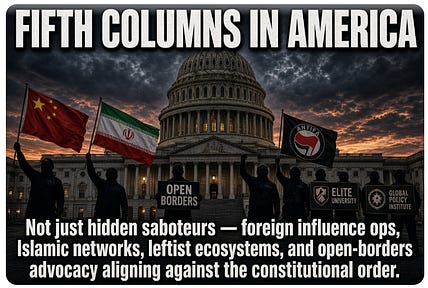
Foreign influence, ideological networks, and institutional capture
Merriam-Webster defines a “fifth column” in its original, literal sense: “a group of secret sympathizers or supporters of an enemy that engage in espionage or sabotage within defense lines or national borders.” That is a high bar (i.e., hidden agents under foreign direction with actions timed to a military objective), and almost nothing discussed in American politics today clears it.
The term has widened in recent years. Political scientists now treat fifth-column politics as rhetoric, policy, or mobilization against domestic “enemies within.” Scott Radnitz of the University of Washington splits it into two types: subversive claims aimed at vulnerable minorities or immigrants, and collusive claims aimed at elites said to serve a foreign power. Neither needs a hidden army or single chain of command. Both describe a domestic network – whether organized or not – whose activities, funding, or ideology line up with a foreign adversary, or that treats the U.S. constitutional order as illegitimate and works to replace it from the inside.
Against the modern definition, at least five clusters loosely qualify at different levels of evidence: documented Chinese, Iranian, and Cuban influence operations; Muslim Brotherhood- and CAIR-linked Islamist networks with an institutional capture strategy; the decentralized Antifa milieu and the Neville Singham-funded PSL/ANSWER/CodePink/People’s Forum/BreakThrough News ecosystem; mass illegal immigration and open borders advocacy; and transnational cartels exercising parallel authority in parts of the U.S. border region.
This analysis examines each cluster, tiers the evidence, maps overlapping interests, and offers monitoring recommendations for the future. The methodology used is described in the Executive Summary.
EXECUTIVE SUMMARY AND HISTORICAL ORIGINS
Only one of the networks examined herein meets the 1936 definition of a fifth column literally: foreign state-directed influence operations run by intelligence services. The other four categories are looser, modern applications of the term to describe ideological, financial, or organizational alignment with actors hostile to the American constitutional order – that is, real patterns, but analogies rather than proven command structures.
Every claim in this article fits one of three evidentiary tiers. [Documented] means confirmed by court record, government designation, sworn testimony, or primary source document. [Credible/Contested] means reported by named officials, congressional committees, or investigative journalism, but disputed, unresolved, or based on a single source. [Speculative/Analogical] means an inference, pattern, or rhetorical framing rather than an established fact. The analysis goal is to “keep things clean” so that the reader can discern documented fact from informed speculation.
Madrid, 1936 marked the origination of the term “fifth column”:
[Documented]: on 30 September 1936 during the Spanish Civil War, a secret German telegram was the first document to record the phrase, attributing to Spanish General Francisco Franco a claim that four Nationalist army columns were closing on Madrid while a “fifth column” inside the city waited to attack the Republican defense from within.
On 3 October, communist propagandist Dolores Ibárruri (“La Pasionaria”) used the phrase publicly in Mundo Obrero (a periodical of the Spanish Communist Party), but attributed it to General Emilio Mola, not Franco. Journalist Noel Monks later claimed Mola used it himself at a 28 October press conference (which was three weeks after Republican media had already popularized it).
[Credible/Contested]: no verified transcript of any Nationalist radio address or speech by Mola, Franco, or Gen Gonzalo Queipo de Llano contains the phrase. Historians remain split on whether Mola coined it, whether it was invented or embellished by Republican propagandists to justify wartime repression of suspected Nationalist sympathizers in Madrid, or some mix of both. What is not contested is the meaning it carried: a clandestine, coordinated network of sympathizers inside a besieged population, working to open the gates from within.
Because that original sense – hidden saboteurs under central military direction – is such a high bar, modern use of the term revolves around Scott Radnitz’s central finding: claims about fifth columns are far more common historically than documented fifth columns themselves, and the rhetoric tends to rise with ethnonationalist and geopolitical anxiety regardless of whether the underlying threat is real.
That does not make every modern application of the term wrong. After all, the analysis in this article describes networks with real and documented ties to hostile foreign actors, but it is the reason why the claims are tiered rather than treating the designation “fifth column” as self-evidently proven simply once the term is invoked.
CATEGORY 1: DOCUMENTED FOREIGN INFLUENCE AND INTELLIGENCE OPERATIONS
This is the category closest to the 1936 meaning – foreign state direction, not domestic analogy – and it is the best evidenced.
[Documented]: the House Select Committee on the CCP’s “United Front 101” memo describes the Chinese communists’ United Front Work Department (UFWD) as a Central Committee body coordinating influence over American universities, think tanks, civic groups, and diaspora organizations “whether legal or illicit.”
The FBI’s October 2022 raid on a secret Chinese police station operating out of the America ChangLe Association in New York (and tied to the Alliance for China’s Peaceful Reunification Network) is a concrete, court-reference example.
Talent recruitment programs (Thousand Talents and successors) have produced multiple DoD prosecutions of “researchers” who concealed CCP funding and IP-transfer obligations from U.S. institutions.
[Documented]: Iran’s Islamic Revolutionary Guard Corps has been directly tied to U.S. election interference. DoJ indicted three IRGC-inked cyber actors in 2024 for a hack-and-leak operation targeting the presidential race.
[Documented]: Cuba’s intelligence apparatus has a long, documented history of U.S.-facing operations; the Wasp Network and Ana Montes cases remain the clearest precedents. Contemporary claims linking Cuban intelligence directly to specific present-day U.S. activist organizations are weaker, perhaps due to the increased pressure being exerted on Cuba by the Trump administration.
[Credible/Contested]: a 2026 House Financial Services subcommittee hearing (“Trojan Horses: Covert Foreign Malign Influence Operations in America”) and a parallel Washington Times op-ed both describe a “red-green alliance” connecting Cuban state-linked entities (ICAP, Resumen Latino americano), Iran-aligned groups, and U.S. organizations including CodePink and the People’s Forum.
The congressional hearing rests on named witnesses, nonprofit tax filings, and a financial paper trail; the op-ed rests on a single Israeli counterterrorism research, public filings, and photograph, with no cited government finding. Both are included because they name real organizations and real money, but the second is closer to [Speculative] than [Documented], by definition.
Summary: this category involves foreign nationalists and intelligence services first, with U.S. persons and organizations as amplifiers rather than originators. That is the structure that separates this category from others examined where the organization is domestic even when the money or messaging has foreign roots.
CATEGORY 2: RHETORICAL AND ANALOGICAL USE – IMMIGRATION AND SANCTUARY POLICY
This category is explicitly an analogy, and treating it as anything more is beyond the precise definition of fifth column as described above.
[Speculative/Analogical]: commentary in outlets like the Jewish Policy Center frames mass illegal immigration, open border advocacy NGOs, and sanctuary jurisdictions as functioning like demographic or political subversion, i.e., eroding assimilation, overwhelming enforcement capacity, and creating parallel legal and political constituencies, but without any claim of central coordination or foreign command. Some of the same commentators extend the label to domestic leftwing networks that treat American constitutional institutions as illegitimate, which overlaps with Category 4 (far-left militant and propaganda networks).
This fits Radnitz’s “subversive claim” pattern almost exactly: an accusation aimed at a large, heterogeneous population (immigrants, asylum seekers, NGO staff, sanctuary city officials) rather than a named, structured organization. That does not make the underlying policy critique of sanctuary jurisdictions or NGO-facilitated migration illegitimate as a policy argument. It is a live, mainstream debate on its own terms, but it means the “fifth column” framing is doing rhetorical work, not evidentiary work.
That said, these amorphous new arrivals can be influenced, radicalized, organized, and leveraged to support the other categories over time. Proto-fifth columns that bear watching.
CATEGORY 3: ISLAMIST NETOWRKS TIED TO MUSLIM BROTHERHOOD AND CAIR
This category includes organizations and activists whose own documents and court record describe a long-term project of settlement, institutional capture, and “civilization jihad” inside the U.S.
[Documented]: in May 1991, Mohamed Akram (a/k/a Adlouni) wrote “An Explanatory Memorandum on the General Strategic Goal for the Group in North America” for the Muslim Brotherhood’s U.S. Shura Council, describing the movement’s work as a “Civilization-Jihadist Process” whose goal is “eliminating and destroying Western civilization from within.” It was entered as a government exhibit in United States v. Holy Land Foundation (2007-2008), the largest terrorism-financing prosecution in U.S. history.
CAIR’s founders were officers of the Islamic Association for Palestine and the broader U.S. Palestine Committee network that prosecutors tied to Hamas fundraising (Hamas was declared a terrorist organization by the U.S. in 1997). CAIR itself was named an unindicted co-conspirator in that case, a designation a federal court later upheld against CAIR’s challenge. The FBI subsequently restricted formal outreach to CAIR at the national level.
In November 2025, Texas Governor Greg Abbott designated CAIR and the Muslim Brotherhood as foreign terrorist and transnational criminal organizations under state law, which was the first time a U.S. state made such a designation of an American-founded organization without a matching federal one. Florida followed suit in December 2025.
[Credible/Contested]: the memorandum’s actual weight is disputed on its own terms. Georgetown’s Bridge Initiative and other Islamophobia critics note the memo was a personal letter from one author to Brotherhood colleagues asking for comment, not a document shown to have been formally adopted. The official 1991 conference report that followed does not reference it, and linguistic analysis finds the phrase “civilizational jihad” is vanishingly rare in the broader corpus of Islamist writing, perhaps so as not to alarm other Americans.
Nevertheless, the fact is that a senior Brotherhood figure articulated a long-term institutional capture strategy in 1991, it entered the trial record of an organization with documented ties to CAIR’s founders, and its status as official, binding Brotherhood policy is contested.
What makes this cluster fit the modern fifth column framing, even without hidden battalions, is this: a documented strategic vision of long-term settlement and institutional capture, court-tested organizational overlap with a Hamas-financing case, and now state-level terrorist designations that is layered onto ordinary, lawful civic and political activity by a much larger population of Muslim Americans who may or may not have any connection to it.
CONCLUDING THOUGHTS
This ends Part I of this two-part article. Part II will cover Category 4 (far-left militant and propaganda networks) and Category 5 (other fifth column candidates), examine where the interests among the categories align, and conclude with monitoring recommendations for the future.
The end.
StuinSD is a reader-supported publication. To receive new posts and support his work, consider becoming a free or paid subscriber.
This article originally appeared in Stu Cvrk’s Substack. Reprinted here with permission
If you enjoyed this article, then please REPOST or SHARE with others; encourage them to follow AFNN. If you’d like to become a citizen contributor for AFNN, contact us at managingeditor@afnn.us Help keep us ad-free by donating here.
Substack: American Free News Network Substack
Truth Social: @AFNN_USA
Facebook: https://m.facebook.com/afnnusa
Telegram: https://t.me/joinchat/2_-GAzcXmIRjODNh
Twitter: https://twitter.com/AfnnUsa
GETTR: https://gettr.com/user/AFNN_USA
CloutHub: @AFNN_USA