I grade things for a living.
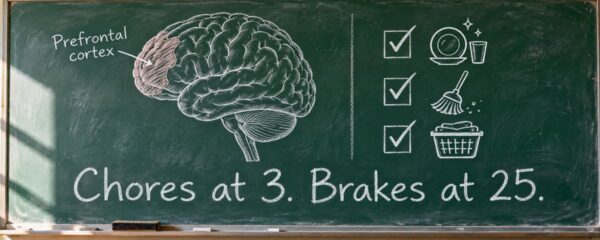
So when a University of Minnesota researcher said chores at age three predicted how kids were doing at twenty-five better than their IQ did, I pulled the study. Then I graded it. The kids who didn’t start chores until fifteen did WORSE than the kids who never did any… and Solomon had the whole thing written down about three thousand years before she ran the numbers.
That study comes back later, caveats and all, because it deserves better than a meme. But it opens the thesis of this entire article.
Every child learns two curriculums. The one you announce at the dinner table, and the one you live when you think nobody is watching. They keep the second one.
Fair warning before we start. I spent twenty-three years as an Army medic, about twenty more running calls as a paramedic in Cleveland, I’m raising four kids, and I teach Anatomy. So this is going to have more brain anatomy in it than you asked for. I genuinely cannot help it. Grab a highlighter.
The Home Is the Curriculum
In 1961, a Stanford psychologist named Albert Bandura put preschoolers in a room with an adult and an inflatable clown called a Bobo doll. Some kids watched the adult punch, kick, and yell at the doll. Some watched an adult play quietly. Then the kids were left alone with the doll. The ones who saw the beating reproduced it, down to the specific moves and the specific words. Nobody told them to. Nobody rewarded them. They watched, and they copied.
That’s the whole parenting problem in one experiment. Your child’s brain is a pattern-recognition machine long before it’s a lecture-recording machine.
Proverbs 22:6 says train up a child in the way he should go. The Hebrew word behind “train” is chanak. It’s the same word used for dedicating a new house in Deuteronomy 20:5 and dedicating Solomon’s temple in 1 Kings 8:63. It’s where Hanukkah gets its name. The picture is setting something apart at the start and pointing it in a direction before the road forks. You don’t get to dedicate the road and then walk a different one in front of him.
So the father who tells his son to work hard while he scrolls his phone until noon is teaching something. Just not what he thinks. The mother who says “respect your father” while she undermines every decision he makes at the table is teaching something too. Kids are the most accurate observers in the house. They weigh your words against your hours, and when the two don’t match, the words get filed under background noise.
The uncomfortable part: if neither parent is producing, the child inherits that. Not as a lecture. As a template. He grows up into the adult who expects a roof with no rent, a phone with no bill, and a life with no output. You never said a word of it out loud. You demonstrated it, daily, for eighteen years. And if the kid only sees one parent not working, and that looks like the easy road, he will copy that parent as an adult. Bandura’s clown, all grown up.
Both Parents, One Standard
Both parents own the discipline. Not one parent as the bad guy and the other as the refuge. Proverbs 13:24 says whoever spares the rod hates his son, but he who loves him is diligent to discipline him. Diligent is a shared verb. Same standard, same consequences, same follow-through from mom and dad.
Here’s the brain reason, not just the Bible one. In 1997, Wolfram Schultz and colleagues showed that dopamine neurons don’t simply fire when a reward shows up. They fire hardest when a reward is unexpected, and the signal shifts to whatever predicts the reward. That’s called a reward prediction error. Pair that with B. F. Skinner’s old finding that intermittent reinforcement, where the reward comes only sometimes, produces the most stubborn behavior of all.
Now picture the house where dad says no and mom says yes when dad isn’t looking. The kid keeps asking because sometimes it works. You didn’t raise a lobbyist. You built a slot machine and handed him the quarters. Every unpredictable “fine, just this once” is a jackpot, and his dopamine system is taking notes.
I have a better idea, actually, and I’d like to propose it to the school board. Socialist chore charts. The kids who finish their chores donate their allowance to the kids who didn’t, so nobody feels left out. The siblings who do the dishes also cover the ones who were “tired.” It’s just common sense. This is not a radical idea. Slight oversight… within a week, every kid in the house is tired.
Discipline Is Not Punishment
Punishment looks backward. It pays for what already happened. Discipline looks forward. It trains for what comes next.
Hebrews 12 is the chapter to read here, start to finish. The writer says God disciplines us “for our good, that we may share his holiness,” and then in verse 11, that no discipline seems pleasant at the time, but painful, yet later it yields the peaceful fruit of righteousness to those who have been trained by it. Trained. The Greek is gymnazō, where we get gymnasium. Discipline is reps, not revenge.
You’re not hurting the child. You’re harvesting the adult. A spanking without a conversation is just violence with a Bible verse stapled to it. A conversation without any consequence is just a TED talk. Both together, that’s discipline.
The research lines up with Solomon on this one. Diana Baumrind at Berkeley sorted parents into three styles in the 1960s. Authoritarian parents had rules and no warmth. Permissive parents had warmth and no rules. Authoritative parents had both, high expectations and high warmth, and across her work their kids tended to do best. Later researchers added a fourth style, the neglectful parent with neither, and you can guess how that went. The permissive parent is a smoke detector with no battery. Looks like protection. Does nothing when the kitchen catches fire. Hold onto Baumrind’s name, because her data shows up again in the chores study.
Same principle scales up. A twenty-eight-year-old in your basement with no job, no school, no chores, and no rent is not a child in transition. That’s a dependent you’ve promoted to permanent. One honest exception: caring for aging parents is legitimate full-time work, and it counts. But lounging on the family insurance and the family phone plan while contributing nothing is not biblical provision. It’s a subsidy with a Hallmark card on it.
The goal from day one is cleaving. Genesis 2:24 says a man leaves his father and mother and holds fast to his wife, and they become one flesh. One flesh doesn’t mean one address forever. It means the marriage becomes the new center and the parents become the previous chapter. Kids who never leave don’t become close to their parents. They become stuck to them, and stuck is not the same thing as loved.
Even special-needs children need this. Not abandonment. Preparation. Those parents won’t live forever, and dropping an adult into a world they were never taught to navigate isn’t love. It’s the cruelest kind of surprise. Teach independence in proportion to what they can carry, with support that shrinks as their capacity grows.
Reality Discipline: Let the World Do the Grading
Psychologist Kevin Leman has been writing about this for forty years. His book Making Children Mind Without Losing Yours came out in 1984, and he followed it years later with the bestseller Have a New Kid by Friday. He calls his approach Reality Discipline, and it grows from the same Adlerian roots as Rudolf Dreikurs, the psychiatrist who popularized natural and logical consequences in the 1960s.
The core idea is almost embarrassingly simple. Let reality be the teacher. You don’t have to manufacture pain and you don’t have to give speeches. You stop standing between your child and the results of his choices.
A few of Leman’s working principles, in my own words. Say it once. If you’re repeating yourself, you’re training him to wait for the fourth warning. Act, don’t yak. The consequence does the talking. B doesn’t happen until A gets done: the game doesn’t start until the homework is finished, and no amount of whining moves B in front of A. Don’t rescue. If he forgets his lunch, he’s hungry until dinner, and he’ll remember tomorrow. And stay calm while you do it, because the moment you’re yelling, the lesson becomes about your anger instead of his choice.
The anatomy behind it: a lecture travels through the auditory cortex of a kid who tuned you out three sentences ago. A consequence he actually feels gets tagged by the amygdala as important, and the amygdala sits right next to the hippocampus, which files long-term memories. Emotion is the highlighter the brain uses to decide what’s worth keeping. One skipped dessert outlasts forty speeches.
There’s a difference worth teaching. A natural consequence happens on its own: you don’t wear a coat, you’re cold. A logical consequence is one the parent connects to the behavior: you don’t put the bike away, you lose the bike for two days. Connected is the word that matters. Taking the phone because he didn’t do the dishes is random. Not driving him to practice because he made everyone late again is connected. Connected consequences teach. Random ones mostly teach resentment.
God parents this way, if you read carefully. In Luke 15, the father of the prodigal didn’t chase him into the far country. He didn’t wire money. He let the famine and the pig pen do what a lecture couldn’t. Then, when the son came home, the father ran. Reality did the discipline. The father did the embrace. That’s the order.
Proverbs Doesn’t Raise Soft Boys
Proverbs 4:1: hear, O sons, a father’s instruction, and be attentive, that you may gain insight. Solomon wrote this as a curriculum, and lesson one is that a boy needs a father who speaks on purpose. Not lectures fired off in anger. Instruction delivered with intent, repeated, and lived in front of him.
Proverbs 22:15 gives the why behind discipline: folly is bound up in the heart of a child, but the rod of discipline drives it far from him. Foolishness isn’t occasional bad behavior. It’s the factory setting. Every child ships with it. Your job is to drive it out with consistent, forward-looking discipline until wisdom has room to grow.
Proverbs 23:13-14: do not withhold discipline from a child; if you strike him with a rod, he will not die, and you will save his soul from Sheol. That’s not a threat. It’s a rescue. Solomon is saying the stakes are eternal, not just behavioral.
Work ethic runs through the whole book. Proverbs 6:6-8: go to the ant, O sluggard, consider her ways and be wise. She has no chief, no officer, no ruler, yet she gathers her food in summer. The ant doesn’t wait for motivation. She works because the season demands it. Proverbs 10:4: a slack hand causes poverty, but the hand of the diligent makes rich. Proverbs 12:24: the hand of the diligent will rule, while the slothful will be put to forced labor. The diligent man governs himself. The slothful man gets governed by somebody else.
Paul makes it practical in 2 Thessalonians 3. He reminds the church that he and his team worked night and day so they wouldn’t be a burden, specifically to give them an example to imitate. Then verse 10: if anyone is not willing to work, let him not eat. Notice the word willing. Paul isn’t talking about people who can’t. He’s talking about people who won’t. There’s a grown man somewhere reading this who couldn’t pour water out of a boot with the instructions printed on the heel, and he’s been on his parents’ phone plan since the Obama administration.
The ant also teaches delayed gratification. You’ve probably heard of the marshmallow test from Walter Mischel’s Stanford studies, where kids who could wait for a second marshmallow seemed to do better years later. Fine print: a large 2018 replication by Watts, Duncan, and Quan found the effect was much smaller once family background and early ability were accounted for. So don’t hang your parenting on one marshmallow. The skill underneath it, putting work before reward, is exactly what Proverbs keeps hammering, and it is trainable.
Proverbs 27:17: iron sharpens iron, and one man sharpens another. A boy doesn’t become a man by being told. He becomes a man by being sharpened against other men: his father, mentors, coaches, brothers in the faith. Isolation produces soft boys. Friction produces men.
And Proverbs 4:23: keep your heart with all vigilance, for from it flow the springs of life. That’s the target. Heart formation. The discipline, the work, the sharpening, all of it is scaffolding aimed at that one wall.
What It Looks Like by Age
Preschool: ages 2 to 5
This is where the foundation gets poured, not where the house gets built. A toddler’s brain is wiring itself at a ridiculous pace, building connections far faster than an adult brain, and over the following years it prunes the ones that don’t get used. Neuroscientists summarize it as “neurons that fire together wire together.” Whatever gets repeated gets kept. Whatever doesn’t gets cut.
So the main job is teaching that words have weight and actions have consequences, immediately and consistently. When a two-year-old throws food, you don’t negotiate. You remove the food, say no once, clearly, and move on. Proverbs 29:15: the rod and reproof give wisdom, but a child left to himself brings shame to his mother. Left to himself doesn’t mean abandoned. It means untrained. Short sentences. Immediate follow-through. You’re not explaining the Federalist Papers to a toddler. You’re establishing that the world has rules and the people who love him enforce them.
Now the study from the top. Dr. Marty Rossmann at the University of Minnesota did a secondary analysis of data from Diana Baumrind’s longitudinal parenting study, yes, the same Baumrind, which followed roughly 84 kids from preschool into their mid-twenties. Rossmann looked at whether, and when, the kids took part in household tasks. The best predictor of how they were doing in their mid-twenties, things like finishing school, getting started on a career, and staying away from drugs, was whether they began doing household tasks at ages three and four. In her analysis it beat IQ.
And the kicker from the top of this article. Kids who didn’t start until fifteen or sixteen did worse on those measures than kids who never did chores at all. Starting late didn’t just miss the benefit. It looked like a deficit.
Now the fine print. Rossmann’s sample was small, about 84 kids. Her findings came out through a university research summary and her own newsletter write-up, not a peer-reviewed journal article with full statistical tables. It also gets mixed up online with the Harvard Grant Study, which pointed to work ethic and love as big predictors but never isolated chores. So treat Rossmann as a strong signal, not a law of physics.
The good news is the bigger studies point the same way. A 2019 study in the Journal of Developmental and Behavioral Pediatrics by White, DeBoer, and Scharf followed nearly ten thousand kindergartners into third grade. Kids who did chores regularly scored higher on self-competence, prosocial behavior, peer relationships, and life satisfaction, independent of sex, family income, and parent education. Kids who rarely did chores had 17 to 27 percent higher odds of landing in the bottom fifth on those measures. They did better in math, too.
A 2022 La Trobe University study in Australia by Tepper and colleagues looked at 207 kids ages five to thirteen and found that self-care and family-care chores predicted better working memory and inhibition, two of the core executive functions. Inhibition is the ability to pause before acting. Harvard’s Center on the Developing Child describes executive function as the brain’s air traffic control system. Chores are flight school.
There’s a brain reason this works. In 2016, Steven Maier and Martin Seligman, the researchers behind learned helplessness, concluded that passivity is the brain’s default setting and control is what gets learned, through circuits in the prefrontal cortex. A three-year-old who sets the napkins on the table and sees dinner happen is getting his first reps on that control circuit. “My action changed something.” Chores at three aren’t about a clean dishwasher. They’re about teaching a child he is a contributor before he has the vocabulary to say it. Proverbs 22:6 again. Set the direction before the road forks, or the default wins.
Elementary: ages 6 to 10
Now you add instruction with explanation. Deuteronomy 6:6-7: these words shall be on your heart, and you shall teach them diligently to your children, and talk of them when you sit in your house, when you walk by the way, when you lie down, and when you rise. That’s not a Sunday school slot. That’s ambient teaching, all day, woven into ordinary life.
But don’t skip the Sunday slot either, because the data on that is better than most people know. In 2018, Harvard researchers Ying Chen and Tyler VanderWeele published a study in the American Journal of Epidemiology that followed more than five thousand young people for eight to fourteen years. Compared with kids who never attended religious services, kids who went at least weekly were about 18 percent more likely as young adults to report higher happiness, 29 percent more likely to volunteer in their communities, and 33 percent less likely to use illicit drugs. Those are relative odds, not percentage points, and the sample leaned toward kids of white, higher-income mothers. Still. That’s a lab result, not a sermon.
Stanford sociologist Ilana Horwitz found the most religiously engaged teenagers, the ones she calls abiders, averaged a 3.22 GPA against 2.93 for the least engaged, after accounting for race, class, and gender. She is careful to call it an association. And a 2003 study by Mark Regnerus and Glen Elder in the Journal for the Scientific Study of Religion found church involvement helped kids stay on track in school, especially kids in low-income neighborhoods.
To be fair, nobody has run chores and church head to head in one study, so I can’t rank them. What I can tell you is that both build the same muscle. Showing up on Sunday morning when you’d rather sleep is a chore too.
This is also when the brain is busy myelinating. Myelin is the fatty insulation that wraps nerve fibers, laid down by cells called oligodendrocytes, and it speeds signals dramatically. Pathways that get used over and over get more of it. Practice doesn’t just make perfect. Practice makes the wiring faster. Every repeated chore is literally insulating a pathway.
Chores here aren’t busywork. They’re the first paycheck of responsibility. A kid who does real work at eight and gets paid for some of it learns that effort turns into provision long before he ever sees a tax form. Let him ride his bike somewhere you actually know, with a rule about being home before dark, the way a lot of us grew up. I wrote about what we lost when that disappeared:
https://x.com/BskiMike22802/status/2096954796641067264
Middle school: ages 11 to 13
This is the danger zone, and Proverbs names it. Proverbs 29:17: discipline your son, and he will give you rest; he will give delight to your heart. The middle schooler is testing whether the rules are real or just noise. This is where parents fold, because the pushback gets personal and exhausting. Don’t. Consistency at thirteen is worth more than eloquence at ten. Start giving him real decisions with real stakes. Not “what do you want for dinner.” Actual choices that cost something if he chooses wrong. A boy who never practices judgment at twelve practices it badly at twenty-two.
Peer influence peaks here, and it’s measurable. In a 2011 study in Developmental Science, Jason Chein and Laurence Steinberg at Temple University put teenagers and adults in a brain scanner playing a driving game, sometimes alone and sometimes with friends watching. Alone, teens and adults drove about the same. With friends watching, only the teenagers started running yellow lights, and the reward regions of their brains lit up more. Your thirteen-year-old’s brain treats an audience like a dare.
This is also where the Dunning-Kruger effect shows up hard. On January 6, 1995, in the Pittsburgh area, a man named McArthur Wheeler robbed two banks in broad daylight with no mask. Security cameras caught his face clearly. In April, his surveillance photo aired on the eleven o’clock news, and police picked him up less than an hour later. When they showed him the tape, he was stunned. He had rubbed lemon juice on his face, because lemon juice works as invisible ink, so obviously the cameras couldn’t see him. Psychologists David Dunning and Justin Kruger opened their 1999 paper, “Unskilled and Unaware of It,” with that story.
Wheeler wasn’t crazy. The same lack of skill that makes you bad at something also makes you bad at judging how bad you are at it. You can’t see the gap, because seeing the gap requires the skill you’re missing. Some statisticians have argued part of that famous curve is a math artifact. Anyone who has spent ten minutes with a seventh grader will tell you the overconfident novice is very, very real.
That’s your eleven-year-old in a nutshell. He can almost deadlift his body weight and he’s certain he understands the world. He doesn’t, and he can’t know he doesn’t. Your job isn’t to shame him out of it. That only teaches him to hide the overconfidence. Your job is to put him where reality grades him. Chores he can’t fake. Consequences that land whether he believes in them or not. A mentor more skilled than he is, because the gap only becomes visible when you stand next to somebody better. That’s when he starts to see the mountain.
The flip side matters too. Genuinely skilled people often underestimate themselves, because they assume what comes easy to them comes easy to everyone. That’s why the quiet kid in the room is sometimes the one who actually knows the material while the loud one is performing. Proverbs 26:12: do you see a man who is wise in his own eyes? There is more hope for a fool than for him. Solomon caught this about three thousand years before Cornell did.
Chores now scale from tasks to ownership. Not “take out the trash” but “you own the trash”: the schedule, the consistency, and the consequence if it doesn’t happen. That’s the shift from doing what he’s told to being responsible for an outcome. Proverbs 12:27: whoever is slothful will not roast his game, but the diligent man will get precious wealth. The lazy man catches dinner and can’t be bothered to cook it.
Don’t fight for popularity at this age. Fight for position. You’re not his buddy right now, you’re his father, and the friendship gets rebuilt later on better terms if you hold the line now. Ephesians 6:4: fathers, do not provoke your children to anger, but bring them up in the discipline and instruction of the Lord. Provoking to anger usually means inconsistency, rules that shift with your mood and consequences that depend on whether you’re tired. A kid can handle a hard standard. He can’t handle a moving one.
High school: ages 14 to 18
Here’s what every parent of a teenager needs taped to the fridge. At puberty, the brain’s reward and emotion systems rev up fast. But the prefrontal cortex, the part that handles planning, impulse control, and weighing consequences, is the last region to finish maturing. NIH researcher Jay Giedd’s long-running brain imaging work showed it still developing into the mid-twenties. Laurence Steinberg calls this the dual systems model. I call it handing a fifteen-year-old a sports car with a full gas pedal and brakes that won’t be installed until he’s twenty-five.
That’s not an excuse. It’s an assignment. Until his own brakes are installed, you are the external prefrontal cortex. That’s the job.
Proverbs 29:15 again: a child left to himself brings shame. By fourteen, “left to himself” looks different. It’s not neglect anymore. It’s abdication dressed up as respecting his autonomy. You don’t stop parenting because he’s taller than you. You change the method because the stakes changed.
Work becomes the proving ground. Not homework, that’s school doing its job. Real work. A job outside the house. Mowing lawns, bagging groceries, swinging a hammer, whatever’s available. Proverbs 14:23: in all toil there is profit, but mere talk tends only to poverty. A teenager who has never earned a dollar has no idea what money costs, because he’s never traded hours of his life for it. When he asks for the car, the phone upgrade, or the trip, skip the lecture and ask one question: what did you do to earn it? If the answer is nothing, the answer is no, and that no teaches more than any sermon.
Discipline at this age shifts almost entirely to natural and logical consequences. Leman’s Reality Discipline, full strength. You can’t spank a six-foot teenager into wisdom, and trying only manufactures fear or rebellion. He blows off his job, he loses it, and he feels it. He breaks curfew, the privilege shrinks. He lies, trust erodes and you say so plainly. You’re not protecting him from consequences. You’re making sure they’re survivable and connected to the choice, so the lesson sticks instead of the resentment.
This is also when you start the cleaving conversation, before it turns into a fight. Genesis 2:24, leave and cleave. You tell him now, while you’re still the authority, that the plan is for him to leave. Not because you don’t love him. Because love that never lets go isn’t love, it’s possession. A boy who knows he’s being trained to launch doesn’t fight the training. A boy who thinks home is permanent fights everything.
And start the conversation about who he’ll eventually marry, because the person he yokes himself to will shape your grandchildren. I wrote one letter for the young men and one for the young women. Men:
https://x.com/BskiMike22802/status/2024177537056698503
Women:
https://x.com/BskiMike22802/status/2024154545048174818
Watch for the Dunning-Kruger echo too. The fourteen-year-old who knows everything about politics, faith, and relationships because he watched some videos. The arrogance is the small problem. The big one is that he’s forming permanent conclusions during the exact window when his brakes are least developed. Your job is to be the friction. Not the enemy. The voice that says “have you considered” when everyone else is nodding along.
Young adult: 18 to 25, college or trade
This is the launch window, and the biggest mistake parents make is treating it like high school with a dorm attached. It’s not a small problem. Pew Research found that in July 2020, 52 percent of Americans ages 18 to 29 were living with one or both parents. That beat the previous high of 48 percent in the 1940 census, at the tail end of the Great Depression. A lot of that was the pandemic. A lot of it wasn’t.
If the discipline and instruction were real, your job now shifts from enforcer to consultant. You stop managing his schedule. You stop paying for things that teach him nothing. You answer questions when he asks, and you let silence do some of the teaching when he doesn’t.
College and trade are not the same track, and pretending they are creates confusion. A trade program is the preschool chore study scaled up: learn a skill, produce output, get paid for it. Proverbs 22:29: do you see a man skillful in his work? He will stand before kings. A four-year degree can be the same thing, or it can be a four-year delay dressed up as preparation. Either door can work. What matters is whether he’s walking through it to become something or to avoid becoming something.
Part-time college with no job is the loudest version of that signal. Part-time with no income means the schedule is built around maximum freedom and minimum output, just enough school to look like progress and just enough not-working to feel like a vacation. That’s not a student. That’s a dependent with a syllabus. Miles to go before he reaches mediocre, and in no particular hurry to get there.
Romans 12:2 says do not be conformed to this world, but be transformed by the renewal of your mind. Fun fact: that’s neuroplasticity, two thousand years early. The adult brain keeps rewiring based on what it repeatedly does. A mind being renewed doesn’t have time to scroll. It has things to build.
The parent who funds the scroll isn’t helping. He’s buying the look of forward motion while his son practices the exact habits that produce the thirty-year-old in the basement. If the son can work and chooses not to, the funding stops. Not as punishment. As truth-telling. You can’t tell him he’s becoming a man while paying him to stay a boy.
Trade it for this: he works and he studies, and both are non-negotiable. If he can only do one, he does the work first and fits school around it. That’s not lowering the bar. That’s ordering it correctly. Provision before polish.
Money is where this gets tested hardest. If you’re paying for everything, you aren’t giving him a safety net. You’re removing the feedback loop. He needs to feel the weight of a phone bill, a grocery run, and a car repair. Not because you’re cruel, but because a man who has never been broke has never learned what broke costs. Proverbs 21:20: precious treasure and oil are in a wise man’s dwelling, but a foolish man devours it. You’re trying to make him competent before life makes him desperate.
The special-needs caveat gets more urgent here. If your child can’t fully launch, aim for maximum independence with a support structure that doesn’t collapse when you do. That might mean supervised living, a job coach, or a sibling brought in early as the next layer. The failure mode is the parent who does everything until the day they die and leaves a thirty-year-old with no map. That’s not love. That’s a cliff with a welcome mat.
Mid-twenties and beyond
This is the final exam. He’s an adult now, his prefrontal cortex is basically finished, and the excuse window just closed. He’s in your house, and he’s not in school full time, or not in school at all. The standard is simple: a forty-hour week. A job, school, or a combination that adds up to forty.
Proverbs 27:23: know well the condition of your flocks, and give attention to your herds. A father who doesn’t know the condition of his adult son’s life is a shepherd who stopped counting sheep. And 1 Timothy 5:8 says anyone who does not provide for his relatives, especially for members of his household, has denied the faith. That verse cuts both ways. A grown son has a household too, even if right now it’s a bedroom down the hall.
If he’s caring for aging parents, that counts, but it’s a real job with real hours and real chores done, not a title he claims while watching TV. If he’s on the family phone plan and the family insurance, he contributes something proportional to what he earns. Run the numbers for him. In Stark County, Ohio, a two-bedroom apartment averages about $1,250 a month. RentalSource lists $1,247, and Rentometer puts typical two-bedrooms between $1,200 and $1,300. That’s roughly $15,000 a year in rent before utilities. Show him that number. Then ask him what he thinks a bedroom, a kitchen, the Wi-Fi, and a hot shower at your place are worth. Otherwise he’s not a son living at home. He’s a tenant who never signed a lease.
The cleaving has to be complete by now. Not estrangement. Separate households. He leaves, he cleaves to his own wife or his own independence, and you become the previous chapter instead of the current one. A man who is forty and still emotionally fused to his mother’s kitchen has never become one flesh with anyone.
For special-needs adults, the standard doesn’t disappear. It adapts. Maximum independence within capacity, with support that shrinks as he grows. Your mortality is the deadline that turns delay into a kind of cruelty. Teaching him to live without you while you’re still here isn’t giving up on him. It’s the last act of love you can guarantee.
That’s the kids’ half of the curriculum. The other half is the marriage they’re watching from the dinner table: the yoke, the spouse who rescues, the spouse who weaponizes being sick, and what Scripture says the husband answers for when the kids aren’t trained. That’s part two, linked in the replies.
But what do I know? I’m only a guy who can’t get through a parenting article without diagramming the prefrontal cortex, and a dad of four with some homework of his own. So which chore did your parents hand you first? And did it stick?
 Mike Borowski is a medically retired Army combat medic with 23 years of service, including a combat deployment to Iraq, and a high school Anatomy and Physics teacher at a high-need Career Technical district in Northeast Ohio — where he also wrote and published the textbooks for both courses. He runs “Bski’s Classroom,” a platform dedicated to cutting through political noise with data, history, and the kind of blunt honesty that comes from someone who has seen both war and the American classroom up close.
—
X (Twitter): x.com/BskiMike22802
Substack: substack.com/@bskimike22802
YouTube: www.youtube.com/@BskiMike22802
AFNN: https://afnn.us/author/mikeborowski/
If you enjoyed this article, then please REPOST or SHARE with others; encourage them to follow AFNN. If you’d like to become a citizen contributor for AFNN, contact us at managingeditor@afnn.us Help keep us ad-free by donating here.
Substack: American Free News Network Substack
Truth Social: @AFNN_USA
Facebook: https://m.facebook.com/afnnusa
Telegram: https://t.me/joinchat/2_-GAzcXmIRjODNh
Twitter: https://twitter.com/AfnnUsa
GETTR: https://gettr.com/user/AFNN_USA
CloutHub: @AFNN_USA