America has 27 constitutional amendments. Twenty-seven. The last one, ratified in 1992, essentially tells Congress it cannot give itself an immediate pay raise. Apparently, it took 202 years to figure out that politicians shouldn’t be trusted with their own wallets.
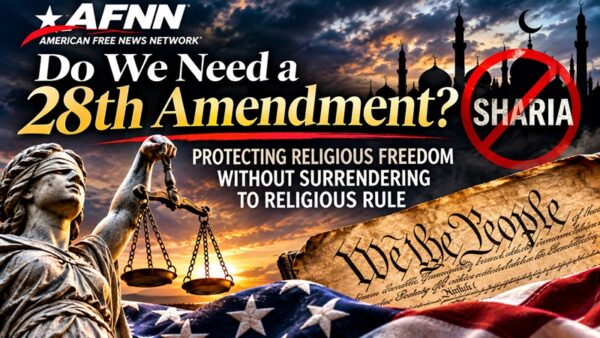
Now comes a more uncomfortable question: Do we need a 28th Amendment to protect America from religious authoritarianism?
Specifically, Sharia law.
Before somebody starts hyperventilating and accusing me of attacking Muslims, understand the distinction. Freedom to practice your religion is American. Forcing everyone else to live under your religion is not.
Osama bin Laden and al-Qaeda openly advocated a transnational Islamic caliphate. Their objective wasn’t religious coexistence beneath a constitutional republic. It was replacing governments with their interpretation of Islamic rule.
That doesn’t make every Muslim an aspiring jihadist, any more than every Christian wants another Crusade. But pretending religious authoritarianism doesn’t exist because discussing it makes people uncomfortable is intellectual cowardice.
Here’s the constitutional problem.
America was founded upon principles of individual liberty, religious freedom, and government deriving its authority from the people. Our Constitution doesn’t recognize divine appointments to Congress, religious police, or clerics empowered to overrule the Supreme Court.
Article VI establishes constitutional supremacy. The First Amendment prohibits government establishment of religion while protecting its free exercise. The Fourteenth Amendment provides additional protections against state abuses.
In other words, our Founders already installed some impressive constitutional armor.
So why discuss another amendment?
Because the greatest vulnerability of any republic isn’t necessarily invasion from outside. It’s the possibility of surrendering its principles from within.
A religious movement could participate in elections, win political offices, and attempt to enact laws based upon its theology. That’s perfectly legitimate political participation—until government attempts to impose religious observance, punish religious dissent, or deny constitutional equality.
At that point, religious liberty becomes religious coercion.
And that principle applies equally to Islamic, Christian, or any other religious authoritarianism.
A proposed 28th Amendment could explicitly establish that no religious legal system, tribunal, or authority may exercise governmental power superior to the Constitution or compel religious obedience.
Call it the Constitutional Sovereignty and Religious Liberty Amendment.
Simple. No government-enforced Sharia. No government-enforced canon law. No American Taliban, regardless of what religious label appears on the packaging.
Private religious practice? Absolutely protected.
Voluntary religious arbitration consistent with American law? Fine.
Religious authorities imposing penalties upon unwilling citizens? Absolutely not.
Of course, passing an amendment isn’t like ordering another executive action from Washington’s political vending machine. Article V requires two-thirds of both houses of Congress, or a convention requested by 34 states, followed by ratification from 38 states.
That’s deliberately difficult. The Founders understood something modern politicians apparently missed: constitutional government shouldn’t change every time somebody loses an election and throws a tantrum.
But here’s the real kicker.
We may not need another amendment. We may simply need the courage to enforce the Constitution we already possess.
You cannot amend your way out of cultural complacency. You cannot legislate Christian conviction into existence. And you certainly cannot preserve Western constitutional traditions while abandoning the civic education that teaches why those traditions matter.
Christians should remember something else. Jesus said His kingdom was not of this world (John 18:36). That’s an inconvenient verse for anyone trying to turn political domination into a religious obligation.
America’s Constitution protects Christianity precisely because it refuses to establish Christianity as compulsory law.
It must extend that same protection to every peaceful faith.
The question isn’t whether Muslims can become Americans. Of course they can.
The question is whether anyone can demand that Americans surrender constitutional government to religious authority.
The answer must remain no.
Twenty-seven amendments have helped preserve this republic for nearly 250 years.
Before demanding number twenty-eight, perhaps we should demonstrate that we still understand the first twenty-seven.
Because a Constitution that nobody will defend is just an expensive historical document behind glass.
If you enjoyed this article, then please REPOST or SHARE with others; encourage them to follow AFNN. If you’d like to become a citizen contributor for AFNN, contact us at managingeditor@afnn.us Help keep us ad-free by donating here.
Substack: American Free News Network Substack
Truth Social: @AFNN_USA
Facebook: https://m.facebook.com/afnnusa
Telegram: https://t.me/joinchat/2_-GAzcXmIRjODNh
Twitter: https://twitter.com/AfnnUsa
GETTR: https://gettr.com/user/AFNN_USA
CloutHub: @AFNN_USA