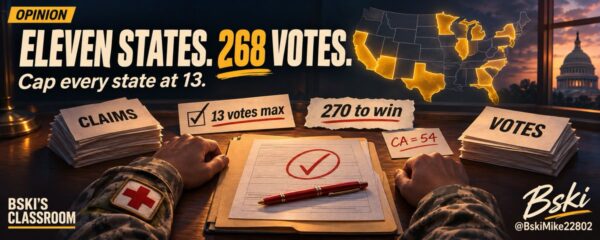
Eleven states hold 268 electoral votes.
A short time back, the Justice Department quit its fight over California’s voter rolls. We lost that round. The math didn’t, and the fix costs Texas too.
It takes 270 to win, and California alone casts 54 of them.
I’m a retired Army medic and a father of four. I’m not here to cry about a court ruling. Judges rule. Fine.
I’m here because the Army drilled one rule into me and I have never found an exception: nothing important rides on a single point of failure. We even had a plan for it, PACE. Primary, Alternate, Contingency, Emergency. If the tourniquet lives in one pocket and somebody loses the pocket, somebody dies.
Our presidential elections run on one pocket, and it has a bear on the flag.
So here is the whole plan up front. No state casts more than 13 electoral votes. Any state that would gets divided into smaller states, each with its own two senators and its own House seats, until none is over the line. California goes. New York goes. And yes, our side, Texas and Florida go too, along with Ohio, Georgia and North Carolina. Illinois, Pennsylvania, Michigan and New Jersey get the same treatment. I felt that one in my chest when I ran the numbers. I’d still do it.
This is the Constitution doing what the Constitution was built to do. I’ll give you the math, the court record, the history and the objections, including the ones that cut against me.
THE MATH — ELEVEN STATES, 268 VOTES
o Confirmed: There are 538 electors and it takes 270 to win. A state’s number is its House seats plus two senators, and the 23rd Amendment gives D.C. three.
o Confirmed: Eleven states sit above 13. California 54, Texas 40, Florida 30, New York 28, Illinois 19, Pennsylvania 19, Ohio 17, Georgia 16, North Carolina 16, Michigan 15, New Jersey 14. They add up to 268, which is 49.8 percent of the whole College.
o Confirmed: California’s 54 is 20 percent of the 270 needed. It outweighs the 14 smallest states put together, which total 51.
What’s next, one state outweighing fourteen others… wait, I’m being told it already does.
Forty-eight states hand every elector to whoever wins a plurality inside their borders. Maine and Nebraska split theirs by district. So a candidate who wins California by one vote and one who wins it by four million both walk away with the same 54. Whatever happens inside that one system, good or bad, gets multiplied by 54.
Picture the Super Bowl where the team with the biggest stadium scores 54 points a touchdown and the scoreboard operator works for the stadium. Browns fans would be in the booth by halftime. Now picture somebody telling them that’s just how the scoreboard works. This is not a radical idea. Fix the scoreboard.
Small states do get a bonus per elector. By the 2020 Census apportionment, a Wyoming elector stands for about 192,573 people and a California elector for about 732,903. But look at what winner-take-all does with that bonus. Miller of UMBC (2007) modeled the chance that one voter swings the whole election and found a California voter carries about 3.41 times the power of a Montana voter. His model assumes votes break at random, so read it as a picture of the structure and not a forecast of any real race. The big-state concentration eats the small-state bonus alive.
Defenders will tell you the only choices are the system as it is or abolishing the Electoral College. That is a false dilemma, the fallacy of pretending the room has two doors when it has three. The third door changes the size of the rooms.
I walked through the Electoral College math in more detail here:
https://x.com/BskiMike22802/status/2045102026300747856
THE ILLUSTRATION — WHAT THE CALIFORNIA CASE DID AND DID NOT SHOW
I know what some of you want to hear. I’m going to give you the record instead, because our side wins when the record is clean.
o Reported: The Justice Department pointed to a list of roughly 20,000 California registrants it called likely non-citizens and asked for emergency relief.
o Confirmed: Judge Carter denied the emergency request. The Ninth Circuit refused to step in, with Judge Bumatay dissenting. The Supreme Court denied relief on Nov. 2, the day before Election Day. The Justice Department voluntarily dismissed the case on Nov. 6.
o Disputed: The list itself. As reported from the filings, of 200 sampled Los Angeles County records, 112 were canceled or inactive. That cuts against the list’s reliability, and I’m saying so out loud.
o Confirmed: California registers voters on the applicant’s sworn statement of citizenship, made under penalty of perjury, and the county’s position in the record is that it can’t go beyond that statement. California is not alone in leaning on attestation.
o Reported: Commentators on the Justice Department’s side argue that a state that knows it can’t check, and chooses not to, falls under willful blindness, which courts also call deliberate ignorance (United States v. Jewell, 9th Cir. 1976, en banc; Global-Tech Appliances v. SEB, 2011). The doctrine is real. No court adopted it against a registrar here.
Some of the loudest voices on our side ran with numbers bigger than anything the court record supports. I won’t. A court didn’t buy the case, and pretending otherwise is how we lose the next one.
Under 18 U.S.C. 611 it is a federal crime for a non-citizen to vote in a federal election, and that law doesn’t care how big the state is. What cares about size is the leverage.
Let me tell you about the Tuesday a unicorn named Gary voted in a town I made up. He filled out the form. He swore, under penalty of perjury, that he was a citizen. Gary has no birth certificate, no hooves on file, and nobody asked. Source? Of course there isn’t one. I invented Gary five seconds ago. That is the whole problem with a system that runs on “trust me”: a form can’t tell Gary from a neighbor. I’m not accusing a single real voter of anything. I’m telling you a signed promise is not a check, and as a verification tool it is about as useful as a waterproof sponge.
Quinn’s Law Number Nine says liberals judge their intentions above their outcomes. “We meant well, and the box was checked” is that law in a nutshell.
There’s a logic trap on both sides of this fight too. “You can’t prove it happened, so it didn’t” and “they can’t prove it didn’t, so it did” are the same fallacy: argumentum ad ignorantiam, an appeal to what hasn’t been shown. A gap in the evidence is a gap. It is not a verdict in either direction.
So take the most skeptical reading. The list is badly wrong, the courts were right, and California did nothing improper. The structural problem still stands. The case asked whether anyone outside one state can check that state’s rolls, and that question matters nationally only because the state is worth 54 electoral votes. A paperwork mistake in Wyoming moves 3 electors. The same mistake in California moves 54, and I don’t want any state holding that kind of lever, whether its governor wears my jersey or the other one.
I covered the paperwork side in the SAVE Act piece:
https://x.com/BskiMike22802/status/2037321023679308274
THE DESIGN — STATES WERE BUILT AS EQUAL PARTNERS
On July 16, 1787, the Convention settled the Great Compromise by a 5 to 4 vote: equal suffrage for every state in the Senate, representation by population in the House. The delegates were trying to keep the biggest states from running the country.
Article IV, Section 4 guarantees every state a Republican Form of Government. Madison’s argument in Federalist 10 is that a large republic with many interests makes it harder for any single faction to seize the whole machine. A single jurisdiction with the power to tip the whole election cuts directly against that. I wrote about the republic and democracy difference here:
https://x.com/BskiMike22802/status/2056365479715881153
The number of states was never sacred, and neither were the lines. We started with 13. Article IV, Section 3 lets Congress admit new states, and carve new ones out of old ones, with the consent of the legislatures involved. It has been done before. Vermont came in 1791, Kentucky came out of Virginia in 1792, Maine came out of Massachusetts in 1820, and West Virginia split from Virginia in 1863. In 1845 Congress even passed a resolution allowing Texas to form up to four additional states, with Texas’s consent. Its legal effect is debated and it was never used.
When somebody says “we have always had 50 states,” that is the appeal to tradition, argumentum ad antiquitatem. Tradition is not an argument. We have had 13 states, and 15, and 16, and 50.
THE PROPOSAL — 13 AND DONE
The cap is simple arithmetic. A 13-vote state has at most 11 House seats plus two senators. Anything bigger gets divided until every piece is at 11 House seats or fewer.
o California has 52 House seats. That becomes five states.
o Texas has 38. That becomes four.
o Florida has 28 and New York has 26. Each becomes three.
o Illinois, Pennsylvania, Ohio, Georgia, North Carolina, Michigan and New Jersey become two each.
That adds 18 states, for 68 in all and 136 senators. The College grows to 574 electors, 288 are needed to win, and the biggest state anywhere casts 13 votes, about 2.3 percent of the total. California holds about 10 percent today.
The lines get drawn in the same law, by a neutral rule written before anyone knows which party it helps: contiguous, compact, population-equal. I’m proposing that. It is not settled fact.
There are three routes and none of them is easy. The first is Article IV, Section 3: each affected legislature plus Congress consents. The second is an amendment under Article V, where 38 states must ratify. The 11 big states can’t block that on their own, since 39 states sit at 13 or below. The third already exists. Article II lets each legislature decide how its electors are chosen, and Maine and Nebraska split theirs by district today. Any state can take that step tomorrow without asking anyone’s permission.
The pattern is older than the Constitution. In Exodus 18:17 to 22, Jethro watches Moses judge the whole camp alone and tells him the load will wear him out. His fix is to appoint capable men over thousands, hundreds, fifties and tens, with only the hardest cases coming up to Moses. The passage is about settling disputes, not electing presidents, so I’m borrowing a pattern and not claiming a proof text. The pattern is that no single desk should carry the whole weight.
THE CLASSROOM — ONE STUDENT HOLDS THE AVERAGE
Suppose one student’s quiz counted 54 times in the class average, and that score came from a box on a form that said “I got an A, I swear.” Nobody checks the box. Nobody is allowed to. The whole class average is now one student’s paperwork.
You’d fix that on day one. You wouldn’t accuse the kid of anything. You’d just say no score is worth 54, and then you’d go find out how the other 49 are doing. It’s just common sense.
THE OBJECTIONS — FAIR IS FAIR
Practicality is the first objection. Asking a big state’s legislature to vote itself into pieces is like trying to get a goat to climb a tree when you’re better off hiring a squirrel. That is why the amendment route matters. At ratification it doesn’t need California, Texas or New York, only 38 states.
The Senate is the second and the strongest. Eighteen new states means 36 new senators, and some pieces of California would lean one way while pieces of Texas, Florida, Ohio and Georgia could lean the other. I won’t promise which party wins the new seats, because the lines decide it. That is exactly why the lines get set by rule in the same bill. A skeptic can call the whole thing a Senate power grab, and the only honest answer is a neutral map written first. Run it in your head and tell me it looks like a gift to the other team. I’ll wait.
Third, the small-state bonus. Each new state gets two Senate-linked electors, which adds to the small-state advantage I described. A fair critic says I’m piling on the bonus I should be fixing. That’s true. The cap limits concentration and doesn’t equalize per-voter weight. If someone wants to fix that too, I’ll listen. Slight oversight! No rush, though.
Fourth, the slippery slope: if you can split California, what stops you from splitting everything? That is the slippery slope fallacy. The cap is a number written into the statute, and the statute says 13.
Fifth, precedent. Four states were carved from existing ones, one of them during a civil war. The Constitution doesn’t say the map froze in 1790, and the people who wrote it didn’t think it had.
The 10th Amendment keeps the right to arrange states close to the states themselves, which I covered here:
https://x.com/BskiMike22802/status/2047292289844642282
The new map idea is here:
https://x.com/BskiMike22802/status/2047697283408339395
Here’s the part that keeps me up. I have four kids. I want them to grow up in a country where the rancher in Wyoming and the plumber in Pennsylvania and the family in Ohio never have to wonder whether one state’s paperwork decided whether their vote mattered. I want that for people who vote the other way too. A republic that only works when my side wins isn’t a republic. It’s a hostage situation with a flag on it.
Anyone who thinks 54 votes in one pocket is fair has a belt that doesn’t go through all the loops.
But what do I know, I’m only a retired Army medic who learned never to trust a plan with one point of failure.
Mike Borowski is a medically retired Army combat medic with 23 years of service, including a combat deployment to Iraq, and a high school Anatomy and Physics teacher at a high-need Career Technical district in Northeast Ohio — where he also wrote and published the textbooks for both courses. He runs “Bski’s Classroom,” a platform dedicated to cutting through political noise with data, history, and the kind of blunt honesty that comes from someone who has seen both war and the American classroom up close.
—
X (Twitter): x.com/BskiMike22802
Substack: substack.com/@bskimike22802
YouTube: www.youtube.com/@BskiMike22802
AFNN: https://afnn.us/author/mikeborowski/
If you enjoyed this article, then please REPOST or SHARE with others; encourage them to follow AFNN. If you’d like to become a citizen contributor for AFNN, contact us at managingeditor@afnn.us Help keep us ad-free by donating here.
Substack: American Free News Network Substack
Truth Social: @AFNN_USA
Facebook: https://m.facebook.com/afnnusa
Telegram: https://t.me/joinchat/2_-GAzcXmIRjODNh
Twitter: https://twitter.com/AfnnUsa
GETTR: https://gettr.com/user/AFNN_USA
CloutHub: @AFNN_USA