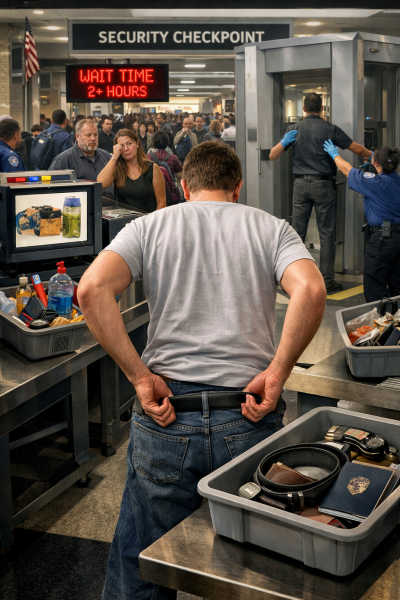
There’s a ritual every American traveler now performs without thinking. Hat off. Laptop out. Liquids in a tiny plastic bag like we’re all part of some low-budget chemistry experiment. Stand in line. Shuffle forward. Get scanned like a mislabeled Amazon package.
And we accept it. Quietly. Obediently. As if this is just the price of modern life.
It’s not.
It’s the price of a 25-year-old panic attack we never recovered from.
The Transportation Security Administration was born in the immediate aftermath of the September 11 attacks—a moment of national trauma where speed mattered more than strategy, and action mattered more than accuracy. That’s understandable. What’s not understandable is why we’re still running the same playbook a quarter century later like nothing has changed.
Because everything has changed.
Let’s talk numbers. TSA burns roughly $10 to $11 billion every single year. That’s not a rounding error. That’s a standing army of bureaucratic friction—tens of thousands of employees, massive infrastructure, endless equipment upgrades—all dedicated to stopping a threat model that no longer exists in the way it did in 2001.
We’ve spent well over $150 billion since its creation. That’s before you factor in the real cost—the hours of American productivity wasted in lines, the missed flights, the delays, the economic drag of turning air travel into a slow-motion cattle chute.
And for what?
We’re told it’s about safety. Deterrence. Peace of mind.
But let’s be honest—this is what Bruce Schneier famously called “security theater.” It looks like security. It feels like security. It reassures people that someone is “doing something.”
But effectiveness? That’s where the story falls apart.
Internal testing over the years has shown failure rates that would get a private-sector contractor fired on the spot. We’re not talking about minor gaps—we’re talking about systems that routinely miss prohibited items when tested by their own oversight mechanisms. If this were a weapons system in the military, it would be scrapped, redesigned, or replaced. Not funded indefinitely.
Meanwhile, the real world moved on.
The threat environment today isn’t centered on hijackers with box cutters. It’s cyber attacks on infrastructure. It’s supply chain disruption. It’s drones. It’s soft-target attacks. It’s asymmetric warfare that doesn’t politely line up at Gate C17 and wait to be screened.
And yet here we are, still confiscating shampoo bottles and nail files like it’s the decisive battlefield.
Even worse, TSA has become a substitute for actual strategic thinking. It gives the illusion of control. A visible, daily reminder that “we are safe now.” But real security doesn’t come from inconvenience—it comes from intelligence, adaptability, and focusing on where the threat actually is.
Here’s the uncomfortable truth no one wants to say out loud:
If TSA disappeared tomorrow, you would not suddenly see a wave of 9/11-style attacks.
Why? Because the system already adapted in ways that actually matter.
Cockpit doors are hardened. Passengers are no longer passive. The entire psychology of hijacking changed the moment Flight 93 proved that Americans will fight back. Intelligence networks are far more integrated. Watchlists, surveillance, and international cooperation—not belt or hat removal—are what actually stop plots.
TSA is not the tip of the spear. It’s the foam padding wrapped around yesterday’s mistake.
And we’re paying billions to keep it that way.
This is classic institutional inertia. Once a bureaucracy is created—especially one tied to national security—it doesn’t go away. It grows. It justifies itself. It evolves enough to survive, but not enough to become efficient. And no politician wants to be the one who says, “Maybe we don’t need this anymore,” because if anything ever happens again, they’ll be blamed.
So the machine keeps running.
Laptop out, Jacket off. Hat off. Belt off. Brain off.
But here’s the strategic reality: continuing to fund TSA at current levels is not just wasteful—it’s dangerous. Every dollar spent maintaining outdated security theater is a dollar not spent addressing actual modern threats. We are literally allocating resources based on nostalgia for a past attack instead of preparation for the next one.
That’s not security. That’s malpractice. That’s stupidity.
Defunding TSA doesn’t mean eliminating aviation security. It means right-sizing it, modernizing it, and shifting resources where they actually matter. Streamline screening. Leverage technology intelligently. Push responsibility back to airports and airlines where appropriate. Invest in intelligence, cyber defense, and real threat detection.
In other words—fight the war we’re actually in.
Because right now, we’re not.
Right now, we’re still standing (pants falling off) in a line that started in 2001, pretending that inconvenience equals safety, and calling it strategy.
It’s not strategy.
It’s habit.
And it’s costing us billions.
If you enjoyed this article, then please REPOST or SHARE with others; encourage them to follow AFNN. If you’d like to become a citizen contributor for AFNN, contact us at managingeditor@afnn.us Help keep us ad-free by donating here.
Substack: American Free News Network Substack
Truth Social: @AFNN_USA
Facebook: https://m.facebook.com/afnnusa
Telegram: https://t.me/joinchat/2_-GAzcXmIRjODNh
Twitter: https://twitter.com/AfnnUsa
GETTR: https://gettr.com/user/AFNN_USA
CloutHub: @AFNN_USA