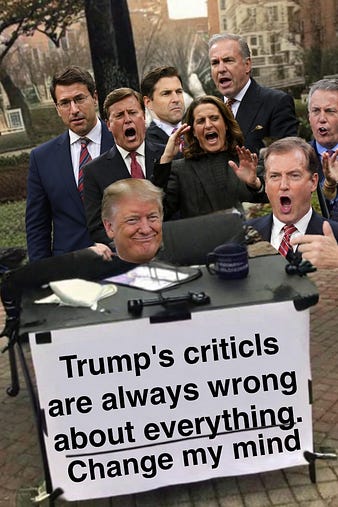
Democrats and their media sycophants and allies have been reflexively against President Trump’s policies throughout both of his terms to date. For example, analyses of 2025 roll-call votes in Congress (e.g., CQ Roll Call vote studies) show Democrats opposed Trump’s policy positions ~88% of the time overall.
Only two significant bills passed by Congress have ever garnered majority Democrat support during the Trump presidencies: the FY2026 National Defense Authorization Act (NDAA) and the HALT Fentanyl Act (HALT All Lethal Trafficking of Fentanyl Act). And neither were particularly controversial.
- Media Research Center (MRC) studies (a conservative media watchdog) consistently find extremely high rates of negative coverage on the three major broadcast evening newscasts (ABC, CBS, NBC), which reach large audiences and are core “legacy” outlets. In the first 100 days of Trump’s second term (2025), they documented 92% negative evaluative statements about Trump and his administration (1,698 negative vs. 143 positive out of 1,841 statements analyzed). Similar patterns held in prior periods: 85% negative during the 2024 campaign vs. Kamala Harris, 92% negative in 2020, and 91% in 2016.
- Earlier Harvard Kennedy School/Shorenstein Center analyses (2017) found 80% negative coverage in Trump’s first 100 days, with CNN and NBC at 93% negative.
- Pew Research (2017) found 62% of stories across a broader set of outlets carried an overall negative assessment of Trump’s early administration (vs. 5% positive), far higher negativity than for prior presidents like Obama (20% negative).
The US political class and the legacy media are not the only ones who have fought President Trump tooth and nail over the years. The unhinged resistance of European elites, ostensible NATO allies, globalists, Islamists, and other ne’er-do-wells has been on display during Operation Epic Fury for all the world to see. Victor Davis Hanson summarizes their angst in a Daily Signal piece whose title says it all: How Trump Outsmarted Iran While Critics Rooted Against America and the Media Melted Down.
President Trump’s critics fall into five overlapping categories, each with its own structural reason to misread what he’s doing.
Let us examine each of those categories.
Category 1 — The establishment blob
The U.S. foreign policy establishment has had three major methodological-ideological characteristics since World War II: constantly expanding open markets, global economic expansionism under U.S.-led liberal international order, and the ideology of American exceptionalism as a historic mission to improve the world.
The people who built and staffed that order — in think tanks, the State Department, international law firms, defense consultancies, NGOs — derive their funding, prestige, and professional identity from it. When Trump dismantles USAID, pauses the FCPA, and extracts NATO spending through threats rather than gentle persuasion, he isn’t just changing policy; he is rendering entire career tracks obsolete. Their criticism is partly institutional self-preservation dressed up as principle.
There is also a deeper cognitive failure: the establishment was trained to treat process as sacred. Trump has rejected traditional approaches to globalism and interventionism for their inefficiency, their moralism, and their failure to deliver visible results. He believes that American power can be exercised more selectively, more transactionally, and with fewer costs borne at home.
Critics raised in the old paradigm cannot separate a good outcome from the method used to achieve it. The NATO 5% spending commitment is objectively superior for American security to everything the previous 75 years of diplomatic courtesy produced — but because it was extracted by threatening to abandon Article 5, critics treat it as a destabilizing move rather than a strategic victory.
Category 2 — The media ecosystem
The press discovered during Trump’s first term that Trump-as-threat was vastly more profitable than Trump-as-dealmaker. Trump’s frenetic diplomacy has transformed U.S. foreign policy into a solo act, casting aside a foreign policy establishment that one predecessor dubbed “the blob.”
The media covered the tariff announcement as a market crash in April 2025 — and barely updated the story when dozens of bilateral trade deals materialized over the following months. The Greenland crisis was reported as NATO’s darkest hour in January; by February it had produced an Arctic security framework favorable to the U.S. The blockade of the Strait is today’s outrage; its resolution will be covered as a separate story by a different reporter with no institutional memory of what came before. Breaking news is congenitally unable to credit outcomes that unfold slowly after alarming beginnings.
There is also a temporal problem. Critics evaluate openings, not conclusions. Trump’s most dramatic and unexpected breaks with Washington’s traditional foreign policy consensus reflect a deep conviction that the United States is operating from a position of weakness rather than strength — and Washington is now acting like a revisionist power that no longer feels it benefits from the status quo. But the establishment media is built to report status quo disruptions as crises, not as the first moves of a longer negotiation.
Category 3 — The academic and legal class
Academics and international law scholars have built careers arguing that the rules-based order is self-justifying and that departing from it is inherently destabilizing. But the order was built by American power, maintained by American power, and was increasingly being exploited by rivals while constraining only America. Today, Washington has far less confidence in the assumptions that underpinned U.S. foreign policy for decades: the indisputable benefits of alliances, the virtues of globalization, and America’s role as an organizing power.
Across the political spectrum, there is a mutiny against elites. Brookings A significant portion of the expert class cannot distinguish between the rules themselves and the American interests the rules were originally designed to protect. When the rules stop serving those interests — as they did when Iran imposed an illegal toll-booth on international shipping — the rules become an obstacle to American power, not an expression of it.
Trump’s success also delegitimizes expertise in a deeply personal way. The same foreign policy professionals who managed the endless wars, the unpoliced trade deficits, and the free-riding NATO allies are now being asked to critique a president who is getting results they never could. The critique is partly professional self-defense.
Category 4 — The partisan opposition
For a significant portion of the political left, opposing Trump has become an identity marker rather than a policy judgment. This creates an almost comical reversal of positions: critics who spent years arguing that free trade was a corporate giveaway now defend it against Trump’s tariffs. Critics who demanded NATO allies pay their fair share now defend European free-riding. Critics who called unconditional foreign aid ineffective now condemn the minerals-for-aid model.
The divisions between Republicans and Democrats challenge the foreign policy establishment’s longstanding principle that partisanship should stop “at the water’s edge” and that international statecraft ought to be a bipartisan endeavor. That principle has been entirely abandoned — but only by one side.
Category 5 — International resistance: globalists, Islamists, and international communists
The fifth category is the most consequential one, because unlike the domestic critics — who are at least arguing in bad faith about American interests — the international resistance bloc is opposing Trump from a position of openly incompatible interests. They are not critics; they are adversaries using the language of criticism as a weapon.
The globalist institutional complex. The WEF, the UN bureaucracy, the WHO, and the sprawling NGO ecosystem constitute what is effectively a supranational governance project — one that only functions if the world’s most powerful nation provides funding, legitimacy, and compliance. The WEF has been an integral part of the liberal international order that emerged from the ashes of the second world war, and the liberal international order of which it was a pillar is unlikely ever to return to its postwar form.
Trump’s withdrawal from the WHO, the Paris Climate Accord, the UN Human Rights Council, and dozens of other bodies isn’t just a policy choice — it is an existential threat to the globalist project itself. China has stepped up with a five-year, $500 million commitment to the WHO and positioned itself to lead on global AI governance and climate, filling the vacuum left by the U.S.
The globalist criticism of Trump is therefore not a principled defense of international cooperation — it is a defense of a specific governance architecture that requires American subordination to function. An America First United States makes that architecture impossible.
The Islamist axis of resistance. Iran and its proxy network — Hamas, Hezbollah, the Houthis — oppose America for reasons that are theological before they are geopolitical. The Islamic Republic was founded on the doctrine that America is “the Great Satan” whose retreat from the region is a religious imperative.
Trump’s maximum pressure campaign, the elimination of Iran’s Supreme Leader, the Strait of Hormuz blockade, and the dismantling of Hamas as a governing authority directly threaten not just Iranian power but the entire theological framework that justifies the regime’s existence.
China, Russia, and North Korea — forming what analysts call the “Axis of Upheaval“ — have for decades helped develop, sustain, and rebuild the very military programs now targeted by U.S. and Israeli operations, and after major battlefield losses, Iran was able to rapidly reconstitute key elements of its military infrastructure with external support. Their “criticism” of Trump is simply warfare prosecuted through diplomatic channels.
The revisionist great powers: China, Russia, and North Korea. These three are united not by shared ideology but by a single strategic goal: dismantling the American-led order that constrains their regional ambitions. The growing cooperation among China, Iran, North Korea, and Russia is fueled by their shared opposition to the Western-dominated global order, an antagonism rooted in their belief that that system does not accord them the status or freedom of action they deserve — and all four see the United States as the primary obstacle to establishing their respective spheres of influence. They do not criticize Trump because his policies are bad for America. They criticize Trump because his policies are bad for them.
When Iran’s closure of the Strait sent oil prices surging toward $120 a barrel, Russia’s war budget — which had been built on oil price assumptions of roughly $60 a barrel — was rescued, providing the Kremlin capital to sustain military operations in Ukraine. And when China tried to broker the ceasefire in Pakistan, it was positioning itself as the world’s responsible statesman precisely because, in their view, Trump had abandoned that mantle. Their opposition to America First is not moral — it is strategic. They preferred the old order because they had learned to exploit it.
CONCLUDING THOUGHTS
What distinguishes the international resistance bloc from the four domestic categories is the honesty of its opposition. The establishment blob, the media, the academic class, and the partisan opposition all pretend to speak in America’s interests while actually serving their own. The globalists, Islamists, and revisionist powers make no such pretense — they openly oppose American primacy because it directly threatens their projects. But paradoxically, this makes the international bloc the most intellectually honest of the five: at least they are not lying about whose side they’re on.
The deeper lesson across all five categories is this. Every major Trump script-flip — from the Hormuz blockade to the NATO spending ultimatum to the minerals deal to the Gaza gambit — was met with a convergence of domestic and international opposition that looked, on the surface, like a broad consensus against the move. What it actually represented was five groups, each with incompatible interests, temporarily aligned by a shared discomfort with American power being exercised unapologetically. That alignment is not a sign that Trump was wrong. In most cases, it is the clearest possible signal that he was doing exactly what needed to be done.
Finally, and perhaps most importantly, much of the criticism is fundamentally aesthetic. Trump is loud, transactional, and openly contemptuous of diplomatic courtesy. His methods offend people trained to value process and stability above outcomes. But unpredictability has genuine strategic value — a counterparty who cannot anticipate your next move cannot pre-position against you.
His unpredictability wins him leverage at key moments — he certainly caught Maduro off guard. The “chaotic” tariff reversals that critics mocked as incompetence were, functionally, a negotiating pressure campaign. The Gaza “Riviera” announcement that scandalized the foreign policy world broke a 60-year diplomatic stalemate in weeks.
Critics trained to value the elegant and the predictable have no framework for recognizing deliberate chaos as a tool. As a result, President Trump continues to run circles around them in achieving his policy goals and objectives. And, accordingly, the critics will lose out bigly in terms of credibility, coin, and careers over the long haul. Rightfully so!
The end.
StuinSD is a reader-supported publication. To receive new posts and support his work, consider becoming a free or paid subscriber.
This article originally appeared in Stu Cvrk’s Substack. Reprinted here with permission
If you enjoyed this article, then please REPOST or SHARE with others; encourage them to follow AFNN. If you’d like to become a citizen contributor for AFNN, contact us at managingeditor@afnn.us Help keep us ad-free by donating here.
Substack: American Free News Network Substack
Truth Social: @AFNN_USA
Facebook: https://m.facebook.com/afnnusa
Telegram: https://t.me/joinchat/2_-GAzcXmIRjODNh
Twitter: https://twitter.com/AfnnUsa
GETTR: https://gettr.com/user/AFNN_USA
CloutHub: @AFNN_USA
Unpredictability can be a valuable weapon against your enemies. But it should never be used with your constituents or your allies. Trump’s rhetoric has changed our path from “America First” to “America Alone”. And that makes us weaker, not stronger.
You list five categories of people who you say are against Trump but ignore a 6th group – lifelong republicans who have not fallen for Trump’s con job. You and many other republicans have taken a big old drink of Trump’s kool-aid. You believe that everything he does is great. Half of our party has totally abandoned long-held republican values in an effort to justify Trump’s actions. Fiscal conservatism? No longer a republican value because Trump has run up a $2 trillion deficit in his first year. The party of law and order? Nope. Trump pardoned January 6th rioters who can be seen on video striking police officers with weapons. He also pardoned Former Congressman George Santos, Geore Gulbrecht – the creator of the underground illicit trade market on the dark web, Changpeng Zhao – the founder of Binance, Juan Hernandez – the former President of Honduras who trafficked 400 tons of cocaine to the U.S., and many other felons. Why? Because they support him. That is not the party of law and order, that is the party of fellow Trump lovers.
Trump has done very little good for our nation since his election. The stand-out exception is stopping the free run of illegal immigrants into this country. Most of his other moves have had poor results. Take his tariff plan for example. He claimed it would eliminate the deficit and could replace the income tax. And his supporters fell for it despite the facts: first, the exporter does not pay the tariff, the importer does – so the tariff money is coming out of the pockets of Americans, not foreigners; second, the math just doesn’t work and any second grader can figure that out – in order to eliminate the deficit and the personal income tax, the tariff rate would have to be 114% on all goods coming into the country (and that assumes that the tariffs would not reduce the amount of goods we import).
Trump’s unpredictability is not some brilliant tactic, but rather the result of total ignorance when it comes to international affairs, and many domestic ones as well. Many republicans are finally starting to catch on to what the rest of us have known since his first term – Trump serves Trump, not the American people.