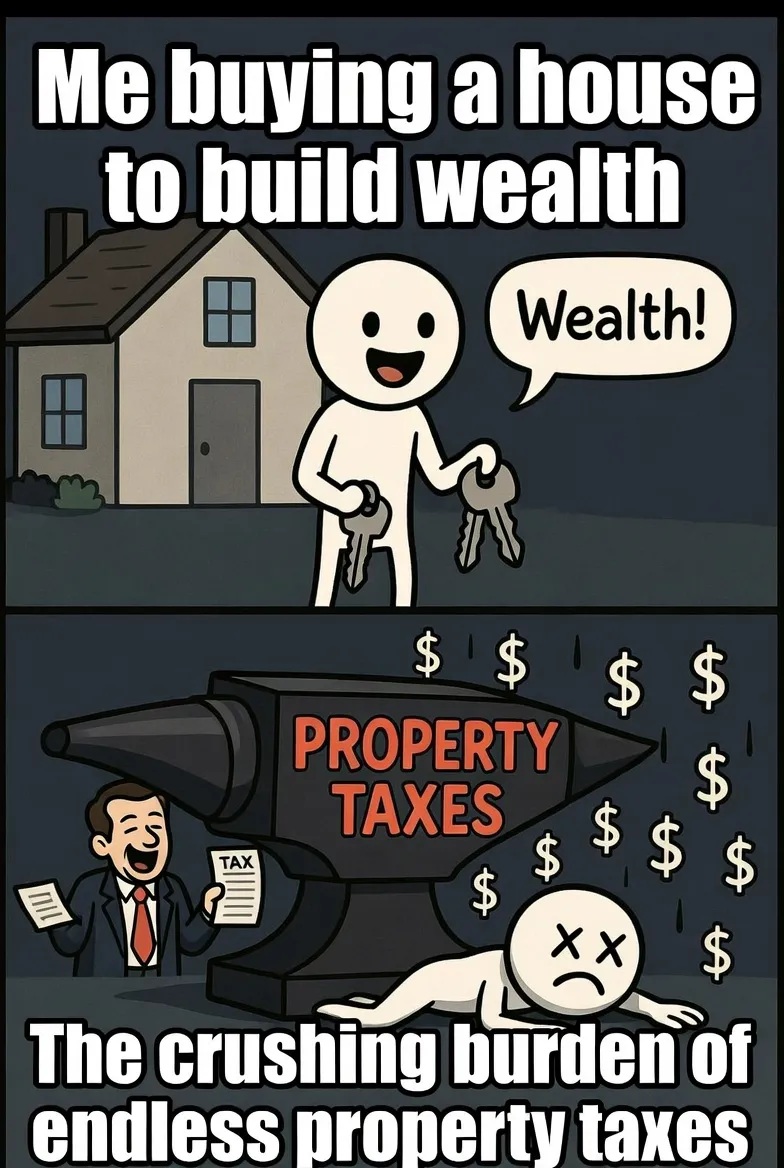
Rising property taxes in South Dakota have become a major burden on homeowners, particularly seniors on fixed incomes and young families, often making homeownership feel unaffordable or like “renting from the government.”
Property taxes have grown sharply (nearly 70% in the past decade for homeowners in some contexts), driven by rising assessments, in-migration, and shifts in tax burden toward owner-occupied homes, leading to concerns about evictions, delayed improvements, and barriers for first-time buyers.
This initiative reflects broader frustration with escalating taxes on homes amid limited relief options, even as the state legislature has pursued partial cuts funded by sales tax adjustments. No one seems to be happy with the band-aid approach to the problem.
Note: the issue of replacing property taxes revolves around burden-shifting, as property taxes have been institutionalized to support schools and local governments. To eliminate them means that revenues must come from another source/sources. The question is, who pays the freight if property taxes are repealed? A transaction tax is a novel way to solve the problem.
Let’s examine the issue in some detail.
THE TRANSACTION PROPOSAL IN BRIEF
The South Dakota Repeal Property Taxes and Establish Flat Retail Transaction Amendment would repeal property taxes and replace them with a flat retail tax — $1.50 on purchases of $15 or more, and a 10% tax on purchases under $15. The measure may appear on the November 2026 general election ballot if supporters collect the required signatures.
The measure was submitted by the group Abolish Property Taxes SD, and Attorney General Marty Jackley provided a neutral explanation of the proposal as required by law, taking no position on its merits.
WHAT’S AT STAKE: THE CURRENT PROPERTY TAX SYSTEM
Understanding why this matters requires appreciating the scope of what property taxes fund. Property taxes are the primary source of funding for schools, counties, municipalities, and other units of local government in South Dakota — and notably, the state does not collect or spend any property tax money itself. Of total property tax revenue, 57% is distributed to school districts, while the other 43% goes to counties, municipalities, townships, fire districts, and other taxing districts.
In calendar year 2024, South Dakota property owners paid over $1.78 billion to fund local governments and K-12 education. The movement’s own website acknowledges the problem: property tax collections were roughly $1.4 billion in 2020 and are projected to reach approximately $2 billion by 2027 — a 39% increase — while the state’s population grew by only 4.7% over the same period.
THE CASE FOR THE TRANSACTION TAX
1. Homeowner and Farmer Relief. The most emotionally compelling argument is simple: people who own paid-off homes — especially retirees and farmers on fixed incomes — face an annual tax bill that doesn’t correlate to their income or cash flow. Property assessments are based on surrounding sales, not actual home value, effectively taxing unrealized gains. Homeowners face unpredictable yearly bills and risk losing their homes if they can’t pay. A transaction tax only triggers when money actually changes hands.
2. Behavior-Based Rather Than Existence-Based. A transaction tax is consumption-driven. You pay tax when you spend money, not simply for owning something. This aligns the tax burden more closely with economic activity and ability to pay in real time.
3. Broadening the Tax Base. South Dakota has a large tourism economy — Mount Rushmore, the Badlands, Sturgis Rally, and hunting and fishing tourism generate enormous transaction volumes from out-of-state visitors. A transaction tax captures this revenue, whereas property taxes fall almost entirely on residents and businesses. The proposal’s backers note that current projections exclude transactions from minors and visitors, and do not account for increases in discretionary spending that would follow from homeowners having more money in their pockets.
4. Forcing Government Accountability. The movement argues that counties almost never request less money — only more — and that the current property tax system enables endless expansion and inefficiency. Replacing it with a transaction tax would force government to “right-size.”
5. Moral/Philosophical Argument. Supporters argue that property taxes are immoral because the government can take your property if you fail to pay, and that the crime of not paying doesn’t fit the punishment of losing your home. They frame this as an “American feudal system.”
THE CASE AGAINST THE TRANSACTION TAX
1. The Revenue Gap Problem. This is the biggest structural concern. Opponents argue abolishing property taxes would create an immediate $850 million shortfall. The proponents dispute the assumptions behind that figure, but independent analysis is thin, and the flat $1.50 per transaction structure makes the math genuinely difficult to verify without knowing total transaction volumes across the state. A $1.50 flat tax generates the same revenue from a $15 bag of groceries as from a $5,000 television — an enormous structural compression of the tax base.
2. Regressive by Design on Small Purchases. The 10% tax on purchases under $15 was criticized as regressive, placing a heavier burden on lower-income individuals. As the South Dakota Retailers Association illustrated: “You’re paying the same on a $20 transaction with this transaction tax as you do on a new mattress, or a boat, or a car.” The flat $1.50 rate on everything above $15 is also proportionally devastating on a $15.01 purchase while being trivial on a $10,000 purchase — exactly inverted from ability-to-pay principles.
3. Rural Inequity. Opponents argued that individuals in rural areas, lacking access to large retail stores, would be forced to pay the $1.50 fee on more frequent, smaller purchases, while those in cities could consolidate their shopping into fewer, larger transactions. “Our poor families or families that live in more rural areas are going to be paying one-fifty, one-fifty, one-fifty, one-fifty where people in Rapid City and Sioux Falls can buy everything all at once.” This is a genuine structural flaw in a flat-per-transaction model applied to a geographically diverse state.
4. Inflation Erosion. Derek Johnson of the Bureau of Finance and Management argued that the fixed $1.50 fee would lose value over time due to inflation, although property tax obligations would continue to rise. A constitutional amendment locking in a flat dollar figure — not a percentage — would require another constitutional amendment to adjust, creating enormous fiscal rigidity.
5. Local Control Eviscerated. This is perhaps the most structurally transformative aspect of the proposal, and it’s largely underdiscussed. Currently, property taxes are managed at the county level, with the County Treasurer responsible for collections. The transaction tax as proposed would presumably require a state-level collection mechanism, with distribution back to counties, municipalities, school districts, and fire districts. Property tax is the main source of revenue for local governments in South Dakota; the state does not collect or spend any property tax revenue.
Replacing this with a centrally collected transaction tax would fundamentally invert the relationship — local governments would become dependent on state distribution formulas rather than directly levying and collecting their own revenue.
This is not merely administrative. It means school districts, townships, and fire districts would lose independent taxing authority. A county in western South Dakota with minimal retail activity would receive far less revenue than its property taxes once generated, while Sioux Falls and Rapid City — with dense commercial corridors — would generate a disproportionate share. The distribution formula becomes a political battleground, and rural counties would almost certainly be disadvantaged.
6. Economic Distortion and Border Leakage. A per-transaction tax creates powerful incentives to shift purchasing to online retailers, neighboring states, or to structure transactions differently. For small businesses in border towns, the competitive disadvantage could be severe. South Dakota already has a significant online retail presence (precedent established in 2018 by the US Supreme Court’s South Dakota v. Wayfair decision for internet sales tax), but a $1.50 per-transaction flat fee is far more aggressive than a percentage-based sales tax and would incentivize behavioral adaptation.
7. No Existing Collection Infrastructure. South Dakota’s existing sales tax infrastructure collects a percentage of transaction value. A flat per-transaction tax is a fundamentally different mechanism — it requires counting transactions rather than summing dollar values. Implementing this would require significant changes to reporting systems, point-of-sale compliance, and audit methodology.
THE DISTRIBUTION AND LOCAL CONTROL PROBLEM IN DEPTH
This deserves its own focused attention because it’s the piece most supporters and opponents gloss over. Currently, South Dakota operates on a “budget then tax” model — local governing boards set the need, and the levy is calculated to meet it. This means a township board or school district has genuine autonomy: they determine their budget, and property taxes rise or fall to meet it within statutory limits.
A transaction tax replaces this with something entirely different. Transaction revenue would have to be collected statewide (likely by the Department of Revenue), then distributed to counties, municipalities, school districts, fire districts, townships, and ambulance districts — perhaps 500+ distinct taxing entities — by some formula. What formula? Population? Assessed value? Historical property tax reliance? Each option creates winners and losers.
The amendment text itself, as described publicly, does not appear to specify a distribution mechanism. This is a critical omission. Without a codified formula, the Legislature would set distribution rules — meaning local control isn’t just reduced, it’s transferred to Pierre. Rural lawmakers would battle urban ones over formulas permanently. And if a county disagrees with its allocation, there’s no recourse analogous to the current appeal and levy process.
WILL IT WORK? CONJECTURE AND ASSESSMENT
The honest answer is: probably not as written, and certainly not without significant revision.
The proposal’s strongest feature — eliminating the cruelty of property loss for tax non-payment — is real and worth solving. The fundamental intuition that a transaction-based tax is more tied to economic activity is also sound in principle. But the specific mechanism has several near-fatal structural problems:
- The flat $1.50 figure is constitutionally frozen, inflation-proof in the wrong direction, and lacks any automatic adjustment mechanism
- The proposal provides no distribution framework for the ~500 local taxing entities that currently depend on property taxes
- It is regressive in a way that disproportionately harms rural South Dakotans — exactly the constituency the movement is trying to help
- The revenue arithmetic is contested but the burden of proof is on proponents, and it hasn’t been met convincingly
WHAT MIGHT ACTUALLY WORK: A HYBRID PATH
Several alternative or complementary approaches deserve serious consideration:
Circuit Breaker Programs: Many states cap property taxes as a percentage of income — so a retiree on $30,000/year never pays more than, say, 4% of income in property taxes regardless of assessed value. This targets the actual hardship without dismantling the system.
Homestead Exemptions for Owner-Occupied Primary Residences: Exempt the first $100,000 to $200,000 of assessed value on a primary residence. This directly reduces the burden on homeowners and renters-by-proxy without touching commercial, agricultural, or second-home property taxes.
Shift More School Funding to the State General Fund: The state finances over 50% of school general fund expenditures for K-12 education already. Increasing the state share — funded through existing sales tax growth or modest rate adjustments — could allow school district levies to fall without eliminating them.
A Percentage-Based Transaction Tax (Not Flat): If the goal is to capture tourism and consumption revenue, a small percentage supplement to the existing sales tax, earmarked for property tax relief, would be less regressive and inflation-adjusting by nature.
Assessment Reform: Limiting assessment increases on owner-occupied primary residences to inflation or a modest annual cap (similar to California’s Proposition 13) would prevent the “unrealized gains” problem without eliminating property tax entirely.
Spending Scrutiny Before Revenue Reform: The movement’s own data showing 39% property tax growth against 4.7% population growth is striking. Before any revenue mechanism is changed, a serious audit of what’s driving that growth — administrative expansion, capital spending, state-mandated services — would clarify how much of the problem is revenue structure versus spending growth.
CONCLUDING THOUGHTS
The Abolish Property Taxes SD proposal correctly identifies a real problem — rising property taxes are genuinely harming fixed-income homeowners, farmers, and rural residents — but the proposed solution has serious structural weaknesses that would likely create new inequities rather than resolve existing ones. The flat transaction fee is constitutionally brittle, the distribution mechanism is unresolved, and rural South Dakotans would bear the brunt of both the transition and the ongoing regressivity.
The more likely path to durable property tax relief is a layered reform: income-based circuit breakers, homestead exemptions, increased state education funding, and assessment caps — each of which can be targeted, adjusted, and undone if they fail, unlike a constitutional amendment that locks in a specific dollar figure.
That said, the ballot initiative is doing something valuable: forcing a genuine public conversation about the relationship between property ownership and taxation that South Dakota’s Legislature has been reluctant to have on its own.
The end.
StuinSD is a reader-supported publication. To receive new posts and support his work, consider becoming a free or paid subscriber.
This article originally appeared in Stu Cvrk’s Substack. Reprinted here with permission
If you enjoyed this article, then please REPOST or SHARE with others; encourage them to follow AFNN. If you’d like to become a citizen contributor for AFNN, contact us at managingeditor@afnn.us Help keep us ad-free by donating here.
Substack: American Free News Network Substack
Truth Social: @AFNN_USA
Facebook: https://m.facebook.com/afnnusa
Telegram: https://t.me/joinchat/2_-GAzcXmIRjODNh
Twitter: https://twitter.com/AfnnUsa
GETTR: https://gettr.com/user/AFNN_USA
CloutHub: @AFNN_USA
“5. Moral/Philosophical Argument. Supporters argue that property taxes are immoral **because the government can take your property if you fail to pay**, and that the crime of not paying doesn’t fit the punishment of losing your home. They frame this as an “American feudal system.””
___
Great piece Stu.
One detail, IIRC, not only can the ‘government’ take your property if you don’t pay but unscrupulous private citizens can swoop in and get your property by just paying the property tax… legalized is state-sanctioned, legal theft of property of another.
An immoral policy if I’ve ever seen one.