AFNN’s Editor had a conversation with David Webb, whose show airs every day on Sirius XM 125. Webb opined that Democrat primary voters need to answer some tough questions. John DiLeo poses some of these below. However, don’t hold your breath waiting for answers.
Ed
There are fifty states in the United States of America, which means there are fifty governors, a hundred U.S. senators, 435 congressmen, hundreds more state constitutional officers (treasurers, attorneys general, etc.), and countless thousands of state legislators, county boards, and local officeholders as well.
Because of this incredible number of elected officials, it’s impossible for most people to pay close attention to any but their own officeholders. Even if they want to, even if they would like to make the time for such awareness, there just aren’t enough hours in the day.
So the average American pays some attention to his own governor, senators, and congressman, and his own state legislators, county and village board or city council members – and just keeping track of that many politicians is all that most people can handle.
But every so often, a year comes along when there are candidates from a state away, or several states away, or even across the country, whose candidacies are so unusual that they attract everybody’s attention, not just their own constituents’. This is one of those years.
Just looking at US Senate seats alone:
Texas Democrats nominated a radical extremist who would stand out as weird anywhere, but is especially peculiar in Texas. James Talarico, who has praised the courage of transgender activists, calls white males a domestic terrorist threat, says Texas is home to “the best drag queens anywhere,” and refers to God as “non-binary,” is a state legislator from Austin whom even his own ultra-liberal constituency considers extreme. One can only imagine what the rest of Texas thinks of him.
Michigan Democrats heavily support marxist unionist Abdulrahman El-Sayed for their open U.S. Senate seat (though the primary isn’t for another month). El-Sayed is an anti-ICE extremist advocate for nationalized healthcare, and has long expressed support for Egypt’s Mohamed Morsi and the terrorist Muslim Brotherhood. He’s the kind of candidate who would be unable to properly participate in a lot of Senate business, because, with these positions, he couldn’t get a security clearance.
And then there’s Maine.
Democrats are always sure that they’re going to defeat longtime incumbent Senator Susan Collins, based entirely on the fact that Maine is a majority Democrat state.
But the vast majority of voters in Maine actually like Susan Collins. Again and again, the Democrats throw everything they’ve got at her, and she always wins. She’s popular with her constituents, but the Democrats can’t bear to let themselves believe that, so every six years, they dream of taking the seat. And every six years, they fall short.
In the 2026 Democratic primary to face Susan Collins, Maine Democrats had three regular candidates (plus one write-in) to choose from, all of whom were essentially identical on the issues. Just like the other Democrat candidates in states mentioned above, the Maine primary options were all ardent leftists – full-fledged advocates of unconstitutionally unlimited government, destructively confiscatory taxes, nationalized healthcare, gun control, fear of petroleum, and all the rest of the standard positions of the modern extreme left.
And from that mix, who did Maine’s Democrat primary voters choose to be their nominee? Did they choose the relatively normal people with radical positions but an exemplary public record? No. Given the opportunity to choose likeable, normal people or a reprobate, they chose the reprobate.
There are those in the press today who would like to give the impression that the primary voters shouldn’t be held accountable, that they must not have known about his character in time. But this is not supported by the facts.
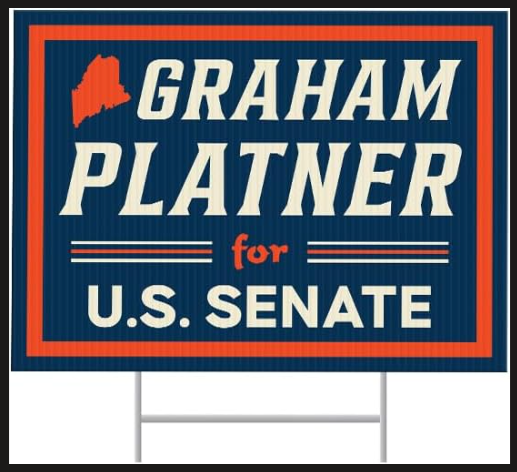
Graham Platner – who has not held elected office before – had a Nazi concentration camp guard’s tattoo on his chest for twenty years, until public opinion forced him to cover it recently. He has been accused of marital infidelity and girlfriend abuse repeatedly throughout his adulthood. His social media posts – going back to the beginning of social media – consistently display an offensive demeanor, with misogynistic language that essentially holds women responsible when they are victims of assault and date rape.
Despite all this having been common knowledge throughout the campaign, he won the nomination with 72% of the Democrat primary vote. The state’s Democrats could have supported people without such baggage, who still agreed with them on the issues. But for some reason, they chose Graham Platner anyway.
The Democrat party bosses forced Platner out of the race on July 8, a month after his primary victory, probably hoping to get some points with the public for doing so, but that puts them at odds with their own primary voters, who chose him despite these awful character traits. So the issues raised by his nomination still stand, unmitigated. No matter what the party bosses do now, the party’s base still picked Graham Platner.
And this leaves the world with some questions.
Actually, with a lot of questions.
We could ask just the Democrat voters of Maine, but frankly, these issues seem to be nationwide in scope. It’s not just Maine Democrats who have picked morally reprehensible people in primaries lately; this is happening all over the country.
California sent a woman to the U.S. Senate – Kamala Harris – who started her political career as the mistress of a local politician (mayor and state legislative boss Willie Brown), who built the foundations of her political career through undeserved plum appointments. That fact didn’t seem to stop Democratic voters from supporting her for other offices. Why not?
New Jersey sent the notoriously corrupt Bob Menendez to the U.S. Senate again and again, until the criminal courts finally sent him to a federal prison. The press had made no secret of his corruption; his bribe-taking was well known. What the rest of us want to know is, Why?
Massachusetts has repeatedly elected Elizabeth Warren to the U.S. Senate, despite her having built both her academic and political careers on being part Native American, when in fact, upon DNA testing, it was discovered that she has virtually no American Indian blood at all (the test estimated her potential indigenous heritage at possibly 1/1024). She has exhibited no shame, no regret, for building her career on this false claim.
So our questions – that is, the questions of Republicans and independents, and not even just of Americans, but the rest of the world too – constitute our effort to understand our opposition. To understand and serve our country, the rest of us need to at least try to understand this odd predilection of the modern Democrat voter.
Question 1: This is the big question, really. Why do America’s Democrat primary voters nowadays seemingly have no desire to nominate decent people? Maine is the perfect example. Janet Mills is an accomplished longtime legislator and executive in Maine government, exactly the kind of resume that should propel a good person to the next elected position. There is no good reason for her to be thrown over for an inexperienced reprobate. If they disagreed on the issues, of course, that could explain it, but they don’t. All that’s left is personality. All other things being equal, why did Democrat voters choose the guy whose personality is utterly toxic?
Question 2: Is there something appealing to today’s Democrat primary voters in a “bad boy” candidacy? Graham Platner is recognized as a tough-talking, tough acting, insulting, abusive character, both physically and verbally. Might the appeal of “the local hoodlum” today be analogous to the “suave and handsome Kennedy mystique” of sixty or seventy years ago? If some voters are inclined to vote for someone who is boyfriend material, and rude abusers are the type of person they want for a boyfriend nowadays, would that explain the choice?
Question 3: How far is too far? In the case of the Platner race, there have really been no new kinds of allegations since the primary. The allegation of non-consensual sex that hit the news cycle on July 6 was essentially of a piece with the girlfriend-abuse allegations that have plagued the campaign since last year. He had a Nazi tattoo; he’d published tons of insulting, offensive comments for years, and the voters knew all this. Might it in fact have been just his poor polling that suddenly made Platner deserving of rejection – now that the window was closing on the party’s ability to replace him on the ballot in time for the fall election? And in that case, isn’t the question really, is winning the only real value they have left? That’s how it looks, if this cretin could advance this far despite a host of unforgivable negatives, and only the likelihood of a loss to Susan Collins would prompt reconsideration.
Question 4: A century ago, political parties chose their candidates in party caucuses. Activists got together to select the nominee whom they thought best represented their memberships’ principles. Democrats called this approach a “smoke-filled room,” and successfully fought for primary elections in many states instead.
In recent years, however, Democrats have signaled their willingness to jettison their duly-elected nominees a few times when their numbers looked weak. The best recent examples were 2002, when they dumped primary winner Robert Torricelli in a US Senate race, replacing him in September with Frank Lautenberg, and in 2024, when they dumped primary winner Joe Biden in July and replaced him with Kamala Harris. Today, Democrats are talking about doing this in Maine, despite Platner’s 72% primary victory, and Democrats appear to be looking at the numbers in other states as well, happy to consider any means necessary to get a candidate who can win in November, full speed ahead, the will of the electorate be damned.
So we must ask, have the Democrats, as a party, abandoned their long-held position that sacrosanct elections are the key to their version of “democracy,” and they will no longer view their primary winner as their champion, but rather, as someone who can be tossed out like last week’s leftovers as soon as their candidacy no longer looks fresh and desirable?
The more we study the 2026 election season, frankly, the more questions come to mind.
But indulge us please. And if you can answer, please do.
Because we would like to understand our neighborly Democrats’ point of view, and for those of us who follow the news, it gets more difficult every year.
Copyright 2026 John F. Di Leo
John F. Di Leo is a Chicagoland-based international transportation and trade compliance trainer, speaker, and consultant. His book on vote fraud (The Tales of Little Pavel), his political satires on the Biden-Harris administration (Evening Soup with Basement Joe, Volumes I, II, and III), his first nonfiction book, “Current Events and the Issues of Our Age,” and his brand new collection of stories about the heroes of the American Founding, “The Founding Generation: The Patriots Who Built America,” are all available in either eBook or paperback, only on Amazon. His trade compliance training practice is available either in person or by webinar.
If you enjoyed this article, then please REPOST or SHARE with others; encourage them to follow AFNN. If you’d like to become a citizen contributor for AFNN, contact us at managingeditor@afnn.us Help keep us ad-free by donating here.
Substack: American Free News Network Substack
Truth Social: @AFNN_USA
Facebook: https://m.facebook.com/afnnusa
Telegram: https://t.me/joinchat/2_-GAzcXmIRjODNh
Twitter: https://twitter.com/AfnnUsa
GETTR: https://gettr.com/user/AFNN_USA
CloutHub: @AFNN_USA