Yes, We Expect Government Officials To Look Professional
State Department bureaucrats are resisting a formal dress code. Why do we have to tell them to dress like we want or need them there?
Citizen Writers Fighting Censorship by Helping Americans Understand Issues Affecting the Republic.
State Department bureaucrats are resisting a formal dress code. Why do we have to tell them to dress like we want or need them there?
If you want a glimpse of how modern pressure can scale fast, look north to the winter of 2022 and the protests known as the Freedom Convoy. What began as a cross-country movement of truckers opposing cross-border vaccine requirements turned into a broader protest against mandates and restrictions. The response from the Canadian government under Justin Trudeau was decisive: emergency powers were invoked, certain financial accounts connected to the protests were frozen, and law enforcement moved to clear blockades. Supporters called it necessary to restore order; critics saw it as a warning shot—how quickly financial access and mobility can be restricted in a modern, digitally connected system.
You didn’t need a history degree to recognize what was happening during the pandemic—you just needed to pay attention to how quickly ordinary people changed under pressure. Not all at once, not everywhere, but enough to notice a pattern. Stress, fear, and anxiety didn’t just shape policy; they reshaped behavior. And in many cases, they …
Under a Chinese-led global order, you wouldn’t necessarily feel “ruled” by China in a direct sense. You would feel aligned to it. Your country’s economy would be plugged into Chinese supply chains. Your infrastructure might be financed, built, or maintained through Chinese-linked systems. Your technology stack—networks, platforms, standards—would quietly converge with theirs because it’s cheaper, faster, and already widely adopted.
There’s a fine line between tactical flexibility and looking like you lost a bet at a surplus store—and right now, ICE is stumbling all over it. Let’s get something straight: uniforms are not about fashion. They’re not about vanity. They are about authority, discipline, and instant recognition. A uniform says, without a word, this person represents the state, is accountable to it, and operates under a standard.
Every few generations, a fresh batch of true believers shows up convinced they’ve cracked the code that baffled every civilization before them. Not tweaked it. Not improved it. Solved it. Permanently. The pitch is always the same—just with better branding, cleaner fonts, and a heavy dose of moral certainty.
Politicians understand something about human nature that civics textbooks politely ignore: most voters do not follow policy, read legislation, or track long-term economic trends. They respond to a handful of very simple signals. Think of it as the national political dashboard. There are four blinking lights that determine whether the public is happy or furious.
Two and a half centuries ago, the American founders attempted something radical. They built a government specifically designed not to accumulate too much power. It was intentionally slow, limited, and divided against itself. The idea was simple: if ambition countered ambition, tyranny would have a hard time getting traction.
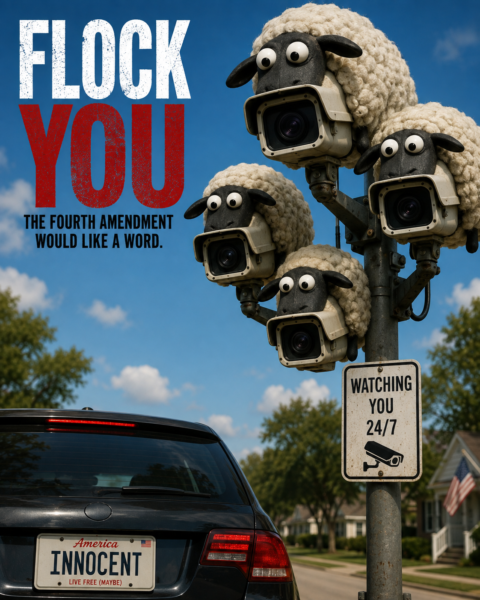
The Founders built a system based on an assumption that now sounds almost quaint: government power would be limited by reality. Communication was slow. Information was scarce. The federal government had trouble collecting taxes, let alone tracking the daily movements of its citizens. If the government wanted to watch someone in 1790, it needed a horse, a spy, and probably a tavern receipt.
We are squandering our country’s wealth to accommodate 10-15 million unskilled, unvetted, third-world intruders who were invited to surge America’s open borders by Joe Biden and his duplicitous Democrat underlings.
Fortunately, Kentucky Girl’s tweet that the idiotic Police Chief of Motor City was going to fire an officer for notifying Immigration and Customs Enforcement turned our to be superseded by time; the officers in question will receive only thirty-day unpaid suspensions rather than losing their jobs, losing their jobs for obeying the law! Detroit police …
I trust my government the way I trust a chainsaw: useful, powerful, and capable of doing exactly what it’s designed to do—right up until someone slips, panics, or decides to use it for something it was never meant to cut. I support enforcing the law. I support borders. I support order. What I don’t support is pretending that massive, flexible, taxpayer-funded detention infrastructure will remain forever confined to the narrow purpose printed on today’s briefing slides. That’s not patriotism. That’s optimism with a short memory.
In 2024, the world tuned in to Paris and was treated to a lavish, high-budget revival of pagan imagery—complete with nods to Dionysus, the ancient god of intoxication, ecstasy, and losing yourself so completely that personal responsibility becomes someone else’s problem. It was art, we were told. It was symbolism. It was “inclusive.” It was definitely not accidental. And it certainly wasn’t Christian.
So what good is voter identification going to do in a state like Colorado where under my theory nearly one million extra ballots are being mailed out that can then be used to form the basis for inside the tabulation machine shenanigans? I show ID as I vote in person, but the vast majority of Coloradans voted by mail.
Throughout America in states-counties-cities known to disregard federal laws in general such as immigration law and the like mentioned above, the federal government-in collaboration with state governments-must undertake steps to monitor the conduct of elections and to enforce best practice documentation procedures.
Americans didn’t wake up one morning and decide they wanted to live under surveillance, financial precarity, endless war, and algorithmic babysitting. This wasn’t a vote. It wasn’t even a debate. It was a process—slow, technical, wrapped in flags and fear, and sold as “temporary” at every stage.
For decades, political science was the academic punchline—the major you picked when calculus broke you, engineering filtered you out, and chemistry made you cry. Everyone knew the line: If you can’t do anything else, go poli-sci. Parents nodded approvingly because “college is good for you,” administrators cashed tuition checks, and students emerged four years later fluent in theory, jargon, and grievance—but functionally incapable of building, fixing, or running anything in the real world. What no one admitted at the time was that political science didn’t just produce underemployed graduates; it quietly trained a generation in how to dismantle systems they never understood and could never rebuild.
In case you haven’t noticed, we have a communist revolution on our hands. It began in earnest in 1962 when our Supreme Court decided that Judeo-Christian values were to be excluded from our public schools. It initiated a profound shift in American education that opened the door to insidious indoctrination that has permeated our society.
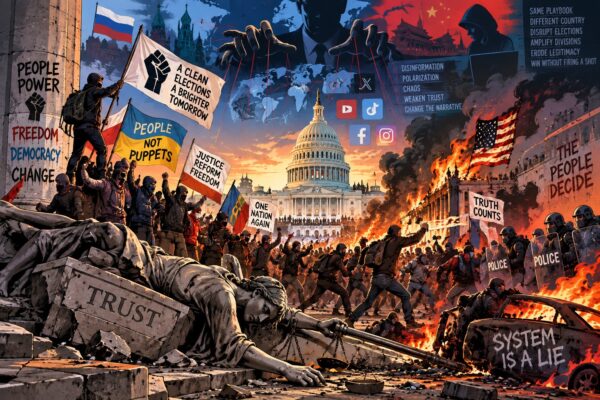
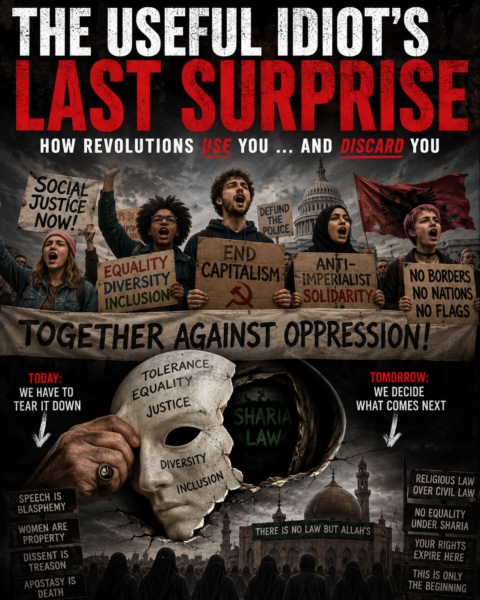
Phase 2 of a color revolution is the “streets on fire” phase. It looks organic. It feels spontaneous. It’s loud, chaotic, righteous, and emotionally intoxicating. This is where the dogs flood the streets. Students, activists, professional grievance collectors, and social-media revolutionaries with ring lights and Venmo links all sprint after the same thing: meaning.
The real problem in our court system is a rot that has its origins over 100 years ago.