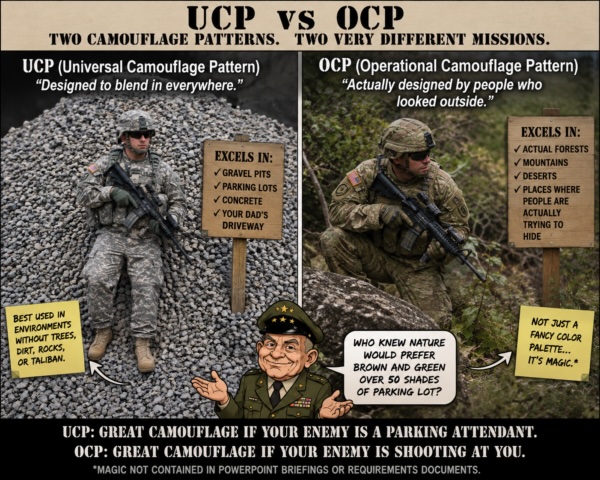
Or: How We Declared War on the Laws of Nature… and Nature Won.
There are moments in military history that deserve to be studied for generations.
Gettysburg.
Normandy.
Desert Storm.
And then… somewhere around 2004… a conference room in the Pentagon where somebody stood up and confidently declared,
“Gentlemen… I’ve got it.”
“Instead of making camouflage that blends into forests… deserts… mountains… and jungles…”
“We’ll make one camouflage that blends into… all of them.”
Silence.
Someone probably nodded.
Someone else probably made a PowerPoint.
Millions of dollars were approved.
Not one squirrel was consulted.
—
For thousands of years, every army on Earth understood one very basic principle.
Camouflage is supposed to look like where you’re standing.
It’s not complicated.
If you’re in the desert…
…look like the desert.
If you’re in the woods…
…look like the woods.
If you’re in snow…
…you’re probably having a really bad day in Alaska.
Then came the modern Pentagon.
Apparently Mother Nature had become too inefficient.
Maintaining woodland uniforms AND desert uniforms?
Outrageous.
What if…
…and hear me out…
…we simply ignored biology, optics, human vision, color theory, common sense, and roughly 300 million years of evolution?
Thus was born the Universal Camouflage Pattern.
Or as soldiers affectionately called it:
The Gravel Pattern.
It was magnificent.
If your tactical objective happened to be hiding behind a Home Depot parking lot, crushed limestone, or a faded cinder block wall, you were practically invisible.
Unfortunately, America spent the next two wars fighting in places that contained trees.
And dirt.
And rocks.
And vegetation.
The enemy, displaying remarkable disrespect for Pentagon planning assumptions, stubbornly refused to attack us while in gravel pits.
—
Then came Afghanistan.
Somewhere, a young lieutenant probably uttered the greatest understatement in procurement history.
“Sir… they can see us.”
No kidding.
Turns out the Taliban had excellent eyesight.
Who knew?
The Army eventually conducted massive camouflage testing.
Hundreds of soldiers.
Thousands of evaluations.
Millions more dollars.
After years of scientific effort, they reached one of history’s greatest engineering breakthroughs:
Brown works better in brown places than gray.
Ladies and gentlemen…
…your tax dollars at work.
—
So the Army started issuing MultiCam.
And soldiers immediately noticed something amazing.
The camouflage actually…
…camouflaged.
Imagine that.
What an innovative concept.
Unfortunately, bureaucracy had one more ambush waiting.
The pattern involved commercial intellectual property.
Now the Pentagon faced an existential crisis.
Do we buy the camouflage that actually works…
…or spend several more years trying to invent one that’s legally different enough?
If you’ve ever worked for the federal government, you already know the answer.
Meetings.
Committees.
Studies.
Working groups.
Executive steering committees.
Integrated Product Teams.
Cross-functional synchronization sessions.
Probably three separate morale patches.
Eventually someone opened an old file cabinet.
“Hey… remember that Scorpion pattern we looked at years ago?”
Silence.
More PowerPoint.
Someone earned a promotion.
And suddenly the Army introduced Operational Camouflage Pattern—OCP.
Which, coincidentally, looks an awful lot like the camouflage everyone wanted in the first place.
It’s almost as if reality had been trying to tell us something all along.
—
Here’s the part that makes engineers twitch.
The entire fiasco wasn’t really about camouflage.
It was about a dangerous institutional disease.
The belief that if enough senior people agree on something…
…physics will surrender.
News flash.
Physics has no chain of command.
Light doesn’t salute.
Human vision doesn’t care about rank.
And Mother Nature has never once said,
“Well… since a three-star approved it, I’ll change the wavelengths of reflected sunlight.”
Nature simply replies,
“Cute briefing.”
Then proceeds to expose everyone wearing gray pajamas in the middle of a green valley.
—
There’s an old saying that a camel is a horse designed by committee.
The Universal Camouflage Pattern was something even rarer.
It was camouflage designed by people who apparently believed the Earth itself was negotiable.
The truly impressive part?
Replacing it cost billions in uniforms, body armor covers, rucksacks, pouches, helmet covers, cold-weather gear, and every other piece of equipment that suddenly had to be recolored because someone confused logistics optimization with optical science.
That’s not a lesson in camouflage.
That’s a graduate-level course in how organizations can become so enamored with elegant ideas that they stop asking the only question that matters:
“Does it actually work?”
So here’s the Cedar Savage engineering rule.
When someone tells you they’ve invented one solution that works perfectly everywhere…
…check your wallet.
When someone tells you they’ve solved millions of years of evolutionary biology with a PowerPoint…
…check your wallet again.
And when somebody proudly unveils a “Universal Camouflage Pattern”…
…head straight to the nearest gravel pit.
Because that’s probably the only place you’ll disappear.
If you enjoyed this article, then please REPOST or SHARE with others; encourage them to follow AFNN. If you’d like to become a citizen contributor for AFNN, contact us at managingeditor@afnn.us Help keep us ad-free by donating here.
Substack: American Free News Network Substack
Truth Social: @AFNN_USA
Facebook: https://m.facebook.com/afnnusa
Telegram: https://t.me/joinchat/2_-GAzcXmIRjODNh
Twitter: https://twitter.com/AfnnUsa
GETTR: https://gettr.com/user/AFNN_USA
CloutHub: @AFNN_USA
I have personal insight into this. I had to review and redact the study conducted at the Natick Soldier Center. Very little had to be redacted except some of the specific numbers. The conclusion was clear: Keep the BDUs and DCUs. It was best to have a specific camo pattern for specific environments. The study concluded that if you had to have one pattern, they recommended one that did okay. That is
NOT the one the Army chose. They chose one that a colonel on the committee said, “looked cool.” When soldiers’ mothers complained, and I read the report, I couldn’t figure out why that pattern was chosen. Simply “looking cool” was more important than saving lives. Period. When the truth came out, the Army wanted the pattern that Natick studied and found that the most effective pattern — if you had to have a sub-optimal single pattern — was under copyright and would cost a LOT of cash. So, back to Natick. They found a government-invented pattern that was similar and just as good. That’s what we have today. A suboptimal single pattern instead of two optimal patterns that won the Cold War.
First, let’s acknowledge this: When the services started messing with digital camouflage patterns, this started with the Marines. The Commandant said he wanted a pattern that looked different from the Army. That’s it. That was the motivation. Never mind that having a single pattern across the entire DoD (in those days) was cost-effective. Never mind that changing cammo in the middle of a war for spurious reasons was a DOGE-like waste of money. There was lip service paid to effectiveness, but at the end of the day, this was about politics. Then each service invented its own pattern. The Navy one was particularly stupid.
We’ve gone from Army Class A’s to pushing dress blues, to the Eisenhower uniform of World War II within a short period of time, and for what? The only thing I could see was to waste money.
I liked the Navy’s blue camouflage uniform, or, as my daughter asked, “What are they trying to do? Make it harder to spot a sailor who has fallen overboard?”
The most active military in the world is the Israel Defense Force, and their uniforms are a simple, solid color, and they kick butt every time. Is it possible that the IDF are smarter than the geniuses in the Pentagon?