Or is it more spitballs and sledgehammers…
My original intent was to write a short piece in favor of the SAVE Act. But exposure to the facts, generally missing from the debate, changed my mind. This effort led to a proposal to replace the SAVE Act, one that respects the wisdom of federalism, rejects one size fits all legislation, and recognizes the reality of legal challenges.
Join me as we examine how relevant history, trends and the current state of our politics reveal an alternate path forward.
Note all references below refer to the most recent SAVE Act S.1383 passed by the House on February 11, 2026 and currently pending in the Senate.
Why Convenience and Safeguards are Both Necessary
It is a testament to successful narrative campaigns that even one word in this article needs to be dedicated to this. Yes, registration and voting should be as easy as possible without opening the door to fraud and mistakes.
A casual observance of our everyday lives reveals every system operates on the same principle. Contracts, bank vaults, Real ID, body cams, and audits etc. Photo IDs are required throughout society. At the bank, doctor’s office, liquor store. We cannot board a commercial airplane without a Real ID or passport that require proof of citizenship or legal residence to obtain. No one claims it is racist or Jim Crow 2.0 for a doctor, airline or welfare office to ask for photo or Real ID.
Millions upon millions of legal and illegal immigrants have entered our country in recent decades which has resulted in a large segment of noncitizens, many unvetted. While my Clash Over Immigration series has only reached 1980, it is a worthwhile read for those unaware of the history, the volume, how politicians have leveraged immigration to their benefit, and the pattern of political inaction by both parties. And this pales in comparison to what happened under the Biden administration. It is likely some noncitizens are not supporters of America. Election integrity is just as vital to national security as keeping terrorists off planes.
The influence campaigns address this reality by saying it is very rare for noncitizens to vote, so we shouldn’t worry about it. So are highjackings and bank robberies.
The Declaration of Independence states: “Governments are instituted among Men, deriving their just powers from the consent of the governed.” Voting is our primary form of consent. We must protect and cherish it, so the script is not flipped, and we subsist at the consent of an all-powerful government.
It is not the odd noncitizen that accidentally registers to vote that will change the course of our country. What is truly worrisome is the knowledge that politicians have historically used immigration to improve their electoral chances. While some politicians may care if it’s easy for us to vote, it is a fair guess that many only care whether it’s easier for them to win. Those opportunists may not be able to resist the juicy temptation of all those potential voters, a voter block that could sway close elections and override the majority citizen opinion. We need safeguards to protect our elections from them.
Below we examine relevant history and trends which show how Democrats and Republicans have been repeating the same patterns for decades.
Historical Background
Our system of government as outlined in the Constitution is federalism which is defined as “a system of government in which the same territory is controlled by two levels of government. Generally, an overarching national government is responsible for broader governance of larger territorial areas, while the smaller subdivisions, states, and cities govern the issues of local concern.”
The Elections Clause in the US Constitution, Article I, Section 4, Clause 1 states: “The Times, Places and Manner of holding Elections for Senators and Representatives, shall be prescribed in each State by the Legislature thereof; but the Congress may at any time by Law make or alter such Regulations, except as to the Places of chusing Senators.”
The 15th Amendment, adopted in 1870, states “The right of citizens of the United States to vote shall not be denied or abridged by the United States or by any State on account of race, color, or previous condition of servitude.”
While the 1870 Enforcement Act included the first federally mandated election requirements, the 1965 Voting Rights Act (VRA) under Democratic President Johnson was the first time the federal government essentially took control of election procedures in states presumed to be suppressing the vote. It banned racially discriminatory voting practices (like literacy tests) in the states in which it was occurring and required certain states with documented histories of discrimination to get federal approval before changing their election laws (preclearance).
A majority Democratic congress passed a bipartisan version of the National Voter Registration Act (NVRA or “Motor Voter” law) that Republican President George H.W. Bush vetoed in 1992. Republican support was insufficient to override the veto. It was reintroduced soon after Democratic President Bill Clinton took office and he signed it May 20, 1993. It took effect January 1, 1995, and required states to offer the option of voter registration when people applied for a driver’s license, certain welfare services (AFDC/TANF, Medicaid, Food Stamps/SNAP, and WIC), disability service and military recruitment. It also required a simple signed attestation of citizenship on a uniform federal registration form rather than documentary proof. This Act represented a continuing pattern of federal intrusion into how states conducted elections.
Wording in the 1993 NVRA will sound familiar: “discriminatory and unfair registration laws and procedures can have a direct and damaging effect on voter participation in elections for Federal office and disproportionately harm voter participation by various groups, including racial minorities.”
In this audio clip from the Face Off radio program, Democratic Senator Ted Kennedy and Republican Senator Al Simpson discuss Bush’s veto of the bill in 1992. Democrats wanted to make it easier for people to register, and Republicans were worried the bill would become “Auto Fraudo”. Kennedy suggested that Republicans are only worried that the newly registered voters will vote for Clinton while Simpson says that is why Democrats proposed the bill in the first place. If I had to bet, this was their only honest exchange.
Same s$%t, different decade.
The Removal of the 1965 VRA Preclearance Requirement
The preclearance requirement established in the 1965 VRA was not removed until 2013. In a 5-4 ruling, Shelby County v. Holder struck down Section 4(b) of the 1965 VRA which required certain states and jurisdictions who had participated in discriminatory electoral practices obtain federal preclearance before changing their election laws. The preclearance requirements remained unchanged for decades even though states no longer employed discriminatory practices. This is because the formula used to determine if preclearance was necessary was based on 40-year-old turnout data that was never updated to reflect actual conditions. Congress was aware of this as they repeatedly reauthorized the law. The Court’s reasoning also rested heavily on the mismatch between a single, nationwide formula and the fact that conditions varied significantly from state to state.
Chief Justice Roberts wrote for the majority: “Our country has changed, and while any racial discrimination in voting is too much, Congress must ensure that the legislation it passes to remedy that problem speaks to current conditions.” Justice Ginsburg’s dissent, joined by Breyer, Sotomayor, and Kagan, famously countered that “throwing out preclearance when it has worked and is continuing to work is like throwing away your umbrella in a rainstorm because you are not getting wet.“
Here we go again.
Democrats supported preemptive federal action when the risk was discrimination but opposed preemptive action when the risk was fraud or noncitizens voting.
Voter Registration
Since 1993 NVRA, when opt-in voter registration upon application for a driver’s license was required, states are now trending towards automatic voter registration (AVR).
Of the AVR states, 15 plus Washington D.C. also issue drivers’ licenses to noncitizens, legal and illegal. Some systems rely on humans to determine whether the person is eligible to vote, others on software. Common sense suggests both are vulnerable to mistakes.
Mail in Voting and Ballot Harvesting
Many states accelerated practices that made it easier to vote during Covid such as mail in voting and ballot harvesting. Without safeguards, both are vulnerable to fraud, especially when in combination.
While 30 states allow no excuse absentee ballots, 8 states conduct “all-mail” elections(California, Colorado, Hawaii, Nevada, Oregon, Utah, Vermont, and Washington). Voter roll accuracy and confirmation of identity is of critical importance in mail voting systems.
Ballot harvesting, or ballot collection, allows a third party to collect a completed absentee or mail ballot from the voter and deliver them via mail, drop box or in person. The majority of states allow some form of ballot harvesting with controls. Others like California permit anyone to return a ballot, with no limit on the number of ballots collected. Plus, it is legal in California to pay ballot brokers as long as the payment is not tied to the number of ballots collected.
As a result, political campaigns, parties, unions, and advocacy groups routinely run organized ballot-collection operations. While Democrats started it after California passed the harvesting law in 2016, both parties are now all in.
No wonder people worry California elections are rigged.
Voter ID
36 states require some form of identification at the polls. The requirement is far more common in red and purple states while many blue states have never required photo ID.
Indiana was the first state to implement voter ID on January 1, 2006. To manage potential disparate impact, Indiana provided free ID cards and allowed an indigency-affidavit exception for voters who couldn’t obtain one.
Democratic aligned groups and Democratic state representative William Crawford immediately challenged the law, arguing it placed an unconstitutional burden on the right to vote and would disproportionately harm poor, minority, elderly, and disabled voters.
On its way to the Supreme Court, the Seventh Circuit suggested that since the law would not deter any of the plaintiffs from voting “the motivation for the suit is simply that the law may require the Democratic Party and the other organizational plaintiffs to work harder to get every last one of their supporters to the polls.”
The Supreme Court ruled in favor of Indiana. The majority opinion stated: “no evidence of any fraud actually occurring in Indiana at any time in its history,” but upheld the law anyway, reasoning that preventing future fraud and bolstering public confidence in elections were legitimate state interests on their own, even without a documented past incident to point to.
Same dance, over and over again.
State practices regarding identity verification for mail in voting are a mixed bag and some could be construed as easy to vote and easy to cheat. Most states utilize signature matching for verification, an imprecise method open to interpretation. Some require a witness signature, notarization or ID verification. A handful of states plus Washington D.C. require a signature but don’t compare it to anything. A voter could sign Mickey Mouse and not be questioned.
Proof of Citizenship
While the 1993 NVRA is a legal impediment for proof of citizenship requirements, red states are trending in that direction and are being sued by democratically aligned groups to stop the practice.
Arizona citizens (not the legislature) put forth and passed Proposition 200 “Arizona Taxpayer and Citizen Protection Act” in 2004. Proponents argued that the state allowed people to declare citizenship without documentation and that requiring the same kind of identification already needed for everyday activities was reasonable for voting. The proposition therefore required documentary proof of citizenship to register to vote and photo identification at the polls.
It was challenged initially by Mexican American Legal Defense and Educational Fund (MALDEF) later joined by the Tribal Council. Political opposition was bipartisan.
In 2013 the Supreme Court ruled against Arizona stating the language of the 1993 NVRA prohibited states from requiring anything, including documentary proof of citizenship, in excess of the attestation of citizenship stipulated in the 1993 NVRA.
Their opinion was based on the language of the bill, not the concept of requiring such proof. In fact, the Supreme Court also said since the 1993 Act applied only to federal elections, states were free to require documentary proof of citizenship for state and local elections.
As a result Arizona created a bifurcated voter registration process: 1) voters who chose not to supply documented proof of citizenship are only allowed to vote in federal elections, 2) those who did supply documentation are allowed to vote in federal, state and local elections.
Beyond Arizona’s bifurcated model, seven states require documentary proof of citizenship at the point of registration itself: New Hampshire, Wyoming, South Dakota, Ohio, and Utah are enforcing these laws for the 2026 elections, while Florida and Louisiana have passed similar laws but have not yet implemented them. Legal challenges by groups aligned with the Democrat party are underway or pending for New Hampshire, Ohio, Florida and Louisiana.
The Federal SAVE System for Citizenship Verification
US Citizenship and Immigration Services (USCIS) has reported that election agencies from over 27 states are currently registered to use the federal Systematic Alien Verification for Entitlements (SAVE) system for voter registration and/or list maintenance. However, this system too is embroiled in legal challenges. While the list has been available for voter related purposes since about 2005, it was only designed for individual citizenship checks. To offer a comprehensive service to states, the Trump administration overhauled it to accommodate full voter roll batch checks.
Democratic aligned groups sued and suggest the overhaul runs afoul of the Privacy Act, Social Security Act and federal rule making procedures and a Biden appointed federal judge concurred placing an injunction on the use of the updated SAVE list. For more information, please consider this Ballotpedia article.
Republican vs Democratic Litigation Trends
Generally Republican litigation involves accessing and cleaning voter rolls and Democratic litigation opposes citizenship and ID laws.
Republicans. Utilizing the 1993 NVRA’s Section 8 list-maintenance provision and section 11 private right of action, Judicial Watch has sued states whose voter rolls exceed the eligible population. They compare publicly available county registration counts against Census citizen voting-age population data. Roughly six million ineligible registrations have been removed nationwide through settlements, including 800,000 that are slated for review and removal in Oregon and 1.2 million already removed in LA County. Note these efforts are unable to address whether noncitizens are on the voter rolls or not.
To verify that lists only contain American citizens, the current Department of Homeland Security (DHS) compared voter registration lists against federal immigration lists for California, New Jersey, Nevada and Pennsylvania and announced that those states could contain between 118,000 to 256,000 noncitizens on their rolls. The lower and upper ends of the range are a result of different methodologies both recognized to be potentially inaccurate.
While each of the four states strongly denied the numbers, within one week New Jersey announced they had found 6,600 noncitizens on the rolls, roughly 400 of which voted. This error occurred in the June 2023-June 2024 voter rolls. New Jersey began AVR in 2018. They began issuing driver’s licenses to legal and illegal noncitizens in 2021. As a result some assume 6600 is an undercount. For more information consider this The New Jersey Vindicator article. Note, Oregon also reported in a July 2025 auditthat 1800 noncitizens out of 1,400,000 AVRs were enrolled to vote. Only 38 of these people voted.
How many noncitizens voted is immaterial. We should be more concerned that the system made errors and registered any noncitizens.
The Trump DOJ has pursued legal action against 30 states seeking their full voter rolls with personal identifiers such as social security and driver’s license numbers. So far, they have lost most of these lawsuits, with courts consistently ruling that DOJ does not have the authority under the referenced statutes to request this data without showing a legal violation. For those who want to dig into further, this Congressional Research Service article covers the Michigan case which is the first of the 30 cases to reach the appellate court.
Democrats. The Biden DOJ sued Georgia and Texas in 2021 over their election integrity bills. Attorney General Merrick Garland announced the Georgia lawsuit in June 2021, asserting the Georgia law was designed “with the purpose of denying or abridging the right of Black Georgians to vote.” The Texas suit, filed that November, argued the law’s mail-ballot ID-matching requirement would disenfranchise elderly voters, those with limited English, and deployed military. The suits were later dismissed by the Trump administration.
The Biden DOJ also sued Virginia and Alabama alleging their programs to remove noncitizens from voter rolls violated the NVRA provision barring systematic removals within 90 days of an election. Neither case reached a full conclusion due to them being withdrawn by the Trump administration. Consider this Votebeat article for more information.
Recent Democratic and Republican Legislative Trends
Democrats. There is a trend among progressive jurisdictions to allow noncitizens to vote. Currently Washington DC, twelve jurisdictions in Maryland, Montpelier and Burlington in Vermont, San Francisco, Oakland and Santa Ana in California allow noncitizens to vote in some or all local elections. Efforts are underway in Richmond, San Jose, Long Beach, Pasadena and Portland ME. New York City tried and failed in 2021.
The Democratic Socialists of America (DSA) appear to be a growing faction of the Democratic party. Their platform states: “Extend full voting rights to all permanent US residents and restore the right to vote for incarcerated people and people with criminal convictions.”
Democrats sought to federalize election procedures during the Biden administration: H.R.1 For the People Act of 2021, H.R.4. John R Lewis Voting Rights Advancement Act of 2021 and H.R. 5746 Freedom to Vote: John R Lewis Act which combined key provisions from both H.R.1 and H.R.4. All three passed the house but failed in the Senate due to Republican filibuster.
The Freedom to Vote: John R. Lewis Act would have imposed nationwide standards for federal elections including: automatic and same-day voter registration, no-excuse mail voting and limits on voter-roll purges. It also mandated that states that required voter ID accept a broad range of non-photo documents (ie utility bills, bank statements).
Additionally, harkening back to the 1965 Voters Rights Act, any state seeking to strengthen its documentation or proof-of-identity requirements or make other specified changes to its voting laws, would require federal preclearance, a near impossibility under a Democratic administration.
Note Republicans attacked the above bills on federalism grounds. One example is a letter from 20 Republican state attorneys general drafted by Indiana AG Todd Rokita: “As introduced, the Act betrays several Constitutional deficiencies and alarming mandates that, if passed, would federalize state elections and impose burdensome costs and regulations on state and local officials.”
Republicans. Current Republican legislation also seeks to federalize elections. The SAVE Act (S. 1383), which passed the House and is pending in the Senate would require in-person documentary proof of citizenship such as a passport, birth certificate, or citizenship-marked REAL ID when registering to vote and a government or tribal photo ID when voting. Since documents must be presented in person either to register or vote, it would effectively end most mail and online registration.
It creates a new federal bureaucracy to implement and manage, federal criminal penalties for election officials, and a private right of action to sue noncompliant officials.
Democrats explicitly criticized the SAVE Act on federalism grounds. One example is a formal multistate letter drafted by AG Letitia James which states: “We… write to express our strong opposition to the Safeguard American Voter Eligibility (SAVE America) Act and to recent efforts by the President to nationalize election administration in ways that undermine state sovereignty”.
Same s%&t, different administration.
In addition to the SAVE Act, Trump also signed an executive order on March 31, 2026 titled “Ensuring Citizenship Verification and Integrity in Federal Elections” which directed the U.S. Postal Service to require Intelligent Mail barcodes on all mail ballots nationwide and required states using USPS for mail voting to transmit mail-ballot recipient lists to the agency. The order directed DHS to compare this list to a citizenship list.
23 states immediately sued. The Election Clause gives Congress the authority to intrude into state election procedures not the President. The language seems clear.
The image of spitballs and sledgehammers comes to mind when considering the strategies above. See if anything sticks and try to sledgehammer it to the wall. This strategy ignores legal realities, dares the fight, with very little chance of legislative success. It is quite successful however in solidifying divisiveness in our society especially when accompanied by manipulative influence campaigns. Lucky us.
Summary of Trends and Why the SAVE Act is Problematic
While there is much density above, it can be summarized simply. Most states have made it easier to vote. Red states are trending towards adding photo ID and proof of citizenship but many face Democratic legal challenges every step of the way.
Blue states are trending toward the removal of safeguards with very loose processes. These states face Republican challenges geared towards their voter rolls. Three of the four states with the loosest election procedures are deep blue while one is purple: California, Nevada, Oregon, and Washington mail every registered voter a ballot, allow unrestricted ballot harvesting, do not require voter ID, issue driver’s licenses to noncitizens and automatically register people to vote upon issuance of a driver’s license. What could possibly go wrong?
Democrats support preemptive federal power when the stated risk is discrimination and oppose it when the stated risk is fraud or noncitizens voting. Republicans reverse the emphasis. They believe fraud and citizenship have evolved into serious concerns and are dismissive of contemporary claims of racial discrimination. All three deserve nonpartisan analysis.
The continuous stream of litigation suggests this has little to do with us. It appears that Democrats think it will be easier to win if they keep election procedures as loose as possible and Republicans think it will be easier to win if they add safeguards and force blue states to clean their voter rolls. The relevant question is “what do we think”.
In the Trump/Biden years, both sides have proposed national control over state election procedures while in power, and rediscover federalism whenever they aren’t. Let’s not be fooled by rhetoric. Power grabs are power grabs regardless of how they are dressed up even if we agree with the premise.
Even though proof of citizenship plus voter ID may sound sensible, there are valid reasons to oppose the SAVE Act and seek an alternate path forward:
· The SAVE Act is as guilty of federalizing elections as the Democrats’ Freedom to Vote proposals. The Election Clause of the Constitution clearly outlines election procedures as state level efforts even though it gives Congress the ability to override. Federal requirements should only be implemented if no other option exists.
· A blanket, one-size-fits-all national standard applied to 50 states with vastly different conditions is ripe territory for a legal challenge. The SCOTUS Shelby opinion relied heavily on opposition to national rules with no state-by-state tailoring when it struck down the 1965 VRA coverage formula and preclearance requirement.
· It is far easier to craft document requirement workarounds at the local level so it is not unduly burdensome for the small group who may have difficulty. This would help avoid disparate impact legal challenges and ensure document requirements are not an impediment to voting.
· If voter rolls are accurate through continuous, meaningful maintenance, the ID’s only job is confirming the match between the voter and list. It doesn’t need to meet the SAVE Act’s narrow, restrictive standard to do that. Any official, photo-bearing identification tied to a real issuing authority, government or institutional, is sufficient. Unnecessarily strict ID requirements will make legal challenges stronger.
· The SAVE Act is vulnerable to challenges due to the vagueness of what data must be submitted in full voter rolls and the lack of specified cure periods if someone is genuinely missing from a citizenship list.
· The SAVE Act specifically requires DHS to use the voter lists from the states to remove noncitizens from the country. It is difficult to imagine this provision surviving a legal challenge.
· The SAVE Act does not include a severability clause. If one provision is struck down by the courts, the entire act could be vulnerable.
Even if someone believes government photo ID and proof of citizenship are worth the federal power grab, additional bureaucracy, and cost, the act as drafted is sloppy.
The SAVE Act will not SAVE America. Chances are it will be successfully challenged and accomplish nothing but a talking point for Republicans. If by some miracle it did survive, it furthers a dangerous pattern of federal intrusion into the states’ administration of elections making it easier for the next administration to force their own vision on the states.
A Potential Alternative
The 1993 NVRA is the legal impediment for states to request proof of citizenship. A repeal of the relevant portions would allow states the option to request proof of citizenship and craft options to address disparate impact tailored to their specific electorate. A bill of this nature could survive a legal challenge since the SCOTUS opinion in Arizona v. Inter Tribal Council of Arizona, Inc. referenced above suggested that if states want to ask for proof of citizenship, Congress should modify the NVRA.
The NVRA already requires states to make reasonable efforts to remove ineligible voters based on death and change of address. The proposed act would modify NVRA to add citizenship to this list and provide states various options to do so, one of which is the SAVE list. With the current injunction against usage of the SAVE list, including it as one option provides the necessary Congressional approval to defang these challenges.
The above has been crafted into new proposed legislation called the CLEAN Act (Citizenship List Eligibility Audit and Notification Act) as a companion piece to this article.
Since most states employ some form of mail in voting and this process is particularly vulnerable to mistakes and fraud, Congress should craft and pass legislation that gives states the option to employ bar code tracking on all mail ballots. The tracking data itself would be legally walled off. It can only be used to confirm a ballot’s location and delivery status, never linked to who someone voted for or used to determine voter eligibility or citizenship.
Details have been crafted into proposed legislation called the TRACE Act (Transparent Reporting and Accountability for Chain-of-custody Elections Act).
While I recognize this proposal does nothing to force California and other states to include safeguards in general and regulate ballot harvesting in particular, it opens the door for other states to do so in a manner that is least likely to be successfully challenged. Trends have a way of picking up steam especially as motivated citizens see what is happening elsewhere and introduce propositions in their own states.
Also, by adding citizenship verification to the private right of action already authorized under NVRA, private groups such as Judicial Watch can add citizenship to their voter roll challenges that are now limited to death and change of address.
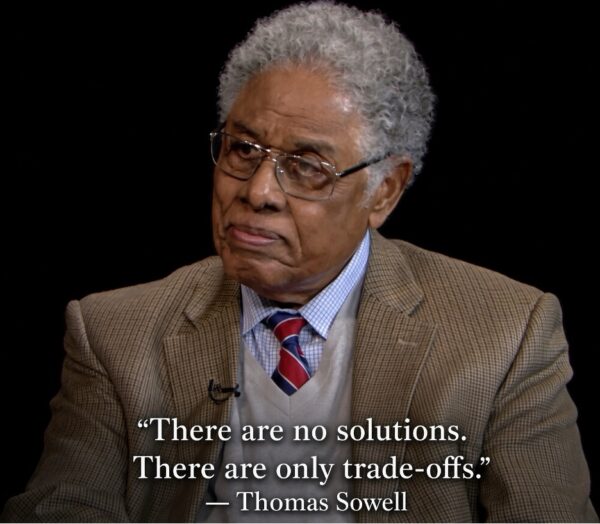
In summary, as Thomas Sowell stated in “A Conflict of Visions”, “There are no solutions. There are only trade-offs.” Spitballs and sledgehammers do not change this reality. We have watched both sides spit and swing repeatedly looking for a solution. The CLEAN Act and TRACE Act don’t pretend to be a solution. They’re a trade-off: federal authorization without federal mandate, letting each state decide what trade-off is right for its own electorate. There is no guarantee that 60 Senators will vote in favor of either proposal but both stand on clearer legal ground and avoid federal overreach.
Let’s unleash the states rather than burden them with nationwide mandates. By respecting federalism, it sends a strong signal of trust that the states and citizens will do the right thing.
If you enjoyed this article, then please REPOST or SHARE with others; encourage them to follow AFNN. If you’d like to become a citizen contributor for AFNN, contact us at managingeditor@afnn.us Help keep us ad-free by donating here.
Substack: American Free News Network Substack
Truth Social: @AFNN_USA
Facebook: https://m.facebook.com/afnnusa
Telegram: https://t.me/joinchat/2_-GAzcXmIRjODNh
Twitter: https://twitter.com/AfnnUsa
GETTR: https://gettr.com/user/AFNN_USA
CloutHub: @AFNN_USA