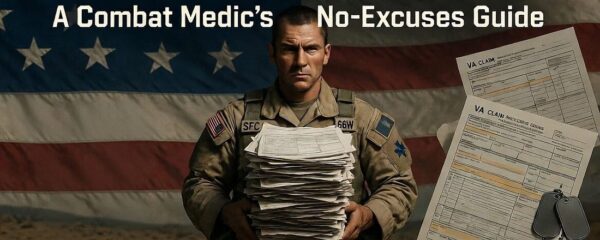
— I FAILED MY OWN CLAIM. MORE THAN ONCE. —
Let me start with a confession, because somebody needs to say it out loud.
I am a medically retired Army combat medic. Twenty-three years. Iraq. I spent my career documenting injuries on OTHER soldiers — SF 600s, sick call notes, MEDEVAC paperwork. If anyone on this planet should have walked into the VA claims process and crushed it on the first try, it was me.
I did not.
I failed. More than once. And the reason was not that my injuries were fake, or that the VA hated me, or that some examiner had it out for me. The reason was simple and it stings to admit: I DID NOT DO MY HOMEWORK.
That is it. That is the whole autopsy. I treated the most important financial day of my Army life like a routine sick call appointment, and the VA rated me like a guy who showed up to a routine sick call appointment.
So this article is the homework I wish someone had shoved in front of me years ago. It is long. Read it anyway. It could be worth tens of thousands of dollars a year, tax-free, for the rest of your life. You sat through longer briefings for a lot less.
— FIRST, UNDERSTAND THE GAME YOU ARE PLAYING —
Here is the part nobody tells you in your transition brief.
A VA claim is not a medical process. It is a LEGAL process that happens to use medical evidence. The C&P examiner is not your doctor. They are not there to treat you, fix you, or hold your hand. They are there to fill out a form — the DBQ, the Disability Benefits Questionnaire — and ship it to a rater you will never meet.
That rater does not see your limp. Does not see you white-knuckle the railing on the stairs. Does not see your wife sleeping in the guest room because your nightmares scared her. The rater sees PAPER. Whatever made it onto the paper exists. Whatever did not make it onto the paper never happened.
Once that clicks, everything else in this article makes sense.
The VA needs three things to service-connect a condition, in this order:
- A CURRENT DIAGNOSIS. Not “my knee hurts.” A diagnosed condition, in a medical record, from a qualified provider. Yes, they can diagnose you, but not likely.
- AN IN-SERVICE EVENT, INJURY, ILLNESS, OR AGGRAVATION. Something that happened on duty that caused it or made it worse.
- A NEXUS. The medical link between #1 and #2, stated as “at least as likely as not” — a 50/50 or better. This is the trickiest part and the one that sinks most claims. You can make an argument, but why risk it. Use your paperwork.
Miss any one of the three and you lose. It does not matter how bad you hurt. The VA is not rating your pain. It is rating your PAPERWORK. Welcome to the federal government.
— DO YOUR HOMEWORK OR DO IT AGAIN NEXT YEAR —
Here is what changed everything for me, and I am going to put it in capital letters because I want it tattooed on the inside of your eyelids:
DOWNLOAD EVERY SINGLE DBQ FOR EVERY CONDITION YOU ARE CLAIMING. ALL OF THEM. BEFORE YOUR EXAM.
The DBQs are public. They are sitting on the VA website right now, free, waiting for you. The DBQ is the test. The examiner is contractually required to fill it out. The 38 CFR rating schedule is the answer key — also public. You are being handed the exam AND the grading rubric in advance, and most veterans walk in cold anyway.
I teach Anatomy and Physics to high school students. If I handed my kids the test a month early, with the answer key stapled to it, and they still bombed it — what would you call that? Right. Do not be that.
So here is the drill:
Print the DBQs. Spread out your service records and your medical records on the kitchen table like you are planning an op. Go through every question. Every one. And every time you find something in your records that answers a question — a sick call note, an SF 600, a profile, a line of duty determination — flag it.
Then UPLOAD ALL OF IT to your case file at VA.gov. And print copies and BRING them to your exam. Yes, both. Not all appointments will accept physical documents, and the examiner frequently has not read your file anyway — some of them did not even know my branch of service. For the VA, REDUNDANCY IS NOT PARANOIA, IT IS DOCTRINE. Belt, suspenders, and a second belt.
Why both? Because if you hand the examiner documents and count on them to upload it — I will be generous and say that happens approximately never. Use the VA Quick Submit portal yourself. It attaches to your open claim automatically. Trust no one. Verify everything. (Twenty-three years in the Army taught me something after all.)
— THE NEXUS: BUILD THE BRIDGE OR WATCH YOUR CLAIM FALL INTO THE RIVER —
While you work through each DBQ question, there are two thoughts that should be running on a loop in your head. Here is the first:
WHAT IS THE NEXUS IN THE MILITARY THAT CAUSED THIS — AND HOW CAN I PROVE IT?
Proof can be more things than you think:
A Statement of Service. A photograph. A buddy letter from someone who was there. A letter from leadership or command. An award citation. A SIGACT. A medical record like an SF 600. Deployment orders putting you in the burn pit’s zip code. A DD-214. ANYTHING that links your condition to your time in uniform.
And if your service records are silent because you never went to sick call — because you were nineteen and indestructible and going to sick call meant your squad leader calling you broke — SAY THAT. Explain the gap. “I self-treated with Motrin and pride because that is what we did.” The VA calls it lay evidence. I call it telling the truth about military culture.
For the strongest claims, get a NEXUS LETTER from a doctor — ideally one who actually treats you, on letterhead, stating they reviewed your records and that your condition is “at least as likely as not” caused by your service, with actual medical rationale behind it. Not a two-sentence note. Reasoning. Studies. Specifics. Avoid the “nexus mills” cranking out generic letters; the VA smells those a mile away and discounts them. And do not assume a great nexus letter exempts you from the C&P exam — it does not. Skip the exam and your decision letter will read “veteran failed to report, claim denied,” and your gold-plated letter goes in the shredder with your claim. ATTEND. EVERY. EXAM.
— THE FOUR AREAS THAT DECIDE YOUR PERCENTAGE —
Here is the second thought for your loop. The rating percentage — the difference between 30% and 70%, which over a lifetime is a HOUSE — comes down to functional impairment under 38 CFR 4.10. The VA measures how your condition wrecks four areas of your life. You need concrete, specific examples in each one BEFORE you walk into that room:
OCCUPATIONAL FUNCTIONING (work and earning capacity). Missed days. Reduced hours. Accommodations. Write-ups. “My knee pain forces me to sit after 10 minutes of standing, so I cannot complete a full workday on my feet.” Do you have evaluations or counseling statements that back it up? Find them.
SOCIAL AND INTERPERSONAL FUNCTIONING (relationships). Isolation. Irritability. The gatherings you skip. “My PTSD causes weekly panic attacks that make me avoid family events and miss work deadlines.” Specific. Datable. Real.
SELF-CARE AND ACTIVITIES OF DAILY LIVING. Bathing, dressing, grooming, getting out of bed. If it takes you ten minutes to get vertical in the morning, that is not a personal failing — that is EVIDENCE.
INSTRUMENTAL ACTIVITIES OF DAILY LIVING. Cooking, finances, driving, medication management, the grocery store you cannot face on a flare-up day.
Plus the rest: mobility, concentration, memory, sleep, endurance, flare-ups. For every claim, think FREQUENCY, EFFECTS, DURATION. “3 to 4 times per week, it puts me on the couch, for half a day.” That sentence is ratable. “It bothers me sometimes” is not.
Document the bad days. Keep a journal with dates and days it sticks out. What prevented you from doing anything in ANY of those categories? You have a phone; make a Google Doc. Submit lay statements — yours, your spouse’s, your buddies’ — describing what they OBSERVE. And for increases or secondaries (the knee that ruined the back, the chronic pain that fed the depression), tie the new limitation directly and explicitly to the service-connected condition. Connect the dots FOR them. The rater will not freelance on your behalf.
— THE PAIN SCALE: YOUR THREE IS NOT THEIR THREE —
This one cost me, personally, so listen close.
Look up the Defense and Veterans Pain Rating Scale before your exam. Actually read the words under each number. Because here is the trap: you and I were trained to treat pain like an inconvenience. What I would casually call a 3 out of 10 — the VA scale would score a 4 or a 5, because on THEIR scale a 4 means the pain DISTRACTS ME FROM ACTIVITIES and a 5 means it INTERRUPTS THEM. That is not “minor.” That is most of my afternoons.
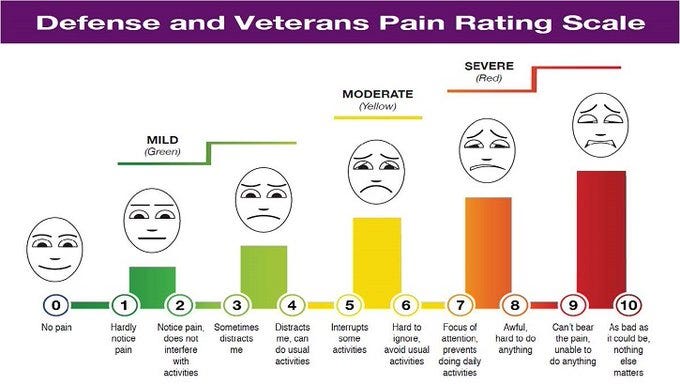 |
This is not math. It is not the number you feel like reporting through gritted teeth. It is a defined scale with defined words, and if you describe your pain in tough-guy units instead of THEIR units, you will be rated incorrectly. Period.
DO NOT LIE. Ever. Exaggeration is fraud, it is wrong, and examiners who see broken veterans all day every day will clock a faker instantly — one genius rolled into his exam in a wheelchair he did not need and then walked to his car in view of the examiner. He went from chasing an increase to fighting a REDUCTION. Do not be a genius.
But also — and hear me, because this is the medic in me talking to every stubborn soldier I ever treated — DO NOT BE THE TOUGH GUY. The exam room is the one place on Earth where “I’m fine” is the most expensive sentence in the English language. Say “I’m fine” and the examiner writes “veteran reports doing well,” and that lowball rating will follow you for years. You are not weak for telling the truth about your worst days. You were not weak when you earned these injuries, either.
Describe your WORST days, honestly, with a range: “Good days I am a 4 and I function. Bad days — two or three a week — I am an 8 and I cannot tie my own boots.” That is credible. That is accurate. That is how chronic pain actually works. (And do not say everything is “a constant 10 out of 10” while sitting calmly in a chair making small talk. A 10 means nothing else on Earth matters. The examiner knows what a 10 looks like. Credibility, once lost in that room, does not come back.)
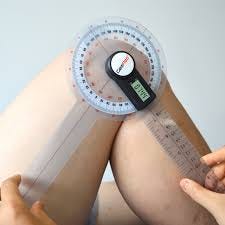
One more for the physical exams: when they test range of motion, ask before you bend — “Do you want me to stop when I feel pain?” Then STOP WHEN IT HURTS. This is not the ACFT. Nobody is handing out a streamer for touching your toes. Push through the pain like a hero and the form reads “full range of motion,” and you just donated your rating to your own pride. And make sure they use the goniometer — the protractor-looking tool. You sign paperwork saying they used it. If they eyeball it instead, that is an inadequate exam, and you should be on the phone with the VA before you leave the parking lot.
 |
— WHAT NOT TO SAY (THE GREATEST HITS OF SUNK CLAIMS) —
“I’m fine.” Covered. The most expensive lie in America.
“I don’t know why I’m even here.” The examiner writes “uncooperative,” and your claim develops a sudden case of denial.
“My buddy told me to say…” Congratulations, every word out of your mouth is now filtered through “is this guy coached?” Your claim. Your story. Your words.
“I don’t remember” — on everything. If memory loss is genuinely a symptom, SAY it is a symptom and give what you can recall. A wall of “I don’t remember” reads as evasion, not TBI.
“I can still work just fine.” Can you? Or are you burning leave, taking breaks, dodging tasks, and collapsing the second you get home? Holding it together with duct tape and stubbornness is NOT “working fine,” and the VA rates occupational impairment. Tell them about the duct tape.
“I don’t take medication” — full stop. Explain WHY. “The pills turned me into a zombie, so my doctor and I manage it with therapy and I still struggle daily” is severity WITH context. “I don’t take anything” reads as “not that serious.”
Also: stay on target. If the exam is for your back, this is not the moment for the director’s cut of your tinnitus saga. Answer what is asked. The examiner is not your friend, not your battle buddy, not your therapist — they are filling out a form. Be polite, be honest, be COMPLETE on the condition being examined, and stop talking.
— BRING A BATTLE BUDDY (THIS IS AN ORDER) —
Here is the advice that I have never once seen in an official VA pamphlet, and it might be the most important thing in this whole article.
HAVE SOMEONE YOU TRUST HELP YOU FILL THIS OUT.
As a medic, I have sat at the kitchen table with my soldiers and my friends and walked them through their DBQs — and every single time, the spouse or the buddy in the room caught things the veteran could not see. Because you cannot see them. You have normalized your own dysfunction so gradually that it just feels like Tuesday.
You do not notice that you check the locks four times. Your wife does. You do not notice you stopped going to your kid’s games. Your kid does. You think you “sleep fine”; the person lying next to you while you fight a war in your sleep at 0300 has a different report. A spouse, a girlfriend, a trusted friend, a coworker — they see what you do not, and their written statements are lay evidence the VA must consider.
We did not survive downrange by working alone. Do not do this alone either.
— AFTER THE EXAM: THE PARKING LOT RULE —
Bad exam? Five-minute drive-by for five claimed conditions? No goniometer? Examiner never asked half the DBQ questions?
Do not stew on it for a week. Call the VA — 800-827-1000 — FROM THE PARKING LOT. Be factual, not emotional: “My exam started at this time and ended at this time. These conditions were not examined. The goniometer was not used.” Facts get new exams ordered. Feelings get sympathy and a denial. Then follow it in writing on a VA Form 21-4138. Move fast, because the rater might rate off that garbage exam before you blink.
And request your exam results afterward. Verify what was written about you. If it does not match reality, challenge it. This is your claim, your record, your life. Own every inch of it.
— ONE LAST THING, FROM ONE BROKEN OLD MEDIC TO YOU —
If you are a combat-wounded veteran who was medically retired before 20 years, getting the rating you earned is only half your battle — because right now the government takes a dollar of your EARNED retirement pay for every dollar of disability compensation you receive. The Major Richard Star Act (H.R. 2102) would end that theft for roughly 54,000 of us. Look up H.Res. 1247 and call your representative: (202) 225-3121. We earned both. We will collect both.
IF THIS ARTICLE MADE YOU THINK:
LIKE this article so the algorithm shows it to the veteran who needs it before their C&P exam, not after.
SHARE this — every share really helps get the word out. Somewhere right now there is a vet about to say “I’m fine” to an examiner. Use it.
COMMENT below with your take. What sank YOUR first claim — or what saved it? Was it the pain scale, the tough-guy reflex, a bad examiner? Tell me. Your story might be the thing that saves the next guy.
And if you want MORE of this — the data, the history, the science, the stories — JOIN Bski’s Classroom community or follow me on YouTube. Even better, subscribe to my account; it is about the cost of a cup of coffee per month. That is it. Your support keeps this classroom open, and I promise I will never run out of material.
But what do I know — I am only a medically retired combat medic who failed his own claim twice before figuring out that the VA does not rate your injuries, it rates your homework.
 Mike Borowski is a medically retired Army combat medic with 23 years of service, including a combat deployment to Iraq, and a high school Anatomy and Physics teacher at a high-need Career Technical district in Northeast Ohio — where he also wrote and published the textbooks for both courses. He runs “Bski’s Classroom,” a platform dedicated to cutting through political noise with data, history, and the kind of blunt honesty that comes from someone who has seen both war and the American classroom up close.
—
X (Twitter): x.com/BskiMike22802
Substack: substack.com/@bskimike22802
YouTube: www.youtube.com/@BskiMike22802
AFNN: https://afnn.us/author/mikeborowski/
If you enjoyed this article, then please REPOST or SHARE with others; encourage them to follow AFNN. If you’d like to become a citizen contributor for AFNN, contact us at managingeditor@afnn.us Help keep us ad-free by donating here.
Substack: American Free News Network Substack
Truth Social: @AFNN_USA
Facebook: https://m.facebook.com/afnnusa
Telegram: https://t.me/joinchat/2_-GAzcXmIRjODNh
Twitter: https://twitter.com/AfnnUsa
GETTR: https://gettr.com/user/AFNN_USA
CloutHub: @AFNN_USA