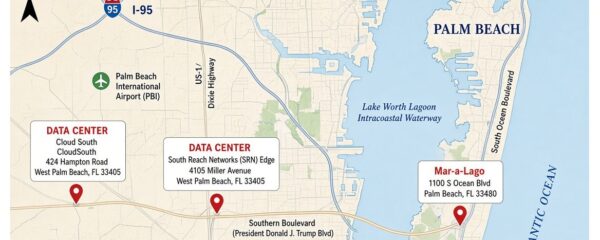
AOC Dared Him To Put One At Mar-a-Lago. There’s Already One Two Miles Away. Now Let’s Talk About Who Else Is All Talk: Bernie’s Three Houses, His $550K Jet Habit, And A Senate Candidate Whose Own Doctor Wife Won’t Take Medicaid.
President Trump posted this week that any community fighting AI data centers is choosing to stay backwards and poor. Rep. Alexandria Ocasio-Cortez had her comeback loaded and ready: put one at Mar-a-Lago, she said, and let’s see how backwards and poor he is in response to that.
Great line. It really is. It is also the kind of line that survives exactly as long as it takes someone to run a search.
Cloud South, 424 Hampton Road, West Palm Beach, Florida. A fully operational data center. Under two miles from Mar-a-Lago. It has been sitting there since it was built by Global Crossing back in 2003 and converted to public colocation more than a decade ago, humming along quietly years before anybody was tweeting about it. There’s a second one a few minutes further down the road too, South Reach Networks, same West Palm Beach zip code cluster. Both are real. Neither one required President Trump to lift a finger, sign an order, or personally invite the servers over for dinner.
Google it. Oops. They’re already there.
I have to hand it to AOC, it is a genuinely great punchline. It is just not a true one, and it took reporters about an hour to prove that, which is roughly fifty-nine minutes longer than it should have taken anybody holding a smartphone.
— PUT YOUR MONEY WHERE YOUR MOUTH IS —
Since I was already checking one Congresswoman’s homework, I figured I might as well check a few more people’s, because it turns out the pattern runs a lot deeper than one bad joke about geography.
Alexandria Ocasio-Cortez spent 2025 touring the country with Bernie Sanders warning crowds about an out-of-control billionaire class and its private jets, while the rest of us wait in line at the gate like suckers. Between stops on that tour, in Bakersfield, California, she was photographed boarding a chartered Bombardier Challenger that runs up to 15,000 dollars an hour. Not commercial. Not coach. A private jet, to warn you about people who fly private jets.
Bernie Sanders has spent half a century building a career on one idea: give according to your ability, take only according to your need. He owns three houses and put 550,000 dollars of donor money into private aviation last year alone. We will get to the full ledger further down, and it is worse than it sounds up here.
Then there’s Abdul El-Sayed, the DSA-backed Democratic nominee for U.S. Senate in Michigan, who has spent months calling doctors who decline Medicaid patients racist, accusing them of discriminating against Black communities. His wife, psychiatrist Dr. Sarah Jukaku, runs a private practice in Ann Arbor. She does not accept Medicaid. She does not accept Medicare. She does not accept insurance of any kind. If you are a senior who needs a psychiatrist and you’re on Medicare, you cannot see Dr. Jukaku unless you pay her rate in full, out of pocket, no reimbursement.
Four different claims. Four different Google searches. One identical pattern underneath all of it: the rules are for you, not for them.
Now let’s talk about an industry that never asked you to believe a word of its marketing, and delivered more for working families in eighteen months than any of the four people above have delivered in their entire careers.
— THE CHECK THAT STARTED THIS —
I want to tell you about a paycheck before I tell you about anything else, because the paycheck is the part that actually got me angry enough to write this.
A rural school district in Louisiana pays its teachers a year-end bonus out of an old local sales tax ordinance, the kind nobody outside the parish had ever heard of. In 2025, certified teachers there got about ten thousand dollars. In 2026, after a Meta data center broke ground nearby, that same bonus check hit fifty thousand nine hundred dollars. The superintendent said that for the first time in her thirty-year career, every single applicant her district interviewed walked in already certified. Nobody had to be talked into the job anymore.
I teach in a high-need district myself. Twenty-three years in the Army first, most of it as a combat medic, one deployment to Iraq where I helped stand up a school and a fire station for people who had neither, and then a second career teaching Anatomy and Physics to kids everybody else gave up on. I have never once seen a bonus check with a five in front of it attached to my job title. So when I watch people two states away hold up a jar of muddy runoff water and scream that the building responsible for that Louisiana teacher’s raise is some kind of villain, I have exactly one question. Do you have any idea what you are talking about, or did somebody hand you the script.
— THE WATER PANIC, GRADED ON A CURVE —
I teach science for a living, so the first thing my brain does with any panic headline is go hunting for the denominator. Strip the context out of a number and a rounding error can sound like a drought.
All data centers combined, AI and otherwise, are projected to use somewhere between 0.03 and 0.06 percent of national water consumption by 2028. The country burns through roughly 443 trillion liters a year. Golf courses use more than the entire industry. Your own front lawn uses more, in aggregate, than every server hall in America. Your local car wash uses roughly double what a comparable data center uses. Agriculture out-consumes data centers by something close to a thousand to one, which makes comparing a server farm to a cornfield about as fair as comparing a garden hose to Niagara Falls. I have stood at both, for what it’s worth.
Most new-build facilities are already walking away from the old evaporative-cooling model anyway. Closed-loop systems recirculate the same water instead of consuming it fresh. Direct-to-chip liquid cooling skips large-scale water use almost entirely. Several operators cool their halls with treated wastewater that was headed for discharge regardless. The industry did not wait around for the argument to finish before it started fixing the thing being argued about. Funny how that works when nobody’s holding a microphone in front of the fix.
— THE RECEIPTS, COAST TO COAST —
Here is my actual thesis, and I will defend every syllable of it, because a science teacher does not get to hand you an opinion without showing his work.
QUINCY, WASHINGTON belongs in a textbook. Before Microsoft opened there in 2006, the assessed value of the county’s top ten taxpayers was about 313 million dollars. By 2025 it was 6.14 billion. Those same taxpayers went from paying 4.2 million dollars a year in taxes to 54.3 million. The residential tax levy rate fell nearly seventy percent, and the town still built an eighty to one hundred twenty million dollar high school, a new hospital while nearby rural hospitals were closing their doors, and in 2026, a fifteen million dollar aquatic center complete with a lazy river. Poverty in Quincy dropped from 29.4 percent in 2012 to 6.2 percent in 2024. Microsoft also built a thirty-one million dollar water-reuse plant that recirculates its own cooling water instead of drawing fresh supply. Somebody bring me a counter-receipt. I will wait, and I promise you I have nowhere else to be.
LOUDOUN COUNTY, VIRGINIA is Data Center Alley, more than two hundred fifty facilities in one county. Computer-equipment taxes there have run between 733 million and 895 million dollars in recent years, with officials now discussing 1.3 billion next year. Strip the industry out and the average homeowner’s tax bill has been estimated to jump by nearly six thousand dollars a year just to hold services flat. The real property tax rate has fallen every year for a decade, and the county killed its vehicle registration fee entirely. That is a bill on your kitchen table going DOWN because somebody else agreed to pay the freight.
ELLENDALE, NORTH DAKOTA sits at about a thousand people, and the school superintendent’s own words for the town before Applied Digital showed up were blunt: a dying little town. Pre-campus, Ellendale collected roughly four hundred thousand dollars a year in sales tax. In the first seven months of 2026 alone, it collected 3.5 million. North Dakota law requires utilities to share a cut of that new industrial revenue with ratepayers, and one published estimate puts the household electric bill reduction near 250 dollars. The campus runs closed-loop cooling. Somewhere a village really was missing its idiot, and it turns out he moved two states over to protest a data center while his own hometown quietly renovated its senior center and reopened its historic opera house.
PRINEVILLE AND CROOK COUNTY, OREGON watched their timber economy collapse to twenty percent unemployment before Meta arrived in 2010, with Apple following across the highway. Average wages there rose from about 34,700 dollars in 2008 to more than 70,000 by 2022, second-highest average wage in the entire state. Yes, Oregon’s enterprise zones abate a large chunk of property tax, and that is the one honest criticism in this whole paragraph. But the electric franchise fee the city actually collects rose from roughly 430,000 dollars in 2011 to nearly 11 million, almost three times the city’s entire property tax take. Meta and Apple also funded a city aquifer storage system, and local officials say the three data centers use about ten percent of Prineville’s water, less than the old lumber mills sprayed on log decks every single day.
LOS LUNAS, NEW MEXICO was a sleepy bedroom community south of Albuquerque before Meta broke ground in 2016. Village gross-receipts collections rose from about eleven million dollars a year to forty million, a 350 percent increase. Is the water math perfectly settled? No, and I am not going to pretend it is. The campus draws real groundwater, sixty-seven to seventy-five million gallons a year, offset by eight Meta-funded Rio Grande watershed restoration projects the company says return more than 172 million gallons annually. Whether every acre-foot nets out is a fair hydrologist’s question for another day. What is not up for debate is that the village’s own mayor has since written letters to OTHER cities, including El Paso, urging them to go land a Meta campus of their own. That is an elected official putting his name on it, not a press release ghostwritten by a PR firm.
THE IOWA CLUSTER earns its own paragraph because four towns ran the same play back to back. Council Bluffs landed Google campuses worth somewhere between five and 6.5 billion dollars combined, plus free citywide Wi-Fi and nearly 300,000 dollars into local schools for STEM credentialing. Altoona took an eleven million dollar water-infrastructure payment from Meta on top of the new tax base. West Des Moines negotiated a Microsoft package worth more than two billion dollars in expected tax revenue, fully matched to renewable energy. And little De Soto modeled a franchise fee on every kilowatt-hour sold inside city limits, now projecting roughly ten million dollars a year from that fee ALONE, more than the entire current city budget.
OHIO’S SCHOOL DISTRICTS around New Albany and Licking County found a version of this that protects education funding directly, because the land under a data center cannot be abated even when the building on it is. In 2024, data-center land alone sent 2.67 million dollars to Licking Heights schools, 2.51 million to Johnstown-Monroe, and 1.93 million to New Albany-Plain. Microsoft’s own Heath and Hebron sites in the same county DECLINED the real-estate tax abatement outright. Amazon’s Marysville agreement sends roughly eighty percent of a one million dollar annual payment straight to schools. Forget the corporate welfare talking point for a second. This is a line item. A specific school board gets to spend it on a specific classroom, this year, not someday, not after the next levy fails for the third time.
THE DALLES, OREGON is the one honest complication in this entire argument, and I am putting it in on purpose, because I do not build sloppy cases. Google is now Wasco County’s largest taxpayer by a wide margin, and it used on the order of 550 million gallons of city water in 2025, a genuinely large share of municipal consumption. That part is real. The other half of the sentence is that Google committed about 28.5 million dollars to water and sewer upgrades, drilled new wells, transferred water rights off an old aluminum smelter site, and built an aquifer storage system, now owned by the city, that adds more than one hundred million gallons of annual storage as a rainy-day fund for the dry season. Towns that copy only half of that story will hate this industry. Towns that write the whole contract will not.
CHEYENNE, WYOMING has had Microsoft since the late 2010s, expanding by the thousands of acres. In 2025 alone that meant about 320 direct jobs, more than a thousand supported contractor roles, and eleven million dollars in taxes, making Microsoft the number one taxpayer in the city. A separate 1.2 billion dollar campus is going up under a structure where the project pays for one hundred percent of its own interconnection cost, meaning the campus buys its own power line instead of putting that bill on your neighbor’s meter.
THE NORTH CAROLINA FOOTHILLS around Lenoir and Maiden lost their furniture and textile mills years ago, but they kept the cheap industrial power and a workforce that already knew shift work. Google’s North Carolina footprint is now described as more than four billion dollars, with another billion planned specifically for Lenoir, and Google paid about 5.2 million dollars in property tax in a recent year, close to ten percent of the entire county’s collection even after incentives. Apple’s Maiden campus created about 400 jobs, and almost none of the hires required anyone to move to town, meaning the payroll landed on people already living there.
MESA, ARIZONA proves this works even in a literal desert. Apple, Meta, AWS, and a cluster of others sit inside the Elliot Road Technology Corridor, and industrial potable water use across the whole corridor, campuses included, was about six percent of city potable water in 2024. Golf courses, power plants, and mining remain the bigger industrial water users in the Phoenix metro, which should tell you exactly which industries actually deserve a protest sign, and it is not the one nobody brings to a fairway.
And the list keeps going if you want more. Louisa County, Virginia used data-center revenue to cut taxes outright. Mecklenburg County, Virginia financed a school construction program above ninety million dollars off Microsoft’s presence. DeKalb, Illinois is banking 250 to 300 thousand dollars a year in utility taxes plus more than a thousand union construction jobs. Montgomery County, Missouri took more than seven million dollars in direct community contributions from Amazon plus a farm-water partnership expected to save local agriculture about one hundred million gallons a year. Lancaster, Pennsylvania published a contract in which a twenty-year tax exemption is directly contingent on at least thirty-one full-time jobs above twenty-six dollars an hour.
A 2026 Brookings analysis of ninety-three counties that landed their first large data center between 2008 and 2024, benchmarked against three thousand counties that did not, found a four to five percent rise in private employment and a three to four percent rise in wages within five or six years. Counties that landed four or more facilities saw employment rise by about twenty-three percent. That is the composite picture, and it is a great deal more than the crowd waving a jar of construction runoff has ever produced in the way of an actual receipt.
— WHO IS ACTUALLY WRITING YOUR PROTEST SIGN —
This is where “useful idiot” stops being a punchline and starts being a documented finding, so buckle up, because I did not invent a single piece of this.
X’s own safety team identified a bot farm of roughly two hundred thousand accounts, with a cluster of about two hundred flagged specifically for content built to manipulate the American debate over AI and energy policy. Separately, OpenAI disrupted a Chinese-linked influence operation, publicly named Data Center Bandwagon, that used chatbot tools to mass-produce fake American personas arguing that data centers would spike your electric bill and wreck your town. OpenAI traced it back to a private Chinese technology company doing contract work for provincial government clients. Not a lone keyboard warrior with strong feelings. A vendor. With a government purchase order.
This is not even the first time this playbook has run. Back in 2022, the security firm Mandiant documented Operation Dragon Bridge, a Chinese state-linked campaign that posed as ordinary Texans opposing a Pentagon-supported rare earth processing facility. Google pulled more than one hundred seventy-five thousand accounts tied to that same network off YouTube and Blogger. The House Energy and Commerce Committee got concerned enough this year to formally ask the FBI and the White House to brief lawmakers on propaganda campaigns from China, Russia, and Iran specifically aimed at slowing American AI development.
Jim Quinn’s Sixth Law of Liberalism nails this one perfectly: facts are the enemy of liberalism. The second you learn a data center uses less water than the country club three miles down the road, the protest sign stops working. So the denominator gets left off. Every single sign. Not by accident, and not by a coincidence that a foreign adversary with a direct strategic interest in slowing American AI infrastructure keeps getting caught manufacturing the exact outrage some of your neighbors are spreading for free on a Tuesday night between dinner and bed. You are not the resistance. You are an unpaid intern for a regime that would not let you post one word of this Article inside its own borders.
I keep hearing that this generation cannot be manipulated because they grew up online and can spot a fake from a mile away. Then I watch an entire city council meeting get hijacked by a talking point that traces straight back to a bot farm on the other side of the Pacific, and I remember that being terminally online is not the same thing as being informed. Blatherskite is the old word for someone who talks foolishly at great length. This month it has a very specific zip code.
What’s next, banning your own phone because the call has to route through a server somewhere? Banning your bank’s app, your weather forecast, the video call with your grandkids, all of which run on the exact infrastructure you’re protesting? Wait. Some of you already tried banning the cell towers that make the phone work in the first place. We’ve been here before. We just changed the hashtag.
— THE ONE THING I WILL ACTUALLY GRANT YOU —
I did not sit down to write four thousand words of pure cheerleading, so here is the honest part, because overclaiming is how you lose an argument you were winning.
Power is a real issue. Data centers are on pace to consume roughly seventeen percent of American electricity by 2028. That number did not come out of a bot farm. It is a legitimate infrastructure question, and pretending otherwise would make me exactly the kind of dishonest debater I spend my classroom correcting.
The private sector is already handling the real part of this, without one new federal program written by a Congressman who could not define a kilowatt-hour under oath if his re-election depended on it. Microsoft signed an agreement to restart Three Mile Island. Google contracted for new nuclear generation. Amazon is doing the same. A data center with its own reactor is not draining your neighborhood. It is closer to a landlord who also happens to run the power company and occasionally cuts you a rebate.
Jim Quinn’s First Law says liberalism always produces the opposite of its stated intent, and nothing proves it faster than watching what happens if these protests actually win. Block the permit and the compute does not vanish into thin air. It relocates to a country with no water standards, no grid requirements, and zero interest in your protest sign. You save nothing. You hand the jobs, the tax base, and the strategic advantage to Beijing, gift wrapped, with a thank-you card written in the language of environmentalism.
— THIS IS NOT AUTOMATIC —
None of this means every proposal deserves a yes, and any official who tells a town otherwise is a mountebank who should not have the job. A thirty-year, one-hundred-percent abatement with no payment-in-lieu-of-taxes clause is a bad deal for a school board. An unmanaged evaporative campus sitting on a stressed aquifer with no offset is a bad deal for a farm town. Quincy and Loudoun and the rest did not get lucky. They negotiated. Closed-loop or recycled water in stressed basins. The tenant capitalizes the treatment plant or the aquifer-storage system, then deeds it to the city. The campus pays for its own interconnection instead of parking that cost on your neighbor’s bill. A trades academy so the technician jobs go to local kids instead of imported labor. A town that wants the Quincy outcome has to write a Quincy contract. That’s due diligence. It’s the opposite of the blind handshake some of you keep accusing this industry of offering.
— WHAT AN ACTUAL SOLUTION LOOKS LIKE —
None of this means the industry gets a blank check either, so let me be specific instead of waving the word framework around like a gascon with a talking point of his own. The correct policy answer is smart, targeted permitting, not a moratorium wearing an environmentalist costume. Require a real power plan before groundbreaking. Require waste-heat reuse planning for the largest facilities, the way parts of Europe already do it, so server heat warms a greenhouse instead of bleeding into the sky for free. Streamline nuclear permitting so a company willing to build its own clean power isn’t buried under a decade of litigation. Let closed-loop and recycled-water systems satisfy the permitting requirement instead of defaulting straight to municipal supply nobody asked them to touch. That’s a framework built on markets and measurable requirements, not a jar of construction runoff and a sign that says no. It solves the actual problem instead of shipping it to a country that won’t lose a minute of sleep over your water table, your electric bill, or your teachers’ paychecks.
— NOW LET’S TALK ABOUT WHO IS ACTUALLY SHARING —
Here is where this stops being about server farms and starts being about the people telling you to be angry at them.
Bernie Sanders has spent close to fifty years translating one sentence into an American political career. Karl Marx wrote it in 1875, in the Critique of the Gotha Programme: from each according to his ability, to each according to his needs. Bernie did not invent the phrase and I am not going to pretend he stood at a podium and recited it word for word, because I check my sources before I publish, unlike some people’s protest signs. But strip the branding off “democratic socialism” and that sentence is the engine underneath it. Sanders spent decades telling YOU to give according to your ability and expect only according to your need. Let’s check whether the man selling that sentence lives inside it.
He owns three houses. A colonial four-bedroom in Burlington, Vermont, purchased in 2009. A one-bedroom row house a few blocks from the Capitol in Washington, D.C. And a lakefront cabin on five hundred feet of Champlain Islands beachfront in North Hero, Vermont, purchased for 575,000 dollars in cash in 2016, the same year he was touring the country asking college kids to feel the Bern about income inequality. Three houses. Reported net worth around three million dollars, most of it built on book royalties written about how unfair it is that other people have money.
I am not asking Bernie Sanders to give away his houses. I would never ask that, because it is his property, he earned it legally, and property rights matter whether the owner is a farmer in Ohio or a socialist in Vermont. That is precisely my point. If property rights matter enough that nobody expects Bernie to hand his lake house to a family sleeping in a Burlington shelter this winter, then property rights matter enough that the rest of us get to keep what we earn too. You cannot argue the principle only applies going one direction, downhill, toward you.
Then there is the jet.
In 2025, Sanders toured the country with Alexandria Ocasio-Cortez on something called the Fighting Oligarchy Tour, warning crowds about the dangers of concentrated wealth and unaccountable elites. Federal Election Commission filings show his campaign spent over 221,000 dollars chartering private jets in the first quarter of 2025 alone, and more than 550,000 dollars for the full year, mostly on a luxury Bombardier Challenger that runs up to 15,000 dollars an hour, operated by a company that advertises “superior cabin comfort.” AOC was photographed boarding that same jet with him in Bakersfield, California, between stops on the very tour built to warn you about people who fly private while everyone else waits in line.
Asked about it on Fox News by Bret Baier, Sanders did not apologize. He said running a campaign with three, four, five rallies a week is the only way to reach thirty thousand people, and that he was not about to sit in line at United while thirty thousand people waited on him. No apologies, he said. That is what campaign travel is about. We have done it before. We will do it again.
Bravo, Senator. A masterclass in shared sacrifice. You shared exactly as much of it as it cost you, which was nothing, while the rest of us are told our SUVs are why the planet is dying.
At least the man leading the crusade against the billionaire class would never personally behave like a landlord with a diversified real estate portfolio and a taste for private aviation… …oh.
What’s next, is the Fighting Oligarchy Tour going to start flying Spirit Airlines and paying the forty dollar personal item fee to prove they mean it? Wait, I already checked. They chartered the Bombardier instead. Never mind.
Couldn’t pour water out of a boot with the instructions printed on the heel, and that goes double for anybody still defending this with a straight face.
— THE DOCTOR WHO WON’T TAKE YOUR INSURANCE —
We opened with him. He deserves more than a drive-by.
Abdul El-Sayed wants to be a United States Senator from Michigan on the strength of one promise: Medicare for All, cradle to grave, no exceptions. He has specifically gone after doctors who decline Medicaid patients, calling it a form of racial discrimination against the Black and brown communities who rely on the program most. Strong words from a man branding himself as the guy who finally fixes a rigged system.
His wife, Dr. Sarah Jukaku, is a psychiatrist. She left a position at the University of Michigan health system, which does accept Medicare, to open her own private practice, Mind Work Psychiatry, in Ann Arbor in 2024. By March of 2025 she had formally opted out of Medicare entirely. Her practice does not accept Medicaid. It does not accept Medicare. It does not accept insurance of any kind. Every patient pays in full, out of pocket, no reimbursement, no exceptions. By El-Sayed’s own public standard, that makes his own household one of the discriminatory offices he has spent this entire campaign condemning.
There’s a second wrinkle, and it’s not a small one. El-Sayed has appeared in campaign ads wearing a white coat, presenting himself with the title “physician,” despite holding no medical license in either Michigan or New York, and never having completed a residency or passed his board exams. His released 2025 tax returns showed 686,069 dollars in total income, clearing Michigan’s top one percent household threshold by nearly 75,000 dollars, a good chunk of it credited to his wife’s cash-only practice. The man running as the enemy of the oligarchy is, by the IRS’s own math, comfortably inside it.
Jim Quinn’s Second Law, and it keeps proving itself no matter who’s holding the microphone: if you want to know what liberals are up to, pay attention to what they accuse conservatives of doing. El-Sayed accused an entire profession of racism for doing precisely what his own household does for a living.
— QUINN’S LAWS, BACK TO BACK —
Jim Quinn’s Second Law: if you want to know what liberals are up to, pay attention to what they accuse conservatives of doing. Sanders built a national brand warning you about an unaccountable oligarchy, people who do not have to follow the same rules as everyone else. Then he went and spent your donation money proving he doesn’t have to follow the same rules as everyone else either. Funny how that works. It’s not a coincidence. It’s the tell, and it’s been sitting in plain sight in a public FEC filing this whole time.
Jim Quinn’s Twenty-Fifth Law: liberals are great at spending other people’s money. Every dollar of that 550,000 dollars came from small-dollar donors who believed they were funding a movement against oligarchy, not a frequent-flyer program for one seventy-nine-year-old millionaire and his tour partner. Somewhere a retired schoolteacher on a fixed income sent twenty-seven dollars to that campaign because she believed the pitch. She could have flown Spirit round trip for less than what it cost to keep the Bombardier’s engines warm between stops.
Snollygoster is the old word for a shrewd, unprincipled politician who dresses up self-interest as principle. It is a hundred and fifty years old and it still fits like it was written yesterday.
— FINAL GRADE —
I have graded a lot of papers in my life, and I know the difference between a student who didn’t understand the material and a student who understood it fine and copied the answer key anyway. Both get the same mark on the page. Intent doesn’t change the grade. It only changes what I write in the comments.
So pick your lane again, because we’re right back to the two I opened with. Read the OpenAI report, the Mandiant findings, the Congressional letter, and keep reciting the water-and-electric-bill script anyway, and you’ve graduated from useful idiot to full sympathizer. Go explain that distinction to a Richland Parish teacher holding a $50,900 check. Or just admit you never read any of it, that you repeated what showed up in your feed because it made you angry at exactly the right moment. That’s not an insult on my part. That’s a job description, and somebody overseas really ought to be paying you for the work.
— BOTTOM LINE —
I lead from the front because twenty-three years in this country’s uniform did not leave me any other option. I do not ask a soldier, a student, or a stranger on the internet to accept a burden I have not accepted myself. That is the whole standard. It is not complicated.
A data center in rural Louisiana just handed a teacher the first real raise of her career without asking Congress for permission or a single dollar out of your pocket. Fifteen towns from Washington State to North Carolina took that same industry and turned it into schools, hospitals, aquatic centers, lower tax bills, and jobs that do not require a four-year degree and a mountain of debt to start. Meanwhile, AOC dared Trump to put a data center in his own backyard without checking whether one was already there. Bernie, who has spent half a century telling you to share, owns three houses he is not sharing and just spent 550,000 dollars of other people’s money proving the rules he writes for you were never meant to apply to him. His tour partner flew on the same jet she uses to warn you about people who fly private. And a Senate candidate built a campaign on calling other doctors racist for declining Medicaid, from inside a house where his own wife’s practice does exactly that.
You get to pick which one of those stories is actually about shared sacrifice.
I already have. It wasn’t close.
But what do I know, I am only a teacher who drives an eleven-year-old truck to a job that apparently pays less than what some people charge to lecture you about capitalism.
IF THIS ARTICLE MADE YOU THINK: LIKE this article so the algorithm shows it to people who need to read it. SHARE this — every share really helps get the word out. Use it. COMMENT below with your take. Bernie, AOC, or the doctor who won’t take Medicaid: which one of these gets asked about it first on their next town hall? Tell me.
And if you want MORE of this — the data, the history, the science, the stories — JOIN Bski’s Classroom community or follow me on YouTube. Even better, subscribe to my account; it is about the cost of a cup of coffee per month. That is it. Your support keeps this classroom open, and I promise I will never run out of material as long as the left keeps trying to out-dumb itself.
#MAGA #Veterans #Trump @JoJoFromJerz @atrupar @TheYoungTurks @TPUSA
 Mike Borowski is a medically retired Army combat medic with 23 years of service, including a combat deployment to Iraq, and a high school Anatomy and Physics teacher at a high-need Career Technical district in Northeast Ohio — where he also wrote and published the textbooks for both courses. He runs “Bski’s Classroom,” a platform dedicated to cutting through political noise with data, history, and the kind of blunt honesty that comes from someone who has seen both war and the American classroom up close.
—
X (Twitter): x.com/BskiMike22802
Substack: substack.com/@bskimike22802
YouTube: www.youtube.com/@BskiMike22802
AFNN: https://afnn.us/author/mikeborowski/
If you enjoyed this article, then please REPOST or SHARE with others; encourage them to follow AFNN. If you’d like to become a citizen contributor for AFNN, contact us at managingeditor@afnn.us Help keep us ad-free by donating here.
Substack: American Free News Network Substack
Truth Social: @AFNN_USA
Facebook: https://m.facebook.com/afnnusa
Telegram: https://t.me/joinchat/2_-GAzcXmIRjODNh
Twitter: https://twitter.com/AfnnUsa
GETTR: https://gettr.com/user/AFNN_USA
CloutHub: @AFNN_USA