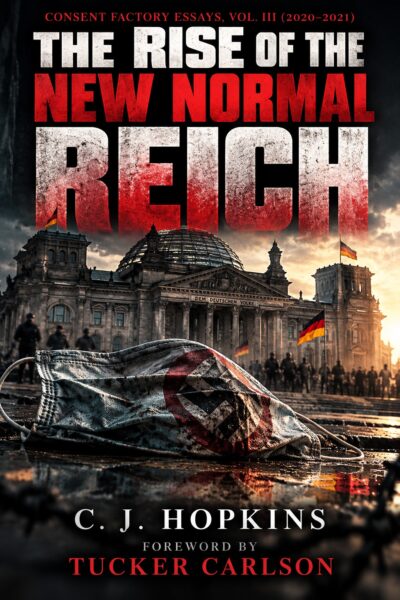
There are books written about history, and then there are books that somehow manage to become part of the history they were warning you about.
C. J. Hopkins’s The Rise of the New Normal Reich is one of those books.
Hopkins is an American playwright, novelist, and political satirist who has lived in Berlin for decades. That matters, because he wasn’t sitting in rural America watching COVID unfold on cable television. He was sitting in Germany—a country that has spent nearly eighty years studying exactly how an educated, sophisticated, democratic society can surrender individual liberty while convincing itself that everything it is doing is necessary.
Then 2020 arrived.
Hopkins watched lockdowns imposed, constitutional freedoms restricted, demonstrations controlled, masks mandated, and eventually vaccination status become a dividing line for participation in ordinary society.
And he started writing.
The Rise of the New Normal Reich is essentially his field notebook from the insanity. The essays were written during 2020 and 2021, while events were unfolding, rather than reconstructed years later with the wonderful clarity of hindsight.
That makes the book fascinating even if you disagree with Hopkins.
He isn’t claiming COVID Germany literally became Nazi Germany. That comparison would be historically absurd.
His argument is subtler and considerably more uncomfortable.
Authoritarianism doesn’t necessarily arrive wearing jackboots.
Sometimes it arrives carrying a clipboard.
One of the defining moments occurred in Berlin on August 29, 2020. Tens of thousands of people gathered to protest Germany’s COVID restrictions. The crowd included ordinary citizens, libertarians, anti-vaccine activists, conspiracy theorists, Reichsbürger adherents, nationalists, and genuine far-right extremists.
Eventually several hundred protesters broke through barriers and rushed the steps of the Reichstag.
Police never stopped them before they entered the parliament building.
Those images became enormously important.
Suddenly the story wasn’t merely tens of thousands of Germans questioning emergency government powers.
The story was extremists at the Reichstag.
Hopkins saw something important in that transformation.
If every critic of government policy can be associated with the craziest person standing somewhere in the same crowd, you never have to answer the critic’s argument.
Just photograph the crazy guy.
Problem solved.
Welcome to modern information warfare.
Hopkins argues throughout the book that fear is one of the most powerful political weapons ever invented. Create—or encounter—a sufficiently frightening emergency, convince the population that extraordinary measures are necessary, and people will voluntarily surrender freedoms they would have defended ferociously six months earlier.
And here’s the really uncomfortable part:
Nobody necessarily needs to believe they’re the bad guy.
Doctors believe they’re protecting patients.
Police believe they’re protecting society.
Politicians believe they’re protecting citizens.
Journalists believe they’re protecting people from misinformation.
Technology companies believe they’re protecting users from dangerous content.
Everybody is protecting everybody.
Pretty soon nobody is free.
That is Hopkins’s real warning.
The historical comparison he makes isn’t primarily Auschwitz. It is the machinery that comes before the catastrophe—the gradual normalization of emergency authority, propaganda, conformity, censorship, social pressure, and the classification of dissent as dangerous.
History rarely sends you a calendar invitation announcing tyranny next Tuesday at 0900.
It happens incrementally.
Then Hopkins’s book took an almost unbelievable turn.
He used provocative cover artwork showing a swastika behind a medical mask, deliberately invoking the imagery of William Shirer’s classic The Rise and Fall of the Third Reich. Hopkins later used that image in social-media posts criticizing Germany’s mask policies.
German authorities prosecuted him for displaying prohibited Nazi symbolism.
Think about that for a second.
Hopkins wrote a book arguing that Germany was becoming intolerant of political dissent.
Germany prosecuted him for imagery he used while making that argument.
A Berlin court initially acquitted him.
Prosecutors appealed.
The acquittal was overturned.
German authorities subsequently searched his home and confiscated his computer during another investigation involving the book.
In June 2026, Hopkins announced that Germany’s highest constitutional court had declined to hear his appeal and that he was withdrawing his original edition from distribution because continuing to sell it exposed him to further prosecution.
You couldn’t write better satire.
Apparently Germany decided Hopkins’s book needed an epilogue, so the government volunteered to write one.
Now Tucker Carlson Books and Skyhorse Publishing are releasing a new American edition, complete with a foreword by Tucker Carlson.
That doesn’t prove everything Hopkins wrote.
It doesn’t mean every COVID policy was malicious.
It doesn’t mean every vaccine criticism was correct.
And it certainly doesn’t mean Germany in 2020 was Nazi Germany.
Those distinctions matter.
But they don’t erase Hopkins’s central question:
How would you recognize authoritarianism while it was actually developing?
That’s considerably harder than recognizing it eighty years later in a history book.
Would people announce that they were abandoning freedom?
Probably not.
They would announce an emergency.
They would tell you the measures were temporary.
Experts would explain why they were necessary.
Media organizations would identify dangerous misinformation.
Corporations would enforce government recommendations.
Neighbors would begin policing neighbors.
And anyone questioning the arrangement would increasingly find himself described not merely as wrong, but as dangerous.
That is what makes The Rise of the New Normal Reich worth reading.
You don’t have to agree with C. J. Hopkins.
In fact, don’t.
Challenge him.
Fact-check him.
Argue with him.
That’s rather the point.
Because Hopkins’s book ultimately isn’t about masks.
It isn’t really about vaccines.
It isn’t even about COVID.
It’s about obedience.
And the most frightening lesson of history isn’t that evil people sometimes acquire power.
We already know that.
It’s that perfectly ordinary people can become participants in extraordinary systems while remaining absolutely convinced they are doing the right thing.
Tyranny rarely introduces itself by saying:
“Hello. We’re the tyrants.”
Usually it says:
“This is for your safety.”
And history suggests every generation eventually gets tested on whether it knows the difference.
If you enjoyed this article, then please REPOST or SHARE with others; encourage them to follow AFNN. If you’d like to become a citizen contributor for AFNN, contact us at managingeditor@afnn.us Help keep us ad-free by donating here.
Substack: American Free News Network Substack
Truth Social: @AFNN_USA
Facebook: https://m.facebook.
Telegram: https://t.me/
Twitter: https://twitter.com/AfnnUsa
GETTR: https://gettr.com/user/AFNN_
CloutHub: @AFNN_USA