A corporate capture risk assessment with Chinese characteristics
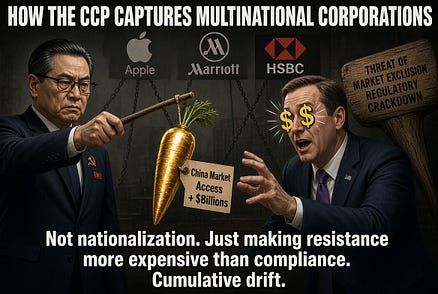
Beijing does not need to nationalize a foreign firm to make it useful. It only has to condition continued access to its market, manufacturing base, or capital on cooperation, then let ordinary corporate incentives finish the job.
A multinational board need not answer to the Party to act as if it does. It need only conclude, repeatedly and rationally, that principled resistance costs more than accommodation. That calculation, made many small times over a decade or more, is what “capture” usually looks like. It is not one dramatic order, but cumulative drift in which self-censorship, data localization, silence on human rights, and favoritism toward state-linked partners become the path of least resistance.
Three multinationals from consumer technology, hospitality, and banking/finance are examined below against economic, governance, technological, and political indicators of this accommodation. The focus is on clusters of documented behavior hard to explain by ordinary commercial logic alone, as well as on the carrots and sticks used by Beijing to motivate the desired behavior.
These companies responded exactly as the communists intended.
APPLE INC. (CONSUMER TECHNOLOGY SECTOR)
How it happened: Apple’s exposure runs through two channels: manufacturing concentration (roughly 80% of iPhones assembled in China) and a 2017 Chinese cybersecurity law that forced a choice between data localization and market exit. Apple chose localization.
The carrot: Access to the world’s largest smartphone market and to unmatched manufacturing scale, skilled labor, and infrastructure. Greater China alone delivered roughly $66.9 billion of Apple’s FY2024 revenue. The Information’s December 2021 report of a 2016 memorandum in which Apple CEO Tim Cook committed roughly $275 billion over five years in investment, technology cooperation, and supplier deals is the clearest documented instance of the exchange being made explicit, i.e., investment and cooperation offered in return for regulatory relief.
Evidence:
- Since February-July 2018, Apple has stored Chinese iCloud accounts and, critically, the encryption keys themselves on servers operated first by state-owned Guizhou-Cloud Big Data, then China Telecom’s state-owned Tianyi cloud unit, placing keys that previously required a U.S. legal process under Chinese courts’ jurisdiction.
- A recurring pattern of App Store removals track almost exactly with CCP political sensitivities: the New York Times app (in January 2017 at “government request”), dozens of VPN apps (in July 2017, citing the new cybersecurity law), the Hong Kong protest-mapping app HKmap.live and the Quartz news app (in October 2019, after People’s Daily accused Apple of enabling “rioters”), the Taiwan flag emoji disappearing from keyboards for Hong Kong/Macau users (in October 2019), and WhatsApp, Threads, and Signal (in April 2024, due to a national security order).
- iOS 16.1.1 (November 2022) quietly limited “Everyone” AirDrop range to 10 minutes for China-region devices weeks before it was used to spread anti-Xi/anti-zero-COVID flyers during the “Blank Paper” protests. The restriction only went global two months later.
- Apple was among companies reported lobby to weaken the Uyghur Forced Labor Prevention Act’s import-ban provisions; the bill passed in 2021 largely intact.
- Independent supply chain research has linked multiple Apple suppliers to Uyghur forced-labor transfer programs.
Strategic alignment: Each accommodation – key relocation, app removals, the AirDrop timing – independently tracks a specific CCP political or security priority (control of information during Hon Kong and Xinjiang-adjacent unrest, domestic surveillance capability) rather than generic commercial caution.
MARRIOTT INTERNATIONAL (HOSPITALITY SECTOR)
How it happened: In January 2018, a routine customer-satisfaction survey administered by a third-party vendor listed Tibet, Taiwan, Hong Kong, and Macau as separate “countries” in a dropdown menu. This triggered a full-scale regulatory and political response from Beijing.
The carrot: Red China was, and remains, one of Marriott’s fastest-growing markets for new hotel openings. The company had recently deepened its China ambitions with a 2017 joint venture with Alibaba’s travel platform to reach Chinese travelers directly. The episode’s real lesson for Marriott was not the one-week shutdown of its Chinese website; it was how quickly full market access was restored once Marriott delivered the apology and rectification plan Beijing wanted, demonstrating that continued growth in China was conditioned on visible compliance, not revoked by it.
Evidence:
- 9-10 January 2018: the survey draws Chinse government attention. On the 11th, Shanghai’s Cyberspace Administration shuts down Marriott’s Chinese website and app for a full week.
- Marriott’s Weibo apology: “Marriott International respects China’s sovereignty and territorial integrity… We apologize for any actions that led to misunderstandings.”
- 17-19 January 2018: Marriott adopts an “eight-point rectification plan,” including employee retraining, a content-approval overhaul, a dedicated Chinese-customer complaints channel, and an explicit commitment to strengthen its “communication mechanism with Chinese government departments.”
- A U.S.-based Marriott social-media employee was fired after “liking” a tweet from a Tibetan-independence group referencing the incident, which was cited by Senator Marco Rubio (R-FL) as “the long arm of China. They can get an ‘American’ company to fire an American worker in America.”
Strategic alignment: The rectification plan’s explicit commitment to closer coordination with Chinese government departments, not merely fixing the software “error,” is the notable element. It reads as an offer of ongoing political compliance infrastructure, not a one-time fix, in exchange for the growth market staying open.
HSBC HOLDINGS PLC (BANKING AND FINANCE SECTOR)
How it happened: HSBC’s 19th century roots as a Hong Kong bank left it with roughly two-thirds of group profit derived from Asia, overwhelmingly in Hong Kong and mainland China. This is a dependence that hardened into a documented pattern of political accommodation once Hong Kong’s political status became contested after 2019.
The carrot: Continued dominance of one of the world’s most profitable banking franchises, actively protected and extended by Beijing through preferential access to Great Bay Area wealth-management and cross-border investment schemes as Hong Kong’s economy reintegrates with the mainland. One of HSBC’s largest shareholders, state-linked Ping An Insurance, pushed in 2022 for a breakup that would have separated HSBC’s lucrative Asian operations from its Western business entirely, underscoring how much of HSBC’s enterprise value now depends on staying inside Beijing’s good graces.
Evidence:
- On 3 June 2020, HSBC Asia-Pacific CEO Peter Wong publicly endorsed Beijing’s imposition of the Hong Kong National Security Law, calling it a move “in the correct direction,” and said: “Sanctions not only hurts Hong Kong, it hurts the US, too.” U.S. Secretary of State Mike Pompeo criticized HSBC for its “corporate kowtow” to Beijing.
- HSBC froze the accounts of Hong Kong pro-democracy figure, including former legislator Ted Hui (December 2020), and action Hui called “succumbing to political pressure.”
- In 2023-2024, HSBC (with Manulife) blocked roughly $2.7 billion in Mandatory Provident Fund pension access for approximately 144,500 Hong Kongers who had emigrated under the UK’s British National (Overseas) visa scheme, prompting a UK All-Party Parliamentary Group inquiry that concluded HSBC was “complicit” in Hong Kong rights abuses.
- HSBC and Standard Chartered were reported lobbying the UK government to avoid classifying China under the strictest tier of new national-security/foreign-influence legislation, arguing it would “impede business.”
Strategic alignment: The NSL endorsement, activist account freezes, and pension denials each independently track specific Beijing priorities around suppressing Hong Kong’s opposition movement and its diaspora, timed closely to the period when HSBC’s Asian profit engine, as well as its relationship with a state-linked top shareholder, was most exposed.
CONCLUDING THOUGHTS
Communist China has deliberately built a system in which market access, licenses, and capital are rewards for cooperation and are placed at risk the moment a company stops. Carrots sit beside sticks because the reward is usually the more effective leverage. Threats create a news cycle; a renewed joint-venture license or a market built over a decade of infrastructure creates a standing incentive to keep complying.
The Atlantic Council’s research on Chinese economic statecraft concludes that Beijing treats “economic inducements” (e.g., market access, investment, contracts, licenses, favorable regulatory treatment) as a “powerful and affirmative means of cultivating influence,” operating through explicit conditionality that links a benefit to a desired outcome, not merely as background commercial opportunity a firm happens to pursue.
In other words, money is fungible to the Party provided the strategic objective, e.g., political silence, data access, technology transfer, narrative alignment, etc., is being advanced. A company doesn’t need to be threatened to be captured if it has already been paid, licensed, or granted growth room on the explicit or implicit condition of continued cooperation.
The three captured multinational corporations examined here are just the tip of the iceberg.
The end.
StuinSD is a reader-supported publication. To receive new posts and support his work, consider becoming a free or paid subscriber.
This article originally appeared in Stu Cvrk’s Substack. Reprinted here with permission
If you enjoyed this article, then please REPOST or SHARE with others; encourage them to follow AFNN. If you’d like to become a citizen contributor for AFNN, contact us at managingeditor@afnn.us Help keep us ad-free by donating here.
Substack: American Free News Network Substack
Truth Social: @AFNN_USA
Facebook: https://m.facebook.com/afnnusa
Telegram: https://t.me/joinchat/2_-GAzcXmIRjODNh
Twitter: https://twitter.com/AfnnUsa
GETTR: https://gettr.com/user/AFNN_USA
CloutHub: @AFNN_USA