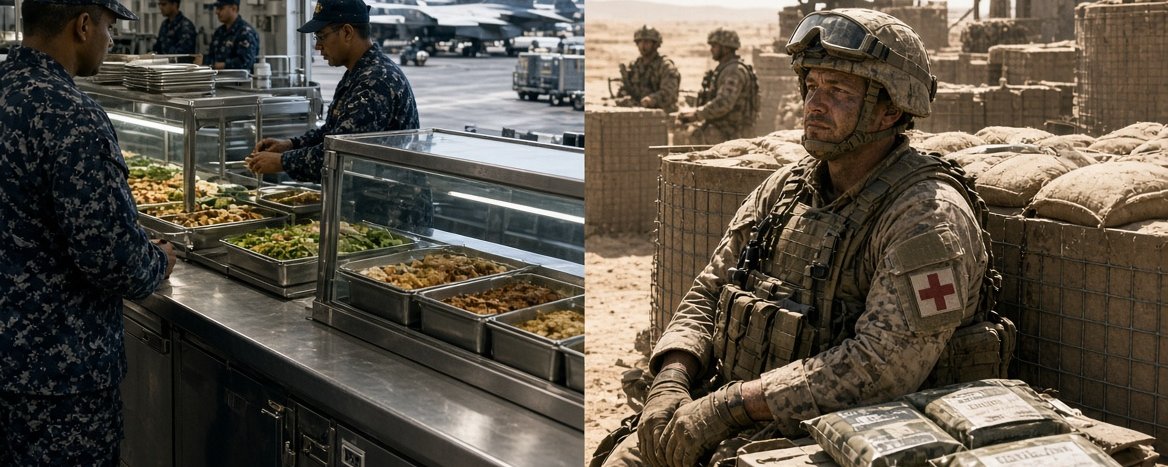
I have not done one of these because I believe every branch has a purpose, and we all work together as a team; but when snowflakes start complaining on camera, I have to call it out.
Let me set the scene. Sailors on the USS Abraham Lincoln went on record — ON CAMERA, to national media — to complain about cold showers, a little mold, and a shortage of fresh fruit after 200-plus days at sea. Stars and Stripes picked it up. Navy Times picked it up. CNN sent a reporter to stand on the flight deck and ask sailors how they were holding up, and the Secretary of War himself had to go on the record with Reuters to say the coverage was “completely misrepresented.” Let that sink in for a second. The SECRETARY OF WAR had to hold a press availability because sailors were unhappy about the produce selection.
I spent my Army career as a medic, including a deployment to Iraq, where I helped stand up a school, a fire station, and a hospital, and where I walked girls to class so they wouldn’t get killed for wanting an education. I am not writing this to dunk on the individual sailors themselves. Most of them are doing a hard job and doing it well, and every branch has guys who complain more than they should. I am writing this because somewhere between the flight deck and the five-star galley, somebody decided the way to handle a rough deployment stretch was to go on television instead of gutting it out the way every other branch has for the last two hundred and fifty years. That is the part I have a problem with.
Every branch complains. That is the oldest tradition in the U.S. military, older than the flag itself. Soldiers complain about the Air Force. The Air Force complains about the Marines. The Marines complain about everybody, mostly because they’re right to. The Army and the Marines have been trading insults since the Revolutionary War, and the Army-Navy football rivalry is over a century old for a reason. But nobody, in the history of that rivalry, has called a press conference about it. You grumble in the chow line, you write a strongly worded letter home, and then you drive on, because that is what separates a service member from a civilian complaining about airline food. What happened here broke that unwritten rule, and since the Navy wants to make its deployment hardships a national news story, I figure it’s only fair we put those hardships next to what a “hard deployment” has actually looked like for the other three-quarters of the U.S. military, going back to before any of us were born, all the way up through the last twenty-plus years of the War on Terror.
WHAT “HARD” ACTUALLY LOOKS LIKE
Let’s start with the number that started this whole story: 200-plus consecutive days at sea for the Lincoln, its longest stretch without a proper port call in the ship’s history. That’s genuinely a long time to be away from home, and I’m not going to pretend otherwise. But let’s put it next to a standard Army deployment cycle in Iraq or Afghanistan during the surge years, which ran twelve months as the baseline and got stretched to fifteen months more than once, because that’s just what the mission required. No port calls on a rotation like that either. No rotation home for a “reset.” You went out, you did the job, and you came home when the Army said you could come home, and if the Army decided halfway through that your unit was staying an extra ninety days, that’s what happened. Nobody put that on the evening news as a hardship story. It was just Tuesday.
Now let’s talk about temperature, because this is where the story really falls apart. Sailors on the Lincoln were upset about cold showers. I want you to sit with that phrase for a second: cold showers. Meanwhile, soldiers pulling guard duty in Iraq during the summer months routinely worked in heat that hit 120 to 130 degrees, with commanders limiting outdoor shifts to four hours at a time specifically because the heat itself was a casualty-producing threat. One Army staff sergeant, describing his time as a gunner on a Bradley Fighting Vehicle, said the inside of that turret hit 140 to 150 degrees with zero air conditioning, hot enough that every piece of metal in the vehicle would burn your hand on contact. Soldiers were drinking seven to eight liters of water a day just to stay conscious, and sweating out nearly all of it, because the alternative was heat stroke in full body armor. Medics in Baghdad described the heat as so intense the mercury in their own thermometers cracked the glass. One Army lieutenant described the culture bluntly: if you’re the one who falls out from a heat injury, or the one complaining that it’s hot, everyone makes fun of you, and you don’t want to be that guy. That was the actual policy. Suffer quietly or get mocked by your own squad. Nobody was flying a CNN crew out to the observation tower to ask how the guys felt about it.
And showers? When U.S. forces first set up a combat outpost in Dhi Qar province, the unit had exactly two sinks with running water. No showers. No air conditioning. In the middle of 130-degree summer days. Soldiers washed their own clothes by hand while building their own observation posts, and it took them months of hard labor before that outpost had anything resembling a climate-controlled room. That’s not a complaint I dug up from a sob story. That’s a matter-of-record account from a unit history. The Navy sailor’s idea of a rough shower is water that isn’t hot enough. The Army soldier’s idea of a rough shower was there wasn’t one, so you used a canteen cup, a baby wipe, and whatever dignity you had left.
Let’s talk about food, since that’s the other half of this controversy. Fresh fruit was apparently in short supply on the Lincoln. Here is what WAS supplied on that carrier and others like it, according to the Navy’s own numbers: 17,000-plus meals served daily, roughly 1,600 pounds of chicken and 350 pounds of lettuce consumed every single day, 160 gallons of milk, 30 cases of cereal, a food budget running $45,000 to $65,000 PER DAY, dedicated bakers running 60-pound dough mixers to produce fresh bread, rolls, and cookies from scratch, and a birthday tradition where sailors get a table with a tablecloth, sparkling cider in wine glasses, soft music, and a main course of PRIME RIB OR LOBSTER. There is a ship’s grocery store on board doing roughly ten thousand dollars a day in snack sales alone. That is the deployment diet the Navy is calling a hardship because the fruit selection had gaps.
Compare that to a standard-issue Meal, Ready-to-Eat, which is what a soldier on a combat outpost was eating for breakfast, lunch, and dinner for weeks at a stretch, sometimes for months if the resupply convoy got hit or the weather grounded the helicopters. No bakery. No prime rib night. No ship’s store. Just a brown plastic pouch, a flameless heater if you were lucky enough to still have the chemical packet, and whatever motivation you could scrape together to eat the same three menus on rotation for the fortieth time that deployment.
THE FULL TOUR OF THE FLOATING FIVE-STAR RESORT
I want to walk through the rest of what actually happens on one of these ships during a “hardship” deployment, because I don’t think most Americans understand the scale of it, and once you do, the complaints get even funnier. A single Ford-class carrier runs FOUR separate two-story galleys operating on a rotation, where two serve while two clean and prep for the next meal, which means the kitchen never actually closes. The ovens on board can bake 1,200 portions simultaneously. Between 93 and 114 trained culinary specialists work the line, all of them graduates of the Navy’s own dedicated culinary school. On a single morning, that team can put out 800 fresh cinnamon rolls before 0700 and cook 480 pounds of bacon at the same time, timed so precisely that the eggs go on the skillet exactly eighteen minutes before the doors open, because heaven forbid a sailor’s eggs get cold.
Then there’s the caste system on board, which I find almost as funny as the fruit complaint. Enlisted sailors eat cafeteria style off a tray in the main mess. Officers get white-jacketed table service in the wardroom. The chief’s mess runs on its own mysterious rules where a new arrival can get corrected for reaching for the salt shaker wrong, and the captain’s table is the last mess to ever see a menu substitution when supplies run low, meaning the enlisted mess decks eat the consequences of any shortage first. I bring this up because when a story runs about “the crew” not having fresh fruit, it’s worth asking which deck that shortage actually hit, because it sure wasn’t the captain’s table.
The laundry operation alone processes 150,000 pounds of uniforms and linens EVERY WEEK, using nine industrial washers, eleven industrial dryers, and twelve steam presses, running sixteen to twenty hours a day. They’ve even added ozone-based cleaning systems in recent years to cut down on water and soap use, because apparently that’s a priority on a ship where sailors are complaining about not having enough of either. And here’s my personal favorite: the plumbing on these newer carriers clogs so often from sailors flushing things they shouldn’t that the Navy has to run what’s called an acid flush to clear it, at a cost of four hundred thousand dollars EVERY SINGLE TIME. Let that number sit next to the number for that Iraq outpost that opened with two working sinks. The Navy will spend more money unclogging a toilet on one ship in one afternoon than an entire combat outpost saw in resupply funding across a whole deployment.
Oh, and there are 87 vending machines on board, stocked with over 15,000 individual snack items, doing more than eight thousand transactions a day across the ship’s retail outlets. There’s a barbershop. A post office. A library. A chapel. Gyms. A ship’s store that restocks every time a resupply ship pulls alongside. I am not making any of this up, and none of it is a criticism of the Navy’s logistics, which really is an impressive feat of modern engineering. It is, however, a pretty rough backdrop for a segment about how tough deployment life has gotten.
SHIT BURNERS AND PISS TUBES: THE PART NOBODY PUTS ON THE EVENING NEWS
Let’s go back to that four-hundred-thousand-dollar toilet acid flush for a second, because I want to introduce you to what the actual sanitation system looked like for tens of thousands of soldiers during the early years of Iraq, and for years afterward at the smaller combat outposts that never got upgraded.
There was no flush toilet. There was a cut-down 55-gallon diesel drum under a plywood outhouse. When that drum filled up, a soldier — usually the newest or most junior guy on the position — pulled it out, poured diesel fuel on top, and lit it with a road flare or a burning rag, then stood there stirring a barrel of burning human waste with a metal pole for however long it took to fully combust, in 120 to 130 degree heat, so it wouldn’t just char and smolder. This had an actual name. It was called “shit detail” or “burn detail,” and it was universally hated, and it happened at nearly every remote position in the country because there was no other option. The smoke was thick, oily, and acrid, and it carried straight through the chow line and the aid station if the wind shifted wrong. That smoke, by the way, is now linked to respiratory illness and cancer in the veterans who breathed it for a year at a time, which is a serious conversation for another day, but I want it on the record here too.
And that’s just the solid waste. Liquid waste went into what was called a piss tube — a length of PVC pipe or metal conduit driven into the ground at an angle, open end at roughly waist height. No privacy. No lighting at night beyond a red-lens flashlight if you were lucky. No water needed, because there wasn’t any to spare. Every gallon that came into an early outpost was rationed for drinking, cooking, vehicle radiators, and keeping wounded soldiers alive. Hygiene got whatever was left over, and some weeks that was nothing at all. This wasn’t a rough first month before things got fixed, either. At the smaller COPs, shit burners and piss tubes remained the entire sanitation system for months or years, right up until the position closed.
Now go back and reread the paragraph about the Navy spending four hundred thousand dollars to acid-flush a clogged toilet system. A nineteen-year-old private stirring a burning drum of his own platoon’s waste with a stick in the Iraqi sun would have signed absolutely anything to trade problems with that ship’s plumbing department.
OUTSIDE THE WIRE
There’s a whole documentary literally titled “Outside the Wire” about what deployment actually meant for troops who left the base, and it’s worth putting a few of those details next to the Lincoln story, because the contrast could not be sharper. Reporters who traveled unembedded through Afghanistan describe roadside bombs going off in the capital so routinely that locals compared it to a rainstorm, something you just learn to live with, and a car bomb close enough to shatter windows in high-rise buildings blocks away. They visited a boys’ high school outside Kandahar with four thousand students enrolled and a library holding a grand total of four hundred books, one of which was an English dictionary nobody could read because the school barely had power a few hours a day. They walked through combat outposts where the entire “hot water plan” was a hand-pumped well that had just been installed that year, delivering exactly one small bag of water at a time. Compare that to a carrier’s reverse-osmosis plant turning four hundred thousand gallons of seawater into drinking water daily, powered by a nuclear reactor that doesn’t need refueling for twenty-five years. That’s the gap we’re talking about. That’s not “rough deployment” versus “slightly rougher deployment.” That’s two entirely different definitions of the word hardship.
A HISTORY LESSON THE NAVY SEEMS TO HAVE SKIPPED
This isn’t new, either, and honestly the Navy’s own history should have prevented this story from ever happening. Go back to November 1950, to the Chosin Reservoir in North Korea, where roughly 8,000 to 12,000 U.S. Marines, alongside Army soldiers and the Navy’s OWN corpsmen serving right there in the field with them, got surrounded by 120,000 Chinese troops in a cold front that dropped temperatures to 35 and 36 degrees BELOW ZERO. Foxholes had to be dug with explosives because the ground was frozen solid. Weapons froze shut. Medical supplies froze solid. Rations froze into rocks men had to thaw against their own bodies just to eat. When the Marines ran out of mortar rounds and radioed for more using the codename “Tootsie Rolls,” a supply mix-up sent them actual boxes of Tootsie Roll candy instead of ammunition, and those Marines used the melted candy to plug cracked fuel lines on their tanks and kept fighting. Nearly six thousand Americans died in that seventeen-day fight, and thousands more came home missing fingers and toes to frostbite, a wound the VA didn’t even formally recognize as service-connected until decades later. Navy medicine was right there in the middle of that. The Navy’s own history includes men who plugged a tank with candy in thirty-below weather and fought their way out. That’s the branch. That’s the legacy. And somewhere along the way it turned into cold showers making the evening news.
Go back further to Vietnam and you’ll find infantrymen who went three, four, five weeks in the field without a shower of any kind, because there wasn’t water to spare for anything but drinking, and because smelling like American soap was a good way to get your position discovered in a jungle where scent carried farther than sound. Grunts used their own steel helmets as wash basins, cooking pots, and shaving bowls, all at different points in the same week. They gave up scented soap, deodorant, and toothpaste on purpose because the smell could get their whole squad killed, and long-range reconnaissance teams took it a step further, going days before a mission without brushing their teeth at all, brushing with plain water or a finger instead. The Army was so serious about scent as a battlefield vulnerability that it actually fielded a helicopter-mounted device nicknamed the “people sniffer” that tried to detect enemy troops hiding in the jungle canopy by sampling the air for human sweat and waste, and the enemy learned to counter it by hanging buckets of buffalo urine in random trees just to send American bombs at empty ground. When the monsoon rain finally came, guys stripped down and stood in the open just to feel clean water on their skin for the first time in a month, and veterans describe it, seventy-some years later, as one of the best physical feelings of their entire war, right up there with dry socks and cold beer. That’s the bar. That’s what “hardship deployment” has meant to the other branches for generations. Cold water pressure on a nuclear-powered warship with a bakery attached does not clear that bar. It doesn’t come close.
THE SQUARE FOOTAGE PROBLEM
Here’s a number that puts the whole thing in perspective. A Nimitz or Ford class aircraft carrier has a flight deck alone of roughly 4.5 acres, with total interior floor space across all the decks exceeding one million square feet, housing a crew of 4,500 to 5,000-plus sailors in a floating city with a gym, a library, a chapel, a barbershop, a post office, and Wi-Fi lounges. A typical combat outpost in Iraq, by comparison, housed somewhere between 30 and 150 soldiers on a total footprint of one to four and a half acres, blast walls included, and the actual hard, enclosed living space inside that footprint was often only a few thousand square feet of shipping-container housing or a repurposed local building with the windows blown out. Do the math on that. A carrier gives its crew, on average, over two hundred square feet of interior ship per sailor once you count every deck. A combat outpost was giving its soldiers a windowless box the size of a walk-in closet, if they were lucky enough to get their own rack at all. Soldiers weren’t complaining about mold in the shower because there usually wasn’t a shower to have mold in.
I understand a carrier is a warship with a real mission, and that mission requires keeping thousands of sailors fed, rested, and combat-effective for months at a time. Nobody is arguing the Navy should intentionally make its sailors miserable, and nobody is arguing that being at sea for over 200 days isn’t a genuine sacrifice worth respecting. What I’m arguing is that when your worst-case deployment includes a bakery crew, a full-time barber shop, a library, and a lobster dinner once a year, going on CNN to describe that as some uniquely unbearable ordeal is going to get you laughed at by three other branches who lived a genuinely different reality for the exact same twenty years of the War on Terror, and by your own branch’s history at a frozen reservoir in North Korea seventy-five years ago.
WHAT’S NEXT?
What’s next, the Navy is going to ask the other branches for a participation ribbon just for finishing a deployment on a boat with Wi-Fi… wait, I was just informed they already hand out a commemorative coin for that.
What’s next, sailors are going to demand hazard pay for a cinnamon roll shortage… wait, I was just informed the ship’s store does ten thousand dollars a day in snack sales, so I don’t think supply is really the issue.
I get it. I really do. Every single service member who deploys is doing something the other 98 percent of this country will never volunteer to do, and that includes every sailor on that ship. I’m not questioning their service. I’m questioning the decision, made by somebody, to turn “the shower wasn’t hot enough” into a national news cycle that required the Secretary of War to personally respond. That’s not a Navy problem. That’s a leadership and messaging problem, and it made the whole branch look soft to guys who spent a deployment eating sand for breakfast, and to Marines whose own grandfathers plugged a tank engine with candy in thirty-below weather rather than call a reporter.
So here’s my actual challenge to my brothers and sisters in Navy blue: the next time deployment gets rough, and it will, because that’s what deployment is, handle it the way the rest of us always have. Complain to your bunkmate. Complain in the chow line. Write your spouse a letter that makes them laugh and worry at the same time. Do NOT call CNN. We’ve got a reputation to protect out here, and dragging it through a segment about lettuce is not how we protect it.
But what do I know, I am only a medically retired combat medic who sweated through body armor in 130-degree Iraqi heat, and who knows exactly what a burn detail smells like, instead of complaining about the Wi-Fi lounge.
IF THIS ARTICLE MADE YOU THINK: LIKE this article so the algorithm shows it to people who need to read it. SHARE this — every share really helps get the word out. Use it. COMMENT below with your take. Which branch do YOU think has the hardest deployment, and why? Army, Navy, Marines, Air Force, Coast Guard — make your case. Tell me.
And if you want MORE of this — the data, the history, the science, the stories — JOIN Bski’s Classroom community or follow me on YouTube. Even better, subscribe to my account; it is about the cost of a cup of coffee per month. That is it. Your support keeps this classroom open, and I promise I will never run out of material as long as the left keeps trying to out-dumb itself.
 Mike Borowski is a medically retired Army combat medic with 23 years of service, including a combat deployment to Iraq, and a high school Anatomy and Physics teacher at a high-need Career Technical district in Northeast Ohio — where he also wrote and published the textbooks for both courses. He runs “Bski’s Classroom,” a platform dedicated to cutting through political noise with data, history, and the kind of blunt honesty that comes from someone who has seen both war and the American classroom up close.
—
X (Twitter): x.com/BskiMike22802
Substack: substack.com/@bskimike22802
YouTube: www.youtube.com/@BskiMike22802
AFNN: https://afnn.us/author/mikeborowski/
If you enjoyed this article, then please REPOST or SHARE with others; encourage them to follow AFNN. If you’d like to become a citizen contributor for AFNN, contact us at managingeditor@afnn.us Help keep us ad-free by donating here.
Substack: American Free News Network Substack
Truth Social: @AFNN_USA
Facebook: https://m.facebook.com/afnnusa
Telegram: https://t.me/joinchat/2_-GAzcXmIRjODNh
Twitter: https://twitter.com/AfnnUsa
GETTR: https://gettr.com/user/AFNN_USA
CloutHub: @AFNN_USA
Compare that to a standard-issue Meal, Ready-to-Eat, which is what a soldier on a combat outpost was eating for breakfast, lunch, and dinner for weeks at a stretch, sometimes for months if the resupply convoy got hit or the weather grounded the helicopters. No bakery. No prime rib night. No ship’s store. Just a brown plastic pouch, a flameless heater if you were lucky enough to still have the chemical packet, and whatever motivation you could scrape together to eat the same three menus on rotation for the fortieth time that deployment.
War story, no shit, there I was, in Korea, on an exercise at the brigade TAC, things had gone nuts from 0500 on. around 1400 I finally got to get something in my stomach, grabbed an MRE, looked up and said, “God, if you love me, there will be a John Wayne bar in this…” I opened, it and it had M&Ms. I looked up like the kids with the Playboy in Animal House, “Thank you God!”
On a more serious comment, if you haven’t watched it, watch They Shall Not Grow Old, came out in 2018 about the British Army in WWI. Induction, training, deployment, and return. One of the images that stuck with me was of a field latrine back then. The men dug a trench (looked like 4 ft deep and 8 ft long), aa 2×4 lengthways along the trench, supported by two “X” brackets at the end. I saw the picture of soldiers using the facilities, drop your pants, lean against the 2×4, handle your business and go on. Don’t know if they had toiler paper and I know the nightmare of falling in had to have happened to someone.
Great article.