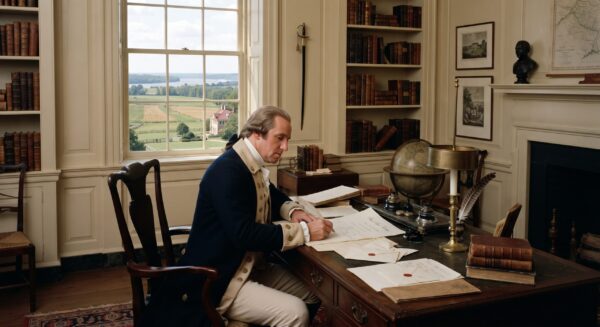
Pick up any of the founding generation’s private letters, public speeches, or founding documents, and you’ll find something that gets edited out of a lot of modern retellings: these men did not talk about liberty in secular terms. They talked about it as a gift, a trust, and a test — language borrowed directly from scripture, deployed without embarrassment, by men who were building a government, not a church.
Providence and the Price of Squandering It
George Washington’s June 1783 Circular Letter to the States is probably the richest single document for understanding this. It was written at the exact moment the American experiment began — the war won, the country’s shape still unsettled. Washington described Americans as having been placed on “a most conspicuous Theatre,” one he said was “peculiarly designated by Providence for the display of human greatness and felicity.” The opportunity, in his telling, wasn’t earned. It was given.
Washington made the outcome a matter of individual character, not luck or circumstance. If the new nation’s citizens failed to become “completely free and happy,” he wrote, “the fault will be entirely their own.” Not fortune’s fault. Not another class’s fault. His own fault, held up against every citizen equally. He closed with a prayer that Americans would carry “that Charity, humility & pacific temper of mind, which were the Characteristics of the Divine Author of our blessed Religion”.
Dignity as a Divine Grant, Not a Government Grant
In an August 1776 speech in Philadelphia, Samual Adams argued that the talents and capacities “which heaven has bestowed on men” were never given “merely to make them more obedient drudges.” They were distributed, he said, with a divine purpose behind them — meaning every person’s capacity to act and build was itself a kind of endowment, not a privilege handed down by a ruling class and revocable at will.
That’s a direct answer to the premise underneath lack consciousness — the idea that one person’s ability and another person’s want are simply arbitrary facts of an unjust system, correctable only by redistribution. Adams’s framing says the opposite: your capacity to work and create is itself the gift. What you do with it is the story, not who gave you a bigger pile to start with. He tied this just as tightly to personal virtue in his correspondence with James Warren, writing that a man void of “virtuous attachments in private life” would very soon become void of “all regard for his country” — private character and public liberty, in his mind, rising and falling together.
Virtue as Structural, Not Decorative
John Adams pushed the same idea into starker terms: virtue wasn’t a nice accessory to the American system. It was the foundation the whole structure depended on. “The only foundation of a free Constitution is pure Virtue,” he wrote, warning that without it, in greater measure than the people already possessed, “they may change their rulers and the forms of government, but they will not obtain a lasting liberty.” A free society, in his accounting, isn’t self-sustaining. It runs on the accumulated diligence, honesty, and self-command of the people living inside it — plenty consciousness, in other words, treated not as a personal virtue but as a load-bearing wa
John Witherspoon, signer of the Declaration and personal teacher to a striking number of the founding generation, drew the line from religious liberty to civil liberty just as directly: “There is not a single instance in history in which civil liberty was lost, and religious liberty preserved entire.” Take away one and the other follows shortly after.
The Same Faith, Two Centuries Later
What’s striking is how directly this same posture — belief, diligence, and a refusal to treat your circumstances as a verdict — shows up in the words of people who built something out of almost nothing, a hundred and fifty years after those quotes from our founders.
Steve Jobs, addressing Stanford’s graduating class in 2005, distilled the entire plenty-consciousness posture into a single instruction: “Sometimes life’s gonna hit you in the head with a brick. Don’t lose faith.” He told them the only way to do work worth doing was to love the work itself, and that the path forward wouldn’t be visible in advance — “you have to trust that the dots will somehow connect in your future. You have to trust in something — your gut, destiny, life, karma, whatever.” Different vocabulary than Washington’s. Same underlying instruction: trust the process, and put in the work regardless of whether you can see where it leads.
Truett Cathy, founder of Chick-fil-A, made the connection to the founders’ language explicit rather than implicit. “I believe that you can combine biblical principles and good business practices,” he testified before Congress, describing how his company trained employees around the Golden Rule. “I think it’s an important factor that we inject Biblical principles into the teaching,” he said elsewhere — a business built, on the record, around the same source Washington credited for the virtue he thought the republic needed.
Sam Walton’s language runs closer to Adams’s virtue-as-foundation argument, but aimed at a company instead of a country. “If you love your work, you’ll be out there every day trying to do it the best you possibly can, and pretty soon everybody around will catch the passion from you — like a fever,” he wrote in his autobiography. He credited his own success to values that wouldn’t have sounded out of place in a founding-era sermon: “a belief in the importance of hard work, honesty, neighborliness, and thrift.”
And Mary Kay Ash may be the cleanest embodiment of the whole argument, precisely because her story starts with a real grievance. At 45, after being passed over for promotion repeatedly in favor of men she’d personally trained, she had every reason available to nurse resentment instead. She founded a company on $5,000 instead. “My priorities have always been God first, family second, career third,” she wrote. “I have found that when I put my life in this order, everything seems to work out.” Where lack consciousness would have told her the system had cheated her and owed her something back, she built something new rather than waiting for repayment — the founders’ whole argument, tested against a real injustice, and answered with diligence instead of grievance.
The Thread
Line these up and the continuity is hard to miss. Washington: the opportunity is given, the outcome is yours. Samuel Adams: your capacity itself is the gift, not the size of anyone else’s pile. John Adams: virtue is the foundation, not decoration. Witherspoon: lose the religious grounding and the civil liberty doesn’t survive it either. And then, two centuries on, four people who built real things out of belief, diligence, and a refusal to treat circumstance as destiny — one of them explicitly naming the same biblical source the founders did, without a hint of self-consciousness about it.
That’s plenty consciousness, stated in two very different centuries, in nearly identical terms. It’s not a coincidence that the country built on the first set of statements produced the conditions that made the second set possible.
Next: what kind of country is created by the lack worldview….
Cushman Younger; Contact: cushman.younger@gmail.com
Some of Cushman Younger’s favorite poems are available on Amazon Kindle under the title “The Cruel March of Time“.
If you enjoyed this article, then please REPOST or SHARE with others; encourage them to follow AFNN. If you’d like to become a citizen contributor for AFNN, contact us at managingeditor@afnn.us Help keep us ad-free by donating here.
Substack: American Free News Network Substack
Truth Social: @AFNN_USA
Facebook: https://m.facebook.com/afnnusa
Telegram: https://t.me/joinchat/2_-GAzcXmIRjODNh
Twitter: https://twitter.com/AfnnUsa
GETTR: https://gettr.com/user/AFNN_USA
CloutHub: @AFNN_USA