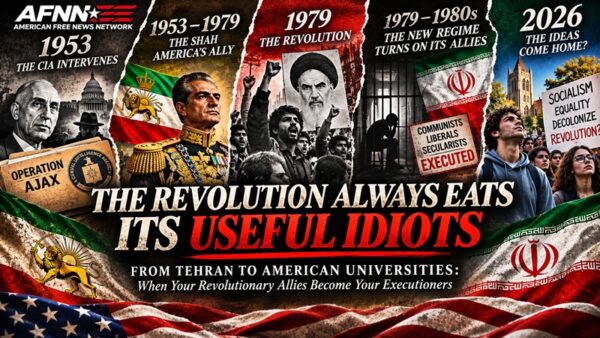
From Tehran to American Universities: When Your Revolutionary Allies Become Your Executioners
In 1979, Iranian communists marched alongside Islamic revolutionaries, convinced they were building a glorious new future. They had finally found common ground: overthrowing the Shah.
Unfortunately, nobody thought to ask Ayatollah Khomeini what he intended to do with the communists after the victory parade.
Spoiler alert: It wasn’t universal healthcare, free college, or government-funded poetry workshops.
Within a few years, the Islamic Republic was imprisoning, torturing, and executing political opponents, including the very leftists who had helped bring it to power.
Apparently, the revolution had a rather strict cancellation policy.
1953: America’s First Brilliant Idea
Rewind to 1953. Washington was terrified that Iran might fall under Soviet influence. Prime Minister Mohammad Mosaddegh had nationalized Iran’s oil industry, infuriating Britain, while communist influence raised American concerns.
There was one inconvenient detail: Mosaddegh wasn’t a communist.
But this was the Cold War, when nuance was apparently considered a Soviet invention.
The CIA and British intelligence helped overthrow Mosaddegh, strengthening Shah Mohammad Reza Pahlavi. Washington had successfully protected its strategic interests.
Mission accomplished. What could possibly go wrong?
For the next quarter-century, America supported the Shah’s increasingly authoritarian government. His secret police, SAVAK, became notorious for repression, while political resentment simmered beneath Iran’s modernization.
America wanted stability. It helped preserve a pressure cooker instead.
1979: Congratulations, Comrades. You’re Next.
When the Shah fell, Iranian Marxists, socialists, liberals, nationalists, and Islamic revolutionaries celebrated together.
They agreed on one thing: the Shah had to go.
What they hadn’t agreed upon was what freedom would look like afterward.
Khomeini had an answer. And it wasn’t particularly interested in competing opinions.
The Islamic Republic gradually eliminated its revolutionary rivals. Communist organizations were suppressed, secular opponents imprisoned, and thousands of political prisoners executed during the 1980s.
The communist Tudeh Party even supported Khomeini before being crushed itself in 1983.
Imagine helping overthrow a government, cheering your new leadership, and discovering that your revolutionary retirement package includes interrogation and a prison cell.
History has a particularly dark sense of humor.
Fast-Forward to America’s Universities
Now consider 2026.
According to Gallup, 57% of Americans aged 18–34 view socialism positively, compared with 43% who view capitalism positively.
That doesn’t mean 57% want Soviet-style communism. Many associate socialism with affordable healthcare, economic equality, and government services.
Nevertheless, the shift deserves examination.
American campuses have become battlegrounds over capitalism, identity, foreign policy, and the legitimacy of traditional institutions.
Some activists denounce Western oppression while expressing sympathy for revolutionary movements whose actual governing philosophies are fundamentally incompatible with their own progressive values.
Consider the contradiction.
A secular activist champions women’s liberation, LGBTQ rights, freedom of expression, and religious equality, then excuses an authoritarian Islamist movement because it opposes the same Western government.
That’s not ideological consistency. That’s ordering the revolutionary combination platter without reading the ingredients.
To be clear, defending Palestinian civilians or Muslim religious freedom is not endorsing Islamist authoritarianism. The problem begins when legitimate humanitarian concerns become excuses for defending organizations that reject those very freedoms.
The Coalition of Contradictions
Iran’s revolutionaries made a catastrophic assumption: because they shared an enemy, they must share a destination.
They didn’t.
The communists imagined a socialist future. Liberals imagined political freedom. Islamists sought Islamic government.
Khomeini understood something his temporary allies apparently missed.
You don’t need to agree with your allies about tomorrow when they’re helping you win today.
Once victory arrived, the disagreements became rather permanent.
This is the danger of political movements organized primarily around resentment. Destroying something requires considerably less intellectual effort than building its replacement.
A university education ought to teach students to recognize that distinction.
Unfortunately, teaching students what to think is considerably easier than teaching them how to think.
The Constitution: America’s Insurance Policy Against Idiots
America’s founders understood that concentrated power becomes dangerous regardless of who holds it.
That’s why they established competing branches of government, constitutional limitations, religious liberty, and protections for unpopular speech.
These weren’t decorative suggestions intended for people who voted correctly.
They were safeguards against precisely the sort of ideological certainty that convinces one faction it has the moral authority to silence another.
And here’s the uncomfortable part: conservatives don’t get to abandon those protections merely because they’re frightened of socialism or Islamism, either.
America helped sustain an authoritarian Iranian government because it feared communism. That intervention contributed to grievances later exploited by an authoritarian religious movement.
The lesson should be obvious.
When defending freedom requires destroying freedom, somebody has misplaced the instruction manual.
Iran’s communists thought they were helping write the next glorious chapter of history.
Khomeini handed them a footnote.
Before Americans celebrate dismantling another institution, perhaps they should ask one question:
Who’s holding the pen when the revolution is over?
Because history suggests that the people chanting loudest at the victory parade aren’t necessarily the ones who survive to write the memoirs.
If you enjoyed this article, then please REPOST or SHARE with others; encourage them to follow AFNN. If you’d like to become a citizen contributor for AFNN, contact us at managingeditor@afnn.us Help keep us ad-free by donating here.
Substack: American Free News Network Substack
Truth Social: @AFNN_USA
Facebook: https://m.facebook.com/afnnusa
Telegram: https://t.me/joinchat/2_-GAzcXmIRjODNh
Twitter: https://twitter.com/AfnnUsa
GETTR: https://gettr.com/user/AFNN_USA
CloutHub: @AFNN_USA