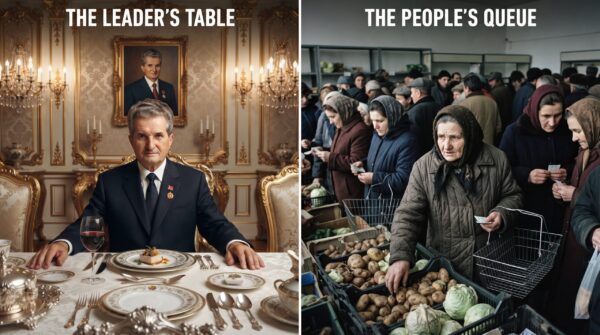
Every argument so far has been about mechanism and philosophy — why lack of consciousness breaks price signals, corrodes incentive, and dresses envy up as justice. What follows is about what happens when a country actually builds a government around it. Four things happen, in order, with remarkable consistency across wildly different cultures, decades, and continents: the economy collapses, the new ruling class gets rich anyway, the exits get welded shut, and the people living through it tell you exactly what it felt like.
When the Theory Meets a Country
North Korea and South Korea are the cleanest natural experiment available. Before the 1960s, North Korea’s GDP per capita was actually 30 to 50 percent higher than South Korea’s — a legacy of Japanese-era industry concentrated in the north. Then the two governments split into opposite systems, and the gap didn’t just close, it inverted and kept widening. By 2023 it stood at roughly 56 to 1 in South Korea’s favor: $35,538 per person against $640. Same peninsula, same people, same starting line.
East and West Germany ran the identical experiment a second time. At the fall of the Berlin Wall, East German GDP per capita was 55 percent of West Germany’s. Thirty-five years and roughly €1.4 billion in West-to-East subsidies later, it still sits at just 66 percent. Even full reunification and enormous transfer payments haven’t closed a gap four decades of central planning opened.
The Soviet Union and China show what central planning does specifically to agriculture. Stalin’s forced collectivization triggered the Holodomor, killing an estimated 3.5 to 5 million in Ukraine alone — while the USSR kept exporting over a million tons of grain to the West during the same famine. This wasn’t scarcity. It was policy. Mao’s Great Leap Forward killed somewhere between 15 and 55 million people, commonly cited around 30 million — the deadliest famine in recorded history.
Venezuela is the case within living memory. Land seizures cut food production 75 percent over two decades while the population grew a third. By 2018, 87 percent of families were below the poverty line, inflation hit 80,000 percent annually, and two-thirds of Venezuelans reported losing an average of 25 pounds in a year — a country that started the century as Latin America’s richest.
Argentina adds a variation worth naming explicitly: elected populism rather than revolution, producing the same outcome. Argentina was the world’s tenth-richest country when Juan and Eva Perón took power in 1946, built their movement explicitly around resentment of “the oligarchy,” nationalized industry, and left behind eight decades of debt default and triple-digit inflation cycles that outlasted Perón himself by generations. Javier Milei’s post-2023 free-market reforms are, so far, an open test of whether that trajectory can run in reverse.
How the People Running It Actually Live
Every one of these systems promised to abolish privilege. Every one of them re-grew it around whoever held political power instead.
Fidel Castro insisted for decades on a $36-a-month salary and challenged reporters to prove otherwise. Forbes estimated his actual net worth at $900 million. His own longtime bodyguard, after defecting, described a private island with a swimming pool and helipad, an 88-foot yacht reportedly gifted by Brezhnev, and a walled compound with its own dairy herd — while ordinary Cubans queued for rationed bread.
The Soviet nomenklatura turned privilege into policy rather than scandal. Milovan Đilas, a former high-ranking Yugoslav communist who broke with the Party, called it plainly in his 1957 book The New Class: communism hadn’t abolished the privileged class, it had just installed a new one — dachas, Black Sea resorts, and special stores stocked with caviar and Western goods, all keyed to political rank rather than wealth.
Nicaragua’s “Piñata” is the most literal case: in the roughly two months between the Sandinistas’ 1990 election defeat and the transfer of power, top leaders — Daniel Ortega among them — transferred ownership of some 28,000 properties, more than a fifth of the country’s land, into their own and their allies’ hands. Ortega personally seized a mansion spanning two city blocks.
China’s “princelings” run offshore companies through relatives while the Party publicly preaches egalitarianism — a 2025 U.S. intelligence assessment put Xi Jinping’s family-linked assets above $1 billion. Venezuela’s boliburguesía made the contradiction almost cartoonish: officials’ children posting luxury lifestyles online while ordinary citizens starved, and one financier indicted in the U.S. for laundering $159 million in bribes into Manhattan real estate and a $4.35 million yacht.
Vote Your Way In, Shoot Your Way Out
There’s a saying with no verified original author but a devastatingly current illustration: you can vote your way into socialism, but you have to shoot your way out.
Venezuela supplies both halves in one timeline. Chávez won genuinely competitive elections in 1998. In 2024, both Maduro and opposition candidate Edmundo González claimed victory; independent observers including the Carter Center assessed the opposition’s own precinct tallies as authentic and showing a González win, while Venezuela’s electoral council declared Maduro the winner within hours. What followed wasn’t a transfer of power — it was killings of protesters, enforced disappearances, and over 850 political prisoners a year later, documented by Human Rights Watch in a report titled, without exaggeration, “Punished for Seeking Change.”
Nicaragua ran the same arc a generation earlier: Ortega accepted his 1990 defeat, returned to power in 2007, and has since made a repeat of that result structurally impossible. Cuba is the purest form — there’s been no genuine multiparty vote to lose since 1959, so exile, imprisonment, or death at sea have been the only exit mechanisms that have ever existed.
What It Actually Felt Like
The regimes speak in statistics. The people who lived under them speak in specifics — and two very different registers of testimony are worth separating: the dissidents targeted for what they believed, and the ordinary people who suffered without ever being political at all.
The dissidents. Aleksandr Solzhenitsyn got eight years for a joking letter about Stalin. Natan Sharansky spent nine years in the Gulag for wanting to emigrate, writing of the moment he stopped hiding his beliefs: “Now, I could say what I thought, do what I said, and say what I did.” Nien Cheng, educated at the London School of Economics, spent over six years in Chinese solitary confinement for refusing to falsely confess, recalling how everyone in China knew how Party leaders actually lived and “carefully looked the other way” rather than say so aloud. Armando Valladares spent 22 years in Cuban prisons for refusing to display a pro-Castro sign on his desk. In East Germany, Stasi agents subtly rearranged objects in targets’ homes to manufacture disorientation and self-doubt — an entire secret police apparatus organized around engineering a person’s inner life, not just restricting their outer one. And in Cambodia, Loung Ung recalled being taught that the regime’s leader “makes us work hard because he wants to purify our spirit” while she starved, wondering “if his kind eyes can see us starving.”
The ordinary people. A Soviet fighter pilot’s diary asked the question that never got a honest answer: “If we have so much bread, why am I standing in line at four A.M.?” In Havana in 2026, a bodega worker said he hadn’t had a customer in nearly two weeks because “no Cuban can truly survive on the products from the ration book anymore”; a 56-year-old in the bread line described his daily allotment shrinking from 80 grams to 40 while the price rose fifteenfold. East Germans waited up to thirteen years for a Trabant, the country’s standard car, manufactured essentially unchanged for three decades. Cambodian survivors described death as simply routine — “every morning, they were hauling away a corpse” — with even foraging wild fruit branded “private enterprise” and punished by death. Vietnamese re-education camp survivors recalled counting “90 kernels” of corn for breakfast, with roughly fifteen people a week dying of starvation and disease at some camps. And in China’s Great Leap Forward, survivors recalled eating tree bark, corn stalks, and grass roots — while in at least one village, no family with a Communist cadre member starved, because the canteen manager reserved the solids at the bottom of the pot for the politically favored, and gave everyone else only the thin liquid skimmed off the top.
The Common Thread
None of these outcomes required a uniquely evil leader, a uniquely unlucky country, or a uniquely corrupt culture. They required only the same premise traced from the start: that inequality is theft, that need should govern distribution instead of merit, and that the people standing in the way of correcting it can be removed by force. Run that premise through an economy and you get North Korea’s stunted GDP, Ukraine’s famine, Venezuela’s hunger. Run it through a government and you get Castro’s hidden fortune, the Piñata, and an election with no path to lose. Run it through an ordinary life and you get a woman counting the grams of her daily bread ration, forty years after the revolution that promised to make sure she’d never have to.
Contact: cushman.younger@gmail.com
Some of Cushman Younger’s favorite poems – NOW available on Amazon Kindle under the title “The Cruel March of Time“.
____________________________________________________________________________________________
If you enjoyed this article, then please REPOST or SHARE with others; encourage them to follow AFNN. If you’d like to become a citizen contributor for AFNN, contact us at managingeditor@afnn.us Help keep us ad-free by donating here.
Substack: American Free News Network Substack
Truth Social: @AFNN_USA
Facebook: https://m.facebook.com/afnnusa
Telegram: https://t.me/joinchat/2_-GAzcXmIRjODNh
Twitter: https://twitter.com/AfnnUsa
GETTR: https://gettr.com/user/AFNN_USA
CloutHub: @AFNN_USA