I understand minutes of angle.
I have understood minutes of angle for decades.
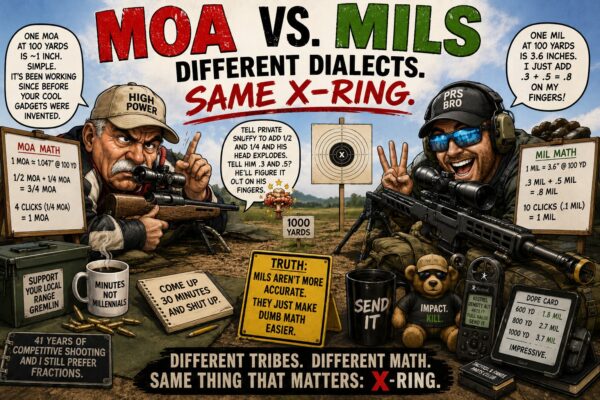
One MOA is roughly one inch at 100 yards. Yes, technically it’s 1.047 inches. I know. Before somebody wearing a Kestrel, Garmin and $4,000 worth of tactical accessories sends me a correction, I’m aware of the extra .047.
We just don’t care.
At 600 yards, one MOA is about six inches. At 1,000, about ten and a half.
Simple. Generations of American riflemen somehow managed to hit things using this system.
Then the PRS crowd showed up.
Apparently long-range shooting wasn’t complicated enough.
Now, before the tactical priesthood begins angrily typing, I know: mils aren’t actually metric. A milliradian is an angular measurement, just like MOA.
But that’s inevitably how somebody explains it:
“One mil is ten centimeters at 100 meters.”
Wonderful.
I was trying to shoot a rifle.
Now I’m converting foreign currency.
Forget centimeters. Forget meters. Forget pretending NATO has seized control of your firing point.
For an American shooter:
One mil is 3.6 inches at 100 yards.
That’s it.
At 500 yards, it’s 18 inches. At 1,000 yards, it’s 36 inches. One mil is approximately 3.438 MOA.
And let’s kill another myth while we’re here:
Mils are not more accurate than MOA.
That’s nonsense.
They’re measurements.
Saying mils are more accurate than MOA is like saying centimeters are more accurate than inches. The accuracy comes from the resolution of the measurement, the equipment, the shooter and whether he can actually put the bullet where he intended.
The ruler doesn’t make you smarter.
But mils do have one advantage that pains me to admit:
**The math is idiot-resistant.**
And suddenly the military’s affection for mils begins making a lot more sense.
Imagine you’re teaching a bunch of infantry dudes who want to become snipers.
“Okay, Private. Add one-half MOA and one-quarter MOA.”
You can practically smell the electrical fire.
Eyes glaze over. Smoke begins coming from one ear. Somewhere a platoon sergeant starts yelling.
Fractions!
The natural enemy of the infantryman.
Now try this:
“Add .3 mil and .5 mil.”
Private Snuffy stares at his fingers for three seconds.
“.8, Sergeant.”
PROMOTE AHEAD OF PEERS.
That’s the real beauty of mils.
They’re decimal.
A typical adjustment is 0.1 mil. Ten clicks equals one mil. You can add .3 and .5 without finding a common denominator or remembering anything from seventh-grade mathematics.
It’s beautifully simple.
Meanwhile, traditional American riflemen continue happily using quarter-minute adjustments because apparently fractions build character.
Four clicks equals a minute. Six clicks equals a minute and a half. Seven clicks equals one and three-quarter minutes.
We’ve been doing it so long we don’t even think about it.
And that’s really what the MOA-versus-mil argument is about.
It’s not accuracy.
It’s familiarity.
Tell an old High Power shooter he’s one minute low at 600 yards and he’ll immediately know what that means.
Tell him he’s 0.3 mil low and he’ll look at you like you’ve just asked him to divide the restaurant bill in Euros.
Meanwhile, tell a PRS shooter to hold .4 left and he’s perfectly happy.
Different tribes. Different languages. Same bullet.
PRS shooters tend to speak mils. Traditional American competitive rifle shooting grew up speaking minutes.
Neither makes the rifle more accurate.
Neither changes gravity.
Neither makes the wind blow less.
And neither one gives the shooter some mystical ballistic advantage over the other.
They’re just two different ways of measuring an angle.
Mils aren’t more accurate.
MOA isn’t more American because George Washington personally decreed quarter-minute clicks at Valley Forge.
One uses decimals beautifully.
The other uses a system generations of American competitive shooters already understand instinctively.
So yes, I finally understand mils.
They’re logical.
They’re efficient.
They’re easy to teach.
I can even see why the military likes them.
But after decades of thinking in minutes, I see no compelling reason to retrain my brain.
The PRS guys can keep saying, “Hold point-three.”
I’ll keep saying, “Give me a minute.”
We’ll both eventually arrive at the same X-ring.
Assuming Private Snuffy isn’t wearing mittens this time.
If you enjoyed this article, then please REPOST or SHARE with others; encourage them to follow AFNN. If you’d like to become a citizen contributor for AFNN, contact us at managingeditor@afnn.us Help keep us ad-free by donating here.
_________________________________
Substack: American Free News Network Substack
Truth Social: @AFNN_USA
Facebook: https://m.facebook.com/afnnusa
Telegram: https://t.me/joinchat/2_-GAzcXmIRjODNh
Twitter: https://twitter.com/AfnnUsa
GETTR: https://gettr.com/user/AFNN_USA
CloutHub: @AFNN_USA
As Mr Cloft is explaining how marksmanship works, my thoughts went to just how bad a shots the criminal gang-bangers are. One intended target among three people, intended target wounded but survives, one innocent bystander killed and the other innocent bystander missed completely, and the Philadelphia Police Department collect sixty shell casings from four shooters at the crime scene.