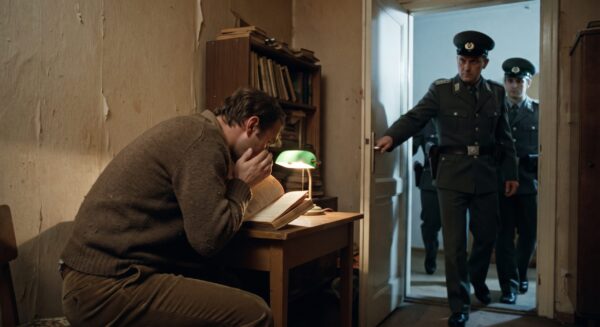
Every regime examined so far shares one more thing in common, and it might be the most important one: none of them could survive an honest conversation about what they actually were. Not Stalin’s Russia, not Mao’s China, not Castro’s Cuba, not Ortega’s Nicaragua or Maduro’s Venezuela. Each one needed its subjects to believe something false — not as an unfortunate byproduct of propaganda, but as a structural requirement, as load-bearing as any wall in the building.
Here’s the argument: the lie isn’t incidental to these systems. It’s necessary to them. And once you see why, everything else already covered — the broken price signals, the hidden fortunes, the vote that can’t be lost — starts to look like different symptoms of the exact same disease.
The Dissident Who Explained the Mechanism
Václav Havel, writing from inside communist Czechoslovakia in 1978, gave the clearest account anyone has ever produced of how this actually works. “Because the regime is captive to its own lies, it must falsify everything,” he wrote. “It falsifies the past. It falsifies the present, and it falsifies the future.”
His most famous illustration is a greengrocer who places a sign in his shop window reading “Workers of the world, unite!” Havel’s point wasn’t that the greengrocer believes it. Nobody believes it, including the people who print the signs. The point is that displaying it costs the greengrocer nothing and protects him from suspicion, while refusing to display it would cost him everything and invite exactly the suspicion he’s trying to avoid. Multiply that single transaction by an entire population, and Havel arrived at the sentence that should be carved somewhere prominent: by going along, “individuals confirm the system, fulfill the system, make the system, are the system.” The lie isn’t imposed from above and suffered from below. It’s manufactured collaboratively, continuously, by millions of people individually deciding that going along costs less than refusing.
And this is why Havel argued the system’s greatest vulnerability isn’t a rival army or a foreign sanction. It’s a single person telling the truth out loud. “If the main pillar of the system is living a lie,” he wrote, “then it is not surprising that the fundamental threat to it is living the truth. This is why it must be suppressed more severely than anything else.” Not suppressed because it’s dangerous in the way a weapon is dangerous. Suppressed because it’s the one thing the entire architecture cannot coexist with.
What the Lie Is Actually For
Hannah Arendt pushed the diagnosis one level deeper. Most people assume propaganda’s goal is persuasion — convince the population the regime is good, generous, historically inevitable. Arendt argued the actual goal is more radical and considerably darker: not to convince people of a specific falsehood, but to destroy their capacity to distinguish falsehood from truth at all. “The ideal subject of totalitarian rule,” she wrote in The Origins of Totalitarianism, “is not the convinced Nazi or the convinced Communist, but people for whom the distinction between fact and fiction… and the distinction between true and false… no longer exist.”
That’s a genuinely different claim than “the regime lies a lot,” and it explains something the earlier explanations couldn’t fully account for on their own. A population that can still tell true from false retains, even under total political control, one piece of leverage no censor can fully confiscate: the ability to notice, privately if nowhere else, that the emperor has no clothes. Destroy that distinction instead of merely contesting it, and the leverage disappears completely. There’s no longer a truth being hidden from you. There’s no longer a “truth” at all, in any sense you could act on.
The Pattern, Wherever You Look
Run that framework back over the ground already covered and the same mechanism appears every time, wearing a different uniform.
Stalin’s government kept exporting more than a million tons of grain to the West throughout the Holodomor, while denying at home and abroad that any famine existed — not a cover-up so much as a demonstration that the state’s version of events would hold regardless of what its own grain ships were doing. Mao’s provincial officials, terrified of admitting the Great Leap Forward’s collectivization was failing, reported harvests far larger than what had actually grown, and Beijing exported food on the strength of numbers that had never been true — a bureaucracy lying to itself all the way up the chain until the lie became the only version of reality anyone could safely act on. Nien Cheng, watching Cultural Revolution propaganda claim economic triumphs that didn’t exist, concluded the lies served “no purpose except to create the impression that truth was unimportant” — which is Arendt’s thesis, stated by someone who lived inside it rather than theorized about it from outside.
Castro’s four-decade insistence on a $36 salary functioned the same way at smaller scale: the claim’s plausibility was never the point. Its persistence regardless of plausibility was the point, because backing down from it would have meant conceding that the whole system’s self-description could be contradicted by evidence — a concession the ideology cannot survive making, once. And Ortega and Maduro’s current information suppression — independent tallies dismissed, journalists jailed, election results announced hours before any real count could exist — is simply the same mechanism running today, in real time, rather than in an archive.
Why This Is the Closing Argument
Here’s the connection worth making explicit. Every mechanism examined earlier — price controls that erase real information, need-based distribution that rewards dishonesty about effort, a ruling class that must hide its actual privilege behind an ideology of shared sacrifice — requires the same thing the lie requires: a population that has stopped checking the distance between the official story and the observable world. You cannot run a rigged price system, a corrupted incentive structure, or a hidden fortune next to a citizenry that’s still permitted to notice and say what it notices. The economic dysfunction and the informational dysfunction aren’t two separate problems these regimes happen to share. They’re the same problem, viewed from two different angles. A system built on a false premise about human nature and scarcity cannot tolerate an honest conversation about its own results, for exactly the same reason it can’t tolerate an honest price: both would immediately reveal what the system is actually doing, rather than what it claims to be doing.
That’s the last piece of the argument built from the start. Lack consciousness doesn’t just misallocate resources and manufacture grievance. It has to, eventually, come for the truth itself — because the truth, left alone, would eventually say what every ration line, every empty shelf, and every hidden villa was already saying quietly the whole time.
Contact: cushman.younger@gmail.com
Some of Cushman Younger’s favorite poems – NOW available on Amazon Kindle under the title “The Cruel March of Time“.
____________________________________________________________________________________________
If you enjoyed this article, then please REPOST or SHARE with others; encourage them to follow AFNN. If you’d like to become a citizen contributor for AFNN, contact us at managingeditor@afnn.us Help keep us ad-free by donating here.
Substack: American Free News Network Substack
Truth Social: @AFNN_USA
Facebook: https://m.facebook.com/afnnusa
Telegram: https://t.me/joinchat/2_-GAzcXmIRjODNh
Twitter: https://twitter.com/AfnnUsa
GETTR: https://gettr.com/user/AFNN_USA
CloutHub: @AFNN_USA