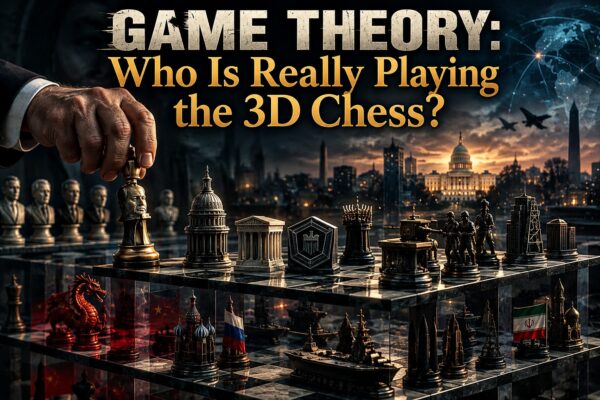
Game theory is mankind’s invention of 3D chess—the mathematical realization that rational people sometimes do things that look completely irrational because they aren’t playing the game you think they’re playing.
The amateur looks at the board and asks, “Why the hell would he do that?”
The strategist asks, “What does he want me to think he’s going to do next?”
Add another player, another bluff, another layer of perception and another twenty years, and suddenly stupid starts looking pretty damn smart.
Now apply that to government.
Americans obsess over presidents. Every four years we convince ourselves that civilization has either been saved or destroyed because a different guy moved into the White House.
There’s just one problem.
Presidents leave.
Institutions don’t.
A president gets four years, maybe eight. The Pentagon can think in decades. The State Department maintains relationships stretching across generations. Intelligence agencies keep files, sources and institutional memories that existed before the current president knew where the Situation Room was.
NATO was founded in 1949. The Pentagon was built during World War II. Aircraft carriers take years to design and build. Nuclear weapons programs span administrations. Overseas bases, treaties, intelligence relationships and defense contracts don’t evaporate because somebody gave a concession speech on Tuesday night.
So who is really playing the long game?
That question doesn’t require a secret room underneath Washington containing twelve guys in robes stroking white cats.
That would actually make government considerably easier to understand.
The reality is more boring and probably more powerful: institutions develop their own incentives.
The Army wants readiness. The Navy wants ships. Intelligence agencies want intelligence. Diplomats want diplomatic leverage. Defense companies want contracts. Politicians want reelection. Allies want American protection. Bureaucracies generally prefer continuing to exist.
None of those desires requires evil intent.
That’s where game theory gets interesting.
Everyone can behave rationally within his own little square of the chessboard and collectively produce an outcome that looks completely insane.
A general requests another weapons system because he believes it is necessary.
Congress funds it because jobs exist in somebody’s district.
The manufacturer expands because Congress funded it.
The Pentagon incorporates it into doctrine because now it exists.
An ally builds its defense strategy around it.
Twenty years later, some newly elected president asks why we’re still doing this.
Welcome aboard, sir. Your orientation packet is on the desk.
And while Americans are arguing about which president personally controls every event on Earth, the chess game continues.
The public has another problem.
We can’t see the whole board.
Intelligence is classified. Negotiations are private. Military capabilities are concealed. Governments bluff. Intelligence agencies deceive adversaries. Some military deployments are intended to communicate something without firing a shot.
Occasionally, uncertainty itself is the weapon.
That was the logic behind the famous “madman theory”: if your opponent can perfectly predict what a rational actor will do, he can calculate exactly how far he can push him.
Predictability becomes vulnerability.
So sometimes the rational move is making the other guy wonder whether you’re irrational enough to kick over the table.
Which brings us back to American politics.
Maybe the question “Who runs America?” is too simplistic.
There isn’t necessarily one player.
There are hundreds of players operating on different timelines with different incentives, information and definitions of victory.
The president may be thinking about the next election.
A general may be thinking about the next war.
A bureaucracy may be thinking about next year’s budget.
A corporation may be thinking about the next quarterly report.
An intelligence service may be thinking twenty years ahead.
And the American public?
We’re watching three squares of the chessboard on cable television while yelling instructions at people who may be playing an entirely different game.
Sometimes government really is stupid. History provides an impressive amount of supporting documentation.
But sometimes the apparently irrational move may be perfectly rational when you can see the whole board.
The biggest mistake in 3D chess may not be misunderstanding the move.
It may be misunderstanding who the players actually are.
If you enjoyed this article, then please REPOST or SHARE with others; encourage them to follow AFNN. If you’d like to become a citizen contributor for AFNN, contact us at managingeditor@afnn.us Help keep us ad-free by donating here.
Substack: American Free News Network Substack
Truth Social: @AFNN_USA
Facebook: https://m.facebook.com/afnnusa
Telegram: https://t.me/joinchat/2_-GAzcXmIRjODNh
Twitter: https://twitter.com/AfnnUsa
GETTR: https://gettr.com/user/AFNN_USA
CloutHub: @AFNN_USA