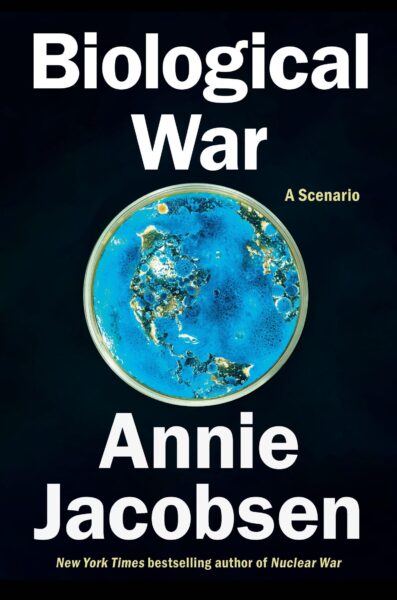
Annie Jacobsen has apparently decided that Americans are sleeping too well.
Her last book, Nuclear War: A Scenario, walked us through how civilization could end in nuclear fire. Apparently deciding mushroom clouds weren’t sufficiently cheerful, she has returned with Biological War: A Scenario.
And somehow this one is worse.
Jacobsen is one of my favorite national-security writers because she possesses a rare combination: she’s smart, curious, skeptical, and apparently has a Rolodex filled with people who once worked behind doors requiring badges most of us will never possess. Biological War is based on dozens of interviews with scientists, military officials, intelligence officers, doctors, emergency planners, and senior government officials.
But understand what you’re reading.
This isn’t Jacobsen predicting that a particular biological attack is coming. It’s a scenario—a fictional timeline constructed using real science, historical biological-weapons programs, government pandemic planning, declassified war games, and expert interviews.
Think RAND Corporation meets Stephen King.
Except the monster is microscopic.
Jacobsen begins her history in 1971, when Stanford biochemist Paul Berg helped pioneer recombinant DNA—the ability to combine genetic material from different organisms. It was one of humanity’s great scientific breakthroughs.
Medicine saw possibilities.
Scientists saw possibilities.
And somewhere, inevitably, a military officer probably looked at it and thought: Cool. Can we weaponize that?
Because humans.
The scientists themselves recognized that recombinant DNA presented risks. The famous Asilomar conference gathered researchers to discuss safeguards. But Jacobsen points toward an enormous blind spot: they concentrated on scientific safety rather than biological warfare. Meanwhile, the Soviet Union was building Biopreparat, its enormous clandestine biological-weapons program, despite having signed the Biological Weapons Convention.
There’s your first lesson.
Treaties are pieces of paper.
Biology doesn’t read them.
Jacobsen then takes us into a hypothetical catastrophe originating at Russia’s Vector biological research complex in Siberia. A genetically engineered pathogen escapes. Travelers unknowingly board airplanes. Airports become distribution hubs. Cases multiply exponentially.
There is no missile warning.
No radar track.
No mushroom cloud.
Tuesday morning just becomes a very bad Tuesday.
That’s what makes biological warfare fundamentally different from nuclear warfare.
A nuclear weapon destroys itself when it detonates. A contagious biological weapon reproduces. The infected population becomes part of the delivery system.
That’s one hell of a force multiplier.
Jacobsen’s fictional pathogen is essentially the biological equivalent of a weapon designed by Satan’s research-and-development department: highly transmissible, extraordinarily lethal, and engineered to defeat expected medical countermeasures. In her scenario, the very antibiotics people believe will save them activate another deadly mechanism.
Then comes the part military planners understand but civilians often don’t.
The pathogen isn’t the only weapon.
Fear is.
Jacobsen says one recurring lesson from biological war-gaming is the “fear of infection.” Hospitals become overwhelmed. Supplies disappear. People stop trusting authorities. Quarantines fail. Rumors spread faster than pathogens. Citizens begin fighting over medicine and food.
Eventually the government isn’t fighting the disease.
It’s fighting societal collapse.
Jacobsen notes that previous American exercises such as TOPOFF 2000 and Dark Winter explored similar problems. Those exercises ran into horrifying questions about vaccine allocation, quarantine, civil disorder, and the government’s ability to maintain control.
COVID should have made that portion easier for us to imagine.
We watched arguments erupt over masks, vaccines, school closures, statistics, laboratory origins, government authority, and censorship while Americans simultaneously hoarded toilet paper.
Now imagine something dramatically more lethal.
This is where Jacobsen’s book becomes more than nightmare entertainment.
We have spent half a century improving humanity’s ability to manipulate biology. Biotechnology has produced extraordinary benefits. Recombinant DNA helped revolutionize medicine. Genetic engineering isn’t inherently evil any more than nuclear physics is inherently evil.
But technology doesn’t have morality.
People do.
And our technical capability is advancing faster than the political, ethical, and security systems governing it.
That’s Jacobsen’s real warning.
There are legitimate criticisms. Her scenario intentionally stacks catastrophic assumptions together, and some historical claims about Soviet engineered biological weapons remain disputed or dependent upon defectors’ accounts. The New Yorker specifically notes that the existence of an actual Soviet “chimera weapon” of the kind discussed has never been proven. Another scientific review criticized some of Jacobsen’s terminology as overly dramatic.
Good.
Those caveats matter.
Because the frightening part isn’t whether Jacobsen’s exact fictional pathogen exists.
It’s that the toolbox increasingly does.
Nuclear weapons require uranium enrichment, specialized infrastructure, missiles, submarines, bombers, and enormous national resources.
Biology has a much lower barrier to entry, and Jacobsen argues that emerging technologies—including AI-assisted biological tools—may continue lowering it.
That changes the strategic equation.
I’ve argued for years that nuclear weapons are strangely self-defeating. Vaporizing cities, factories, ports, farmland, and infrastructure leaves you owning radioactive rubble.
Biological warfare presents the darker alternative.
Kill the people.
Leave the infrastructure.
Jacobsen documents that Soviet biological-war planners explicitly contemplated biological weapons partly in those strategic terms. Former Soviet program officials described ambitions to devastate an enemy while destroying its confidence in medicine and government.
That should make you uncomfortable.
Biological War isn’t perfect, and it isn’t prophecy.
It’s a war game in book form.
And like every useful war game, its purpose isn’t to predict exactly what will happen.
It’s to ask what happens if the thing everyone says could never happen…happens.
Annie Jacobsen has written another excellent book.
Unfortunately, you’ll probably sleep better if you don’t read it.
Read it anyway.
If you enjoyed this article, then please REPOST or SHARE with others; encourage them to follow AFNN. If you’d like to become a citizen contributor for AFNN, contact us at managingeditor@afnn.us Help keep us ad-free by donating here.
Substack: American Free News Network Substack
Truth Social: @AFNN_USA
Facebook: https://m.facebook.
Telegram: https://t.me/
Twitter: https://twitter.com/AfnnUsa
GETTR: https://gettr.com/user/AFNN_
CloutHub: @AFNN_USA