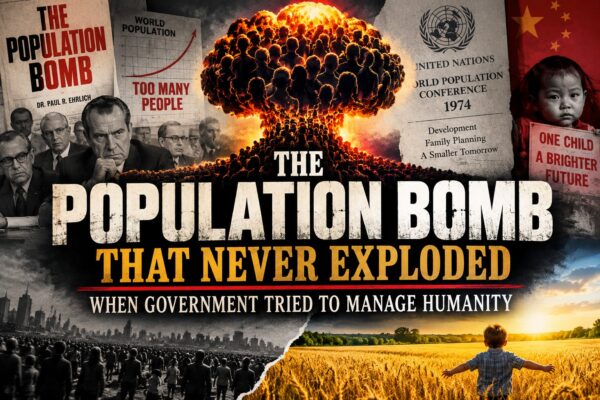
In the late 1960s and 1970s, the smartest people in the room discovered something terrifying: you.
More specifically, there were apparently going to be too many of you.
Too many babies. Too many mouths. Too many people consuming food, fuel, land and resources. The graphs went up and to the right, the computers spit out scary projections, and an impressive collection of professors, foundations, bureaucrats and governments concluded that humanity was approaching a demographic cliff.
They believed and trusted the science.
Sound familiar?
This does not require a secret meeting in a volcano where Henry Kissinger, Chairman Mao and a collection of Bond villains stroked white cats and decided to eliminate half the planet. The historical record is actually more interesting than that.
They largely told us what they were doing.
Paul Ehrlich’s 1968 bestseller, The Population Bomb, popularized predictions of catastrophic overpopulation and famine. Governments were already thinking along similar lines. Population growth increasingly became connected to poverty, pollution, resource depletion and political instability.
Then government got involved, because government has never encountered a complicated human problem it couldn’t improve with a committee.
In 1972, President Nixon’s Commission on Population Growth and the American Future recommended policies intended to slow population growth and eventually achieve population stabilization. Among its recommendations were expanded contraception, sterilization access, population education and liberalized abortion laws. Nixon notably rejected abortion as a method of population control, but the larger debate was unquestionably happening inside the federal government.
Then things became even more interesting.
In April 1974, the Nixon administration issued National Security Study Memorandum 200—NSSM 200—ordering the government to examine the “Implications of Worldwide Population Growth for U.S. Security and Overseas Interests.”
That’s not something somebody found scribbled on the back of a napkin at Area 51.
It’s sitting in the State Department’s historical archives.
The resulting study examined population through demographic, economic, resource and national-security lenses and developed recommendations for a global population strategy. President Ford’s administration subsequently considered those recommendations.
Meanwhile, the United Nations held the 1974 World Population Conference in Bucharest. Representatives of 135 countries gathered to discuss population and development. The resulting World Population Plan of Action treated population policy as part of socioeconomic planning while also affirming that couples should freely determine the number and spacing of their children.
But governments being governments, “perhaps people should have fewer children” didn’t always remain a suggestion.
China began its “Later, Longer, Fewer” campaign during the 1970s: marry later, space births farther apart and have fewer children. Chinese fertility plunged from roughly 5.9 children per woman in 1970 to about 2.7 by 1979. Then came the One-Child Policy. Research documents coercive measures associated with China’s birth-planning campaigns, including forced pressure surrounding abortions and sterilizations.
The theory was straightforward.
There were too many people.
Resources were finite.
Food production couldn’t keep up.
Therefore, government needed to manage human reproduction.
There was just one annoying variable the models repeatedly underestimated:
Human beings.
While one group of experts was counting mouths, Norman Borlaug and agricultural scientists were figuring out how to feed them.
The Green Revolution introduced improved wheat and rice varieties, fertilizers, irrigation and better agricultural techniques. Borlaug reported that Pakistani wheat production increased from 4.6 million tons in 1965 to 8.4 million in 1970. Indian wheat production climbed from 12.3 million tons to 20 million tons over roughly the same period. Fields didn’t get dramatically larger. Human beings figured out how to produce more food from them.
Imagine that.
The equation contained an unmodeled variable called human ingenuity.
That’s where this becomes more than an interesting history lesson.
Science wasn’t the problem. Borlaug was a scientist too.
The problem comes when scientific projections become political certainty, uncertainty gets discarded, dissent becomes ignorance, and government acquires enough confidence in a model to start reorganizing human behavior around it.
You don’t need a conspiracy.
You need consensus.
Get enough respected institutions working from the same assumptions, reading the same literature, attending the same conferences and funding research built around the same premises, and independent governments can begin implementing remarkably similar policies without anybody sending orders from World Headquarters.
Everyone is simply “following the science.”
And occasionally the science changes.
The biblical contrast is fascinating. Genesis doesn’t describe humanity merely as another column on the resource-consumption spreadsheet. It says:
“Be fruitful, and multiply, and replenish the earth, and subdue it.” — Genesis 1:28.
That doesn’t mean resources are unlimited. Scripture also imposes stewardship. You don’t get permission to trash creation because God told Adam to have children.
But Genesis recognizes something the spreadsheet can miss.
A human being isn’t merely another stomach.
He’s another brain.
Another pair of hands.
Another farmer, engineer, inventor, scientist or Norman Borlaug who might discover how to grow twice as much wheat on the same dirt.
The population pessimists counted consumers.
God counted creators, made in his image.
And there’s your warning from history.
The dangerous phrase isn’t necessarily, “We have a secret plan.”
Sometimes it’s much simpler:
“Don’t worry. The experts agree. Just trust the science.”
If you enjoyed this article, then please REPOST or SHARE with others; encourage them to follow AFNN. If you’d like to become a citizen contributor for AFNN, contact us at managingeditor@afnn.us Help keep us ad-free by donating here.
Substack: American Free News Network Substack
Truth Social: @AFNN_USA
Facebook: https://m.facebook.
Telegram: https://t.me/
Twitter: https://twitter.com/AfnnUsa
GETTR: https://gettr.com/user/AFNN_
CloutHub: @AFNN_USA