It is no longer a secret that virtually all sources are biased in some way.
Every pundit, analyst and man-on-the-street enters any political discussion with the biases of his own background, philosophy, values and self-interest.
The only questions are how hard the person tries to rise above them to give relatively unbiased opinions, if he wants to rise above them at all, or if he sees his opportunity to opine as an opportunity to affect the outcome.
It is no secret that polling has been broken for some time. Even honest pollsters – and yes, there are still some of them – admit that it’s more difficult than ever to gain an accurate read on any population today, for a number of reasons:
- The disappearance of land lines makes location harder to confirm, and makes identified targets harder to reach.
- Conservative distrust of polling makes conservatives less likely to agree to be polled if called upon.
- The knowledge that there is election fraud, but the unknowable nature of the extent of it, makes it more difficult than ever for pollsters to correct for it in their analysis.
- The fact that so many groups now make political decisions against their own self-interest (such as Jews and gays who still support islamist candidates who vocally advocate for their eradication) makes it harder to make traditional assumptions about many voting groups.
- The knowledge that there is so much identity theft and other hacking out there keeps even people who would otherwise be willing to answer a poll, hesitant to pick up the phone for any unknown caller further limiting the poll’s potential participant pool.
And that’s before we even address the fact that most of the pollsters out there are really doing push-polling nowadays, intentionally asking leading questions to drive public opinion rather than measure it.
So it is that those of us who worry about upcoming elections look for some other source to study, and we have found one: the betting markets.
Thanks largely to the internet, and to the difficulty that many anti-gambling states have found in trying to control gambling, there is now a way to gamble on virtually every question on earth, especially if you just don’t call it gambling. When you just change the name to “prediction market,” even absolutely anti-gambling states find it difficult to ban the practice from their borders.
There are subtle (and some not so subtle) differences between gambling sites, betting exchanges, and prediction markets. Some have membership costs, the house keeps varying percentages of the pot, and so forth; different gamblers therefore participate in different sites.
And since it’s a relatively new and rapidly changing field – at least in this internet world – there isn’t as much data as there is in a century of polling, so it’s much more difficult to judge its track record.
The latest thing – therefore, for people who want to sound like they are keyed into the latest thing – is to dismiss the polls and judge the odds reported on Kalshi, Polymarket, and similar sites. “Forget the polls,” one might say, “What does Las Vegas think is really going to happen?”
This sounds great.
It gives the impression that the speaker is more modern, more thorough, more sophisticated, than all those analysts who just pay attention to boring old polls.
But there’s a problem with this one too, and it may be an even bigger problem than there is with polling.
Unlike polling – at least, unlike the stated purpose of polling, whether honest or dishonest – gambling is fundamentally all about making money, not about getting a prediction right.
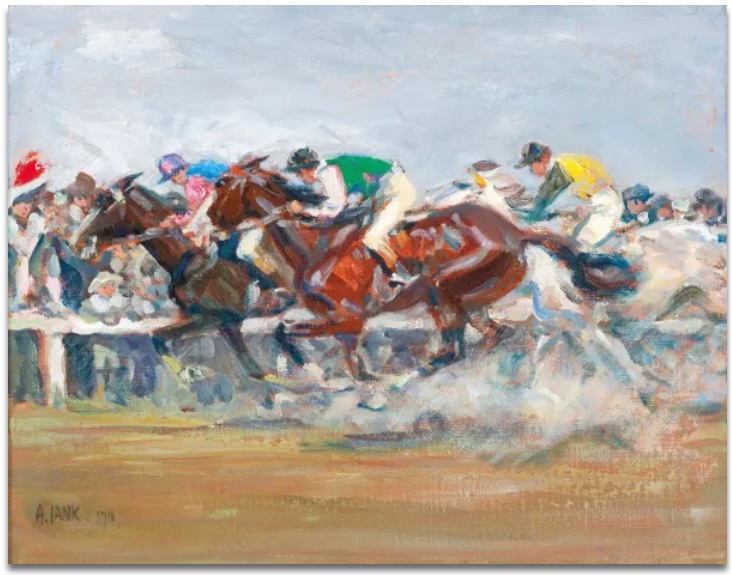
When you go to a horse race, you don’t see a simple choice of winners and get rewarded if you pick the right one. What you see is a range of odds, and you get rewarded if your package of bets turns out to be the most lucrative package of bets for you. These are very different things.
Gambling is about studying the odds, and then, making the most of those odds.
- If everyone knows who’s going to win a certain race, you don’t bother to bet it at all, because everyone is going to bet on the obvious winner and there won’t be anything substantial to split in the payout.
- If a race is tight, with near-equals going up against each other, the relative odds may make the difference between it being worth the bother or not.
- If a race has very unpredictable candidates – such as one horse that’s great in mud and another that’s great in dry conditions, and the weather forecast changes from two weeks out, to one week out, to race day – then the odds will change wildly over the course of time, causing a range from 5-to-4 to 2-to-1 to 10-to-1 to 40-to-1 over the days and hours from when betting opened.
Note Bene: I’m not a gambler, so I’m just mentioning the highlights. A real gambler could provide a dozen more scenarios illustrating the variety of how odds work in sports, but this much should suffice to make the necessary point:
The gambler isn’t so much trying to predict the winner as to maximize his final jackpot. If he bids on eight races in one day, he doesn’t care if he’s wrong on half of them, if the total payout for the four he won works out well enough for him.
True gamblers therefore skip many races, and focus on the ones where they can make money if they guess right. Win one race at 20-to-1 and you’ll do better than winning several races at 5-to-4. So you bet on the ones where you have a feeling it’s possible, not certain, if the odds are high enough.
And you know what else you can do with gambling? You can bet on both outcomes. You can cover yourself by betting on one winner in one marketplace and on his opponent on another marketplace, just because the conditions of those two separate bets work out differently.
This isn’t to say there’s anything dishonest about the gambling markets. Unless you have an ethical opposition to gambling in general (which is certainly a legitimate concern), there’s nothing wrong with the way it’s done and the variety between the approaches.
These sites are businesses – and their participants are viewing the practice as a business for themselves as well.
So when we look at these markets and say “The betting markets think this candidate, or this party, is going to win this race or this state,” we are really getting it absolutely wrong.
In reality, what we’re seeing is that “The majority of people in the betting markets think they’ll make the most money on their bets if this candidate, or this party, in this race or this state wins.”
It doesn’t really mean that they favor a candidate or a party. It doesn’t mean they think a candidate or a party will be better for their country than the opposition. It just means that on that race, with the conditions placed on the bet by the site in question, the gambler thinks he’ll make more money if he structures his bet that way. That’s all it means.
In fact, it’s likely than in some cases, perhaps many, a voter depressed by his gubernatorial candidate may be hoping to recoup in gambling winnings some of the cost that the likely winner will rob him of, in taxes and economic opportunities, if he gets in. You can picture a voter thinking “If the good guy wins, he’ll lower my taxes, but if the bad guy wins, he’ll raise my taxes, so I’ll bet on both, considering the current odds on this site, so I can at least make some gambling winnings off the bad guy if he gets in, to make up for the tax collection he’ll steal from me over the next four years.”
The betting markets are also a severely lagging indicator, where elections are concerned. They include people who placed bets weeks or months ago (depending on how the stats are reported), as opposed to last weekend’s poll taken over a known span of two or three days, or as opposed to the actual number of people who’ve shown up at the early vote locations this week.
If you want current data, in the moving target of a national election, the betting markets are harder to analyze, not easier.
None of this is to say that we shouldn’t pay any attention at all to the gambling markets at election time, as one more data point in the mix, along with polling, news coverage, campaign money, absentee ballot requests, early voting numbers, and everything else.
But it is to say that we shouldn’t accept some analysts’ opinion that the gambling market is somehow a more pristine predictor than these others.
In many ways, it’s a less accurate predictor than the rest, because of that fundamental issue: the gambler’s goal is to make money, not to get it right.
Copyright 2026 John F. Di Leo
John F. Di Leo is a Chicagoland-based international transportation and trade compliance trainer, speaker, and consultant. His book on vote fraud (The Tales of Little Pavel), his political satires on the Biden-Harris administration (Evening Soup with Basement Joe, Volumes I, II, and III), his first nonfiction book, “Current Events and the Issues of Our Age,” and his brand new collection of stories about the heroes of the American Founding, “The Founding Generation: The Patriots Who Built America,” are all available in either eBook or paperback, only on Amazon.
His trade compliance training practice is available either in person or by webinar. And as a member of the Chicagoland theatre community, his current performance is as Archie in Brigadoon in Palatine, Illinois, from October 3 through 18, 2026.
If you enjoyed this article, then please REPOST or SHARE with others; encourage them to follow AFNN. If you’d like to become a citizen contributor for AFNN, contact us at managingeditor@afnn.us Help keep us ad-free by donating here.
Substack: American Free News Network Substack
Truth Social: @AFNN_USA
Facebook: https://m.facebook.com/afnnusa
Telegram: https://t.me/joinchat/2_-GAzcXmIRjODNh
Twitter: https://twitter.com/AfnnUsa
GETTR: https://gettr.com/user/AFNN_USA
CloutHub: @AFNN_USA