The bigger view one takes of the world today, the clearer the picture becomes.
Americans are often asked to judge foreign policy one headline at a time. A tariff announcement. An energy agreement. A demand that an ally pay more for its defense. Each becomes a separate controversy, and the larger strategic question disappears beneath the noise.
What happens when we consider these actions together? (NOTE: Geopolitics and foreign policy have been integral to my professional background for 35 years.)
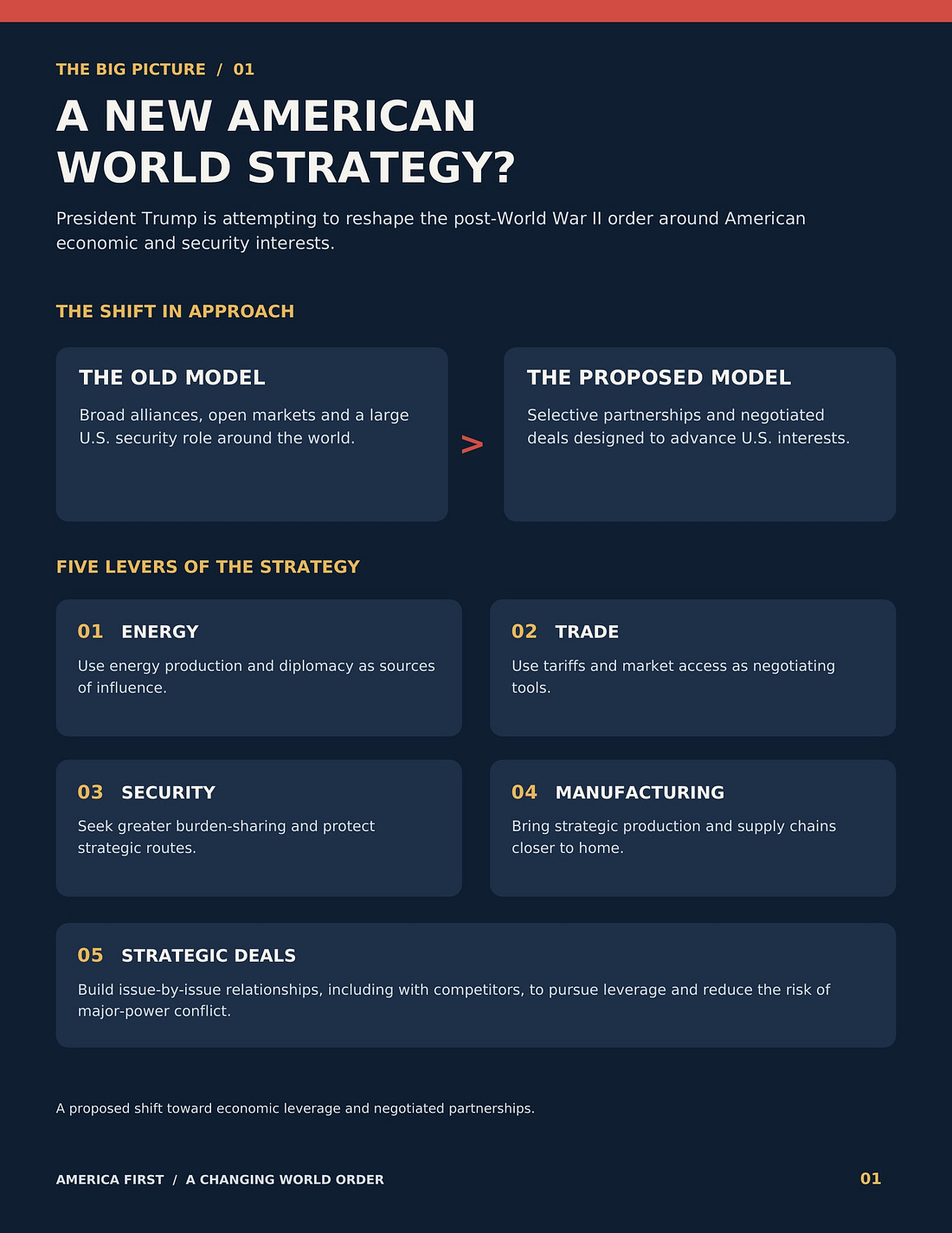
The approach outlined here suggests President Trump is attempting to reorganize America’s relationships around a straightforward principle: our international commitments should produce measurable benefits for the American people. Energy, trade, manufacturing, diplomacy, and military power become mutually supporting tools toward that objective.
That is the proposed strategy. Understanding how it could work requires looking beyond today’s announcement.
To complete this analysis of today’s global environment, I drew on work I did in the military building strategies to enhance America’s strength through means beyond military power. The two products lined up well, and it helped me see what is happening because I built much of this strategy years ago. I have no idea where it went at the time and still don’t. But, like my work in drones and autonomous warfare in 2010, I get to watch things I worked on decades ago become reality.
After World War II, the United States helped build an international system supported by alliances, trade, financial institutions, and American military strength. That system served important American interests. It also created extensive commitments that deserve continued examination. An arrangement that made sense under one set of conditions should not become an obligation nobody is allowed to question.
A military commander must continuously assess whether the mission, resources, and operating environment still align. National strategy requires the same discipline.
The central question is simple: what are Americans receiving in return for what we commit?
I. Energy.
Energy underpins nearly every other source of national power. Factories need electricity. Transportation requires fuel. Agriculture depends on both. A nation’s ability to produce reliable energy affects its economic strength and its freedom to make decisions without outside pressure.
Under this proposed approach, American energy production also becomes an instrument of diplomacy. Countries seeking dependable supplies could have stronger reasons to build relationships with the United States. Expanding available supply could give buyers alternatives to suppliers willing to use dependence as a weapon.
However, production alone does not guarantee lower prices. Infrastructure, transportation, investment, and global conditions still matter. The strategic objective is greater resilience and influence. Promising that every development will immediately reduce the family fuel bill would confuse an objective with an outcome.
II. Trade
Access to American consumers has value. The proposed strategy treats that access as something negotiators can use to seek better terms, encourage investment, and address vulnerabilities in critical industries.
Tariffs fit into that approach as a means to apply pressure. But pressure needs a purpose. What concession is being sought? How does a person define success? Under what conditions would the tariff change?
Without answers, a negotiating instrument can become a continuing expense with no clear purpose.
Americans should also understand that tariffs can raise costs for importing businesses and their customers. Whether the longer-term benefits justify those costs depends on the agreement achieved and the economic response. Calling a tariff patriotic does not remove the requirement to evaluate its results.
Manufacturing is where these economic questions become security questions.
A country that cannot reliably obtain critical components, medicines, industrial equipment, or defense supplies has a vulnerability others can exploit. A military formation may have excellent personnel and equipment, but its effectiveness declines quickly when its supply lines fail. Consider this in light of the new requirement for each major military base to maintain 90 days of supplies to ensure autonomy and the ability to respond in a crisis.
The same principle applies to a nation.
Bringing strategic production closer to home could reduce exposure to overseas disruptions while creating investment and employment opportunities. That requires more than announcing a factory. Reliable power, skilled workers, transportation, financing, and predictable rules must support actual production.
The objective should be the ability to sustain essential national functions during a crisis. A ribbon-cutting ceremony is only the beginning.
III. Security Commitments
Alliances can extend American reach and help prevent conflict. Their strength also depends on partners contributing meaningful capabilities. Seeking greater burden-sharing asks whether those relationships have the resources and responsibilities necessary to endure.
Strategic routes matter for the same reason. Energy and commerce must move. Ports, shipping lanes, and other transportation corridors connect economic activity to military requirements.
Economic security and military security meet wherever those routes can be disrupted.
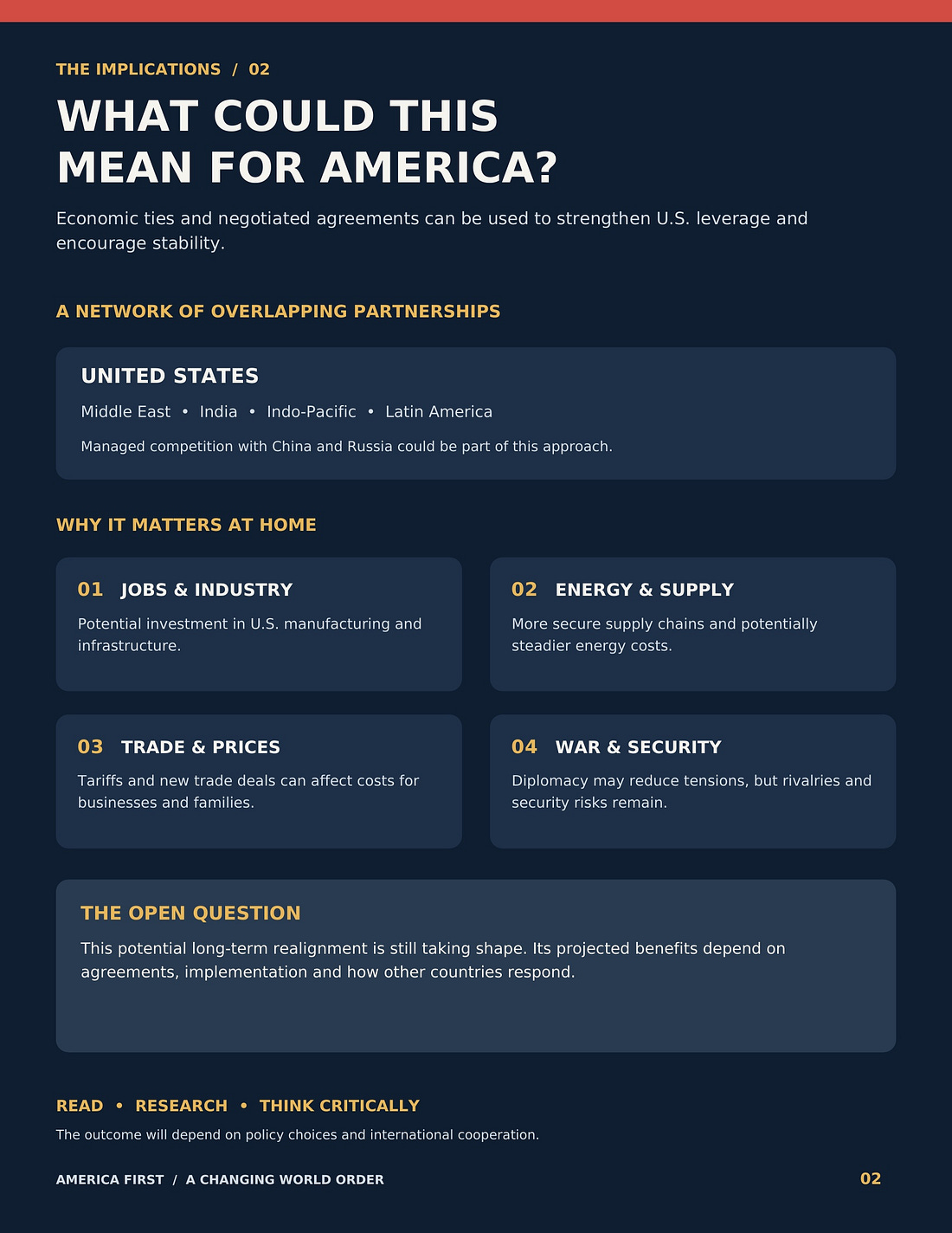
The proposed network of partnerships would connect these interests across the Middle East, India, the Indo-Pacific, and Latin America. Different relationships could serve different purposes. One might emphasize energy, another manufacturing, another access or regional security.
This approach could also include limited agreements with competitors such as China and Russia.
Negotiating with a competitor requires clear objectives and an accurate understanding of its interests. An agreement can be useful without settling every disagreement. It can also fail if one side mistakes a signature for a change in the other side’s ambitions.
Managed competition would therefore require verification, credible consequences, and the ability to walk away. Economic ties may increase the cost of conflict, but they cannot guarantee peace.
What does any of this mean for Americans at home?
Potentially, it means stronger industrial capacity, more dependable supplies, and partnerships that distribute security responsibilities more effectively. It could also mean higher costs in some sectors, retaliation against American producers, or uncertainty that delays investment.
Execution will determine which consequences become dominant.
That is why citizens should demand specific measures of success. Are critical industries becoming more resilient? Are agreements producing the promised access? Are partners contributing more? Can families better afford essential goods? Is the risk of war declining?
America First means all actions must be accountable to American citizens alone.
The opportunity described here is to connect national resources and international relationships to clear national purposes. Whether that opportunity becomes lasting strength depends on disciplined implementation and honest assessment.
Read beyond the headline. Examine the agreements. Follow the results. Understand what is happening; it’s a lot bigger than any headline.
(THIS COULD SPARK SOME HEALTHY DEBATE, IT SHOULD)
Below you’ll see two picture graphics that summarize this article, and a pdf file for those who prefer that.
 |
 |
This article first appeared on Darin Gaub’s Substack. Reprinted here with permission.
If you enjoyed this article, then please REPOST or SHARE with others; encourage them to follow AFNN. If you’d like to become a citizen contributor for AFNN, contact us at managingeditor@afnn.us Help keep us ad-free by donating here.
Substack: American Free News Network Substack
Truth Social: @AFNN_USA
Facebook: https://m.facebook.com/afnnusa
Telegram: https://t.me/joinchat/2_-GAzcXmIRjODNh
Twitter: https://twitter.com/AfnnUsa
GETTR: https://gettr.com/user/AFNN_USA
CloutHub: @AFNN_USA