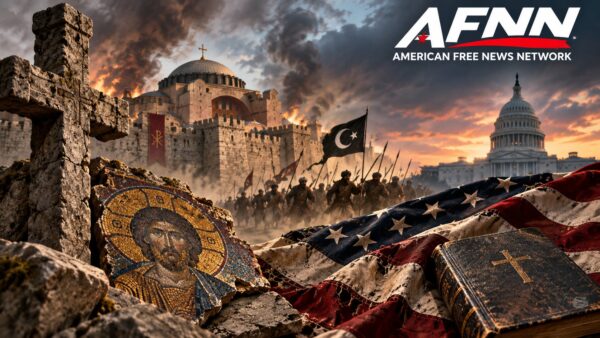
Fourteen centuries ago, Christian civilization was losing a war against Islam. One theologian had a disturbing explanation: God wasn’t necessarily helping the Muslims. He was punishing the Christians.
By 690 AD, Christian civilization had suffered a geopolitical ass-kicking of biblical proportions.
In barely fifty years, Muslim armies had ripped Syria, Palestine, and Egypt from the Byzantine Empire. Jerusalem, the city where Christ was crucified and resurrected, had fallen under Islamic rule. Ancient Christian communities now answered to Muslim rulers, and Constantinople was staring down an expanding Islamic empire.
Christianity hadn’t simply lost a few border skirmishes. It had lost some of its holiest lands.
Enter Pseudo-Methodius, an anonymous Christian theologian with a diagnosis that must have gone over about as well as a fart during Easter Mass.
What if God wasn’t rewarding the Muslims for their righteousness? What if He was using them to punish Christians for abandoning theirs?
That’s right. According to Pseudo-Methodius, the enemy wasn’t winning because God approved of its religion. The enemy was winning because God’s own people had become morally corrupt.
And he brought receipts.
Men dressing as women. Prostitution. Sexual immorality. Same-sex relations. Christians abandoning their faith and treating biblical commandments like optional suggestions.
Apparently, seventh-century Christianity was already auditioning for a Netflix original.
But Pseudo-Methodius wasn’t simply complaining about the latest moral outrage. He was making a much more disturbing theological argument.
Sometimes God doesn’t destroy a disobedient civilization Himself. He allows its enemies to do the demolition.
The Old Testament repeatedly describes God using foreign powers to discipline His people.
Isaiah 10 calls Assyria the rod of God’s anger. Assyria punishes Israel, then faces judgment for its own arrogance and brutality.
Babylon conquers Judah, destroys Jerusalem, and carries its people into exile.
The biblical message is unmistakable.
God can use an unrighteous nation to punish a disobedient people without endorsing the conqueror’s beliefs or behavior.
Pseudo-Methodius believed the Islamic conquests followed that pattern.
He wasn’t suggesting Christians should surrender their faith, embrace Islam, or welcome conquest.
Quite the opposite.
His warning was that abandoning Christian morality had consequences, and military strength alone couldn’t compensate for spiritual decay.
Fast-forward to 2026.
America possesses technology that would make Byzantine emperors faint.
Artificial intelligence, satellites, smartphones, and refrigerators that apparently know when we’re cheating on our diets.
Yet we’ve somehow become confused about questions our ancestors considered fundamental.
What is truth? What is morality? What constitutes a family? Is anything inherently right or wrong?
Welcome to moral relativism, where everybody gets their own truth and objective morality is treated like an embarrassing family heirloom.
Throw in nihilism, the belief that life lacks inherent meaning, and congratulations!
You’ve created a society with unlimited entertainment, unlimited opinions, and increasingly little agreement about what makes life worth living.
We celebrate freedom while forgetting that freedom without responsibility eventually becomes chaos.
We dismiss traditional morality as outdated, then complain about dishonesty, selfishness, broken families, and declining trust.
Apparently, civilization is supposed to function like an IKEA bookshelf assembled without instructions.
Sure, there are extra screws lying around, and the whole thing leans fifteen degrees to the left.
But questioning its structural integrity is apparently intolerant.
Here’s where Pseudo-Methodius becomes particularly relevant.
His argument wasn’t that Christians should ignore external threats while endlessly criticizing themselves.
It was that defending Christian civilization requires actually preserving Christian civilization.
That means defending religious liberty, marriage, family, personal responsibility, objective morality, and the biblical principles that shaped Western institutions.
It also means understanding that Christianity isn’t simply a cultural identity or a political affiliation.
It’s a faith with commandments, obligations, and standards that don’t change every time public opinion discovers a new fashion.
Christians cannot demand that society respect their values while treating those values as optional in their own lives.
Nor should they pretend that every competing ideology is equally compatible with the principles of a free constitutional republic.
Religious freedom protects the individual conscience. It doesn’t require Americans to surrender constitutional government to any religious political system.
Those distinctions matter.
America debates immigration, religious extremism, collapsing birthrates, declining church attendance, and cultural fragmentation.
Those aren’t imaginary concerns.
But a civilization facing external challenges is particularly vulnerable when it has forgotten what it believes.
Imagine Byzantine soldiers standing on Constantinople’s walls while their commanders debate whether defending the city is morally appropriate.
The invading army would probably appreciate the philosophical discussion.
Pseudo-Methodius believed the Islamic conquests were both a genuine threat and an instrument of divine judgment.
We cannot know whether his interpretation was correct, much less declare that God is delivering the same judgment upon America today.
But the biblical principle deserves serious consideration.
A civilization cannot abandon its moral foundations and expect its military, economy, or government to preserve what its people no longer believe.
The Byzantine Empire survived the seventh-century conquests, but its struggle offers a warning worth remembering.
Fourteen centuries later, America has better weapons, greater wealth, and technology beyond medieval imagination.
What it increasingly lacks is agreement about truth, virtue, and responsibility.
Maybe Pseudo-Methodius was wrong about why the Muslims were winning.
But he understood something we seem determined to forget.
You cannot defend a civilization’s values if you’re busy dismantling them from the inside.
And if the foundations finally collapse, don’t blame the fellow standing outside with a hammer.
We spent decades pulling out the load-bearing beams ourselves.
If you enjoyed this article, then please REPOST or SHARE with others; encourage them to follow AFNN. If you’d like to become a citizen contributor for AFNN, contact us at managingeditor@afnn.us Help keep us ad-free by donating here.
Substack: American Free News Network Substack
Truth Social: @AFNN_USA
Facebook: https://m.facebook.com/afnnusa
Telegram: https://t.me/joinchat/2_-GAzcXmIRjODNh
Twitter: https://twitter.com/AfnnUsa
GETTR: https://gettr.com/user/AFNN_USA
CloutHub: @AFNN_USA