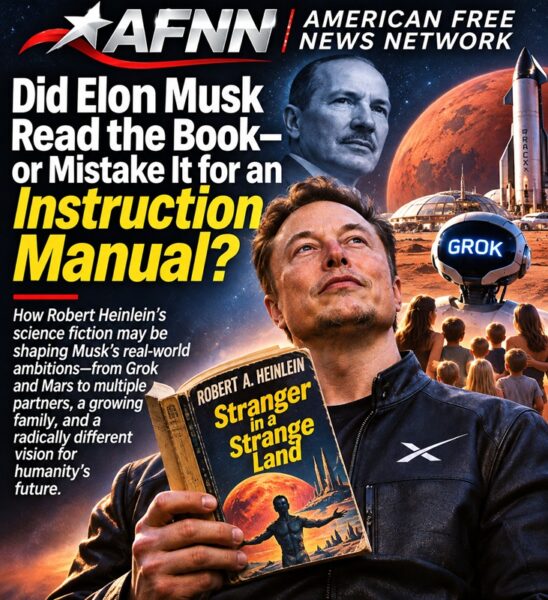
Did the world’s richest science-fiction fan read Robert Heinlein’s novels—or mistake them for an instruction manual?
In 1961, science-fiction author Robert A. Heinlein published “Stranger in a Strange Land,” a novel about a human raised on Mars who returns to Earth, questions conventional society, establishes an unconventional religion, and embraces some rather creative family arrangements.
Sixty-five years later, along comes Elon Musk.
He’s building rockets to Mars, developing artificial intelligence named Grok, fathering enough children to field a football team, and dreaming of expanding human consciousness throughout the universe.
Coincidence? Perhaps. But somebody should check whether Heinlein’s novels are sitting on Musk’s nightstand next to a fertility calendar.
Science Fiction or Business Plan?
Musk’s fascination with Heinlein isn’t speculation. He named his artificial intelligence Grok, borrowing the Martian word for profound understanding from “Stranger in a Strange Land.” He also introduced an AI companion named Valentine, after the novel’s protagonist.
Then there’s Heinlein’s “The Moon Is a Harsh Mistress,” featuring a self-aware computer named Mike that helps lunar colonists overthrow Earth’s authority. Musk has praised the novel and even discussed its electromagnetic mass-launching technology.
Apparently, some people read science fiction for entertainment. Others start companies.
Heinlein envisioned humanity spreading across the solar system, intelligent machines, independent colonies, and civilizations challenging traditional political institutions.
Sound familiar?
Musk received the Heinlein Prize in 2011 for his accomplishments in commercial spaceflight. The connection between the author and the entrepreneur isn’t particularly subtle.
Welcome to the Family Nest
Here’s where things get entertaining.
In “Stranger in a Strange Land,” followers of the fictional Church of All Worlds establish communal households called Nests. Traditional marriage takes a backseat to unconventional relationships, shared experiences, and expanded definitions of family.
Musk has 14 publicly reported children with four women. He’s been married three times, twice to the same woman, and several children were born outside marriage.
The man believes in reusable rockets. Apparently, conventional family structures are another matter.
Reports also surfaced that Musk considered establishing a Texas family compound where several mothers of his children could live near one another.
Heinlein called them Nests. Musk apparently prefers Texas real estate.
To be fair, Musk’s stated concerns about declining birthrates offer a perfectly plausible explanation for his reproductive enthusiasm. Having multiple partners doesn’t make someone a disciple of Heinlein.
Otherwise, Hollywood would need its own religious denomination.
The Power of a Good Story
But there’s a more fascinating possibility here.
How much of our adult worldview is shaped by the books, movies, and stories that captured our imaginations when we were younger?
Heinlein imagined intelligent machines, Martian civilization, unconventional families, individual liberty, and humanity transcending Earth’s limitations.
Musk is pursuing several remarkably similar ambitions.
Does that mean he’s consciously following Heinlein’s philosophy? Not necessarily. Musk himself has suggested “Stranger in a Strange Land” goes off the rails toward the end.
But inspiration doesn’t require complete agreement.
Sometimes a story plants an idea that quietly grows into an ambition. We absorb fictional worlds, identify with their characters, and eventually begin treating yesterday’s imagination as tomorrow’s possibility.
Heinlein wrote about humanity’s future.
Musk has the money, engineering teams, and apparently the reproductive enthusiasm to attempt his own version.
Maybe it’s coincidence. Maybe it’s conscious inspiration. Or perhaps Heinlein’s fictional universe became part of the mental blueprint Musk uses to imagine the future.
Either way, it’s a remarkable example of how literature can influence reality.
Most of us finish a science-fiction novel and put it back on the shelf. Elon Musk apparently finishes one and starts checking whether the technology exists to build it.
And judging by his family tree, he might have read a few chapters twice.
If you enjoyed this article, then please REPOST or SHARE with others; encourage them to follow AFNN. If you’d like to become a citizen contributor for AFNN, contact us at managingeditor@afnn.us Help keep us ad-free by donating here.
Substack: American Free News Network Substack
Truth Social: @AFNN_USA
Facebook: https://m.facebook.com/afnnusa
Telegram: https://t.me/joinchat/2_-GAzcXmIRjODNh
Twitter: https://twitter.com/AfnnUsa
GETTR: https://gettr.com/user/AFNN_USA
CloutHub: @AFNN_USA