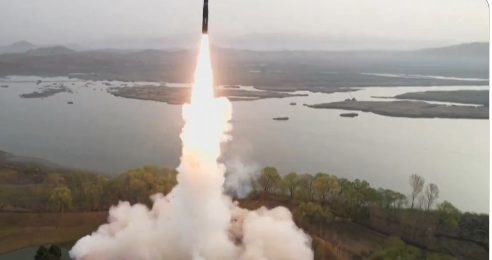
How in the hell did North Korea get the technology to develop hypersonic missiles? Their budding new alliance with Russia is sprouting up many such benefits.
On Wednesday, South Korea’s military authorities reported that North Korea had launched what was believed to be a hypersonic missile that failed mid-flight. The missile was launched at approximately 5:30 a.m. from a site in North Korea and headed towards the eastern coast where it subsequently exploded.
❗🚀🇰🇵 – North Korea has tested a hypersonic missile.
According to the South Korean military, the missile flew 250 km and exploded over the Sea of Japan.
The tests were presumably unsuccessful. pic.twitter.com/wRcQRPODJ0
— 🔥🗞The Informant (@theinformant_x) June 26, 2024
According to military sources, the missile was suspected to be powered by solid fuel and exhibited an unusual amount of smoke during its flight, which may indicate an engine malfunction. This event has led to increased scrutiny by regional powers.
In response to the launch, senior diplomats from South Korea, the United States, and Japan met and denounced the act, labeling it a clear breach of United Nations sanctions. This condemnation was echoed by South Korea’s Foreign Ministry, highlighting the international tension surrounding North Korea’s missile tests.
#VantageOnFirstpost: North Korea tested a “hypersonic” missile early this morning as South Korea and the US began joint air drills. North Korea’s “hypersonic” missile test failed and the rocket exploded before hitting its target. @Alysonle tells you more. pic.twitter.com/6yGYjnpMva
— Firstpost (@firstpost) June 26, 2024
The incident comes amidst a backdrop of escalating psychological warfare between the Koreas, reminiscent of Cold War tactics. This includes the use of balloons and loudspeakers to send propaganda and irritants across the border. South Korea reported that North Korea has been sending over balloons filled with garbage for three consecutive days, with previous payloads including materials such as manure and cigarette butts.
These provocative balloon launches have had tangible impacts, causing disruptions such as the temporary suspension of flights at South Korea’s Incheon International Airport, located near the border. This suspension lasted for three hours to ensure aviation safety.
In a tit-for-tat response, South Korea has resumed its loudspeaker broadcasts at the border, a practice not seen in years, and is prepared to continue this method of psychological pressure.
🚨 North Korea announced the successful test of its hypersonic missile .
The South Korean military notes that the missile flew only 250 kilometers and exploded over the Sea of Japan. pic.twitter.com/XUVtsyqfhe
— Alex Kennedy (@therealmindman) June 27, 2024
The regional military dynamics were further complicated on Wednesday as South Korea and the U.S. conducted joint military exercises involving 30 advanced fighter jets. Additionally, the arrival of the USS Theodore Roosevelt in South Korea earlier in the week marked a significant show of allied military strength. During his visit to the aircraft carrier, South Korean President Yoon Suk Yeol emphasized the robust alliance between South Korea and the U.S., referring to it as a formidable force capable of overcoming any adversary.
This show of allied strength comes at a crucial time, as North Korea has been increasing its military cooperation with Russia, evidenced by a recent summit in Pyongyang between Kim Jong Un and Russian President Vladimir Putin that resulted in agreements to bolster military and economic ties.
Major Points
- North Korea launched a suspected hypersonic missile that exploded mid-flight off its east coast early Wednesday morning.
- The missile, thought to be solid-fueled, displayed unusually high amounts of smoke, suggesting an engine malfunction.
- The launch was condemned by senior diplomats from South Korea, the U.S., and Japan as a violation of U.N. resolutions.
- Tensions have escalated with both Koreas engaging in psychological warfare, including propaganda balloon launches and loudspeaker broadcasts.
- In response to increasing threats, South Korea and the U.S. conducted joint military exercises and strengthened their strategic alliance.
Kirk Volo – Reprinted with permission of Whatfinger News
If you enjoyed this article, then please REPOST or SHARE with others; encourage them to follow AFNN. If you’d like to become a citizen contributor for AFNN, contact us at managingeditor@afnn.us Help keep us ad-free by donating here.
Substack: American Free News Network Substack
Truth Social: @AFNN_USA
Facebook: https://m.facebook.com/afnnusa
Telegram: https://t.me/joinchat/2_-GAzcXmIRjODNh
Twitter: https://twitter.com/AfnnUsa
GETTR: https://gettr.com/user/AFNN_USA
CloutHub: @AFNN_USA