Editors Note: The major purpose of American Free News Network, is education; education on American Civics and how our government is supposed to work. John Parillo has put forth a stellar effort to explain not only what the Framers did when they wrote our Constitution, but why.
Ed
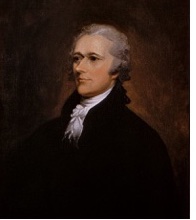
Hamilton is always interested in the economic arguments for a republic in addition to the organizational reasons that Madison and John Jay articulate. In Federalist 22 he starts off again with this theme. Hamilton continues to discuss the limitations of the existing Articles of Confederation, as well as to point out that the British had already threatened to restrict trade with the new union until they could decide on a single trade policy among the various states. He uses the example of the German empire whose trade,
“is in continual trammels from the multiplicity of the duties which the several princes and states exact upon the merchandises passing through their territories, by means of which the fine streams and navigable rivers with which Germany is so happily watered are rendered almost useless.”
If the federal government does not gain through the new constitution the ability to regulate interstate commerce, it is likely that they will fall into the same state of economic disrepair.
In addition to the free trade argument, the system for raising an army at the time allowed the states to bid among themselves to provide men, This delayed the time it took for recruits to be delivered, which could threaten the safety of the individual states, and it drove up the cost to the existing federal government. As Hamilton puts it, these delays resulted in
“slow and scanty levies of men, in the most critical emergencies of our affairs; short enlistments at an unparalleled expense; continual fluctuations in the troops, ruinous to their discipline and subjecting the public safety frequently to the perilous crisis of a disbanded army.”[1] The result was that the states closest to the conflicts worked harder to provide men, but those who were at greater distance from the fighting were less “diligent”
in their efforts.
In addition to the issues created in raising an army, and in a hint of what is to come, Hamilton talks about how, under the current system, a majority of states with a minority of the population can control the wishes of the rest of the union. He points out that Road Island has the same voting power as New York and that, while each state is sovereign and therefor equal, that system cannot long survive. His subtle threat is that the smaller states should acknowledge their need for the larger states when it comes to their common defense and thus be willing to give up a bit of their power in exchange for a federal government that can protect them. Hamilton points out that under the current system, “A sixtieth part of the Union, which is about the proportion of Delaware and Rhode Island, has several times been able to oppose an entire bar to its operations.” Hamilton brings up the possibility of foreign interference in our affairs as an example of how this sort of unanimous decision making can hinder a coherent policy.
“In such a state of things, this (an outside country) would evidently find it much easier, by his bribes and intrigues, to tie up the hands of government from making peace, where two thirds of all the votes were requisite to that object, than where a simple majority would suffice.”
He points out that,
“In republics, persons elevated from the mass of the community, by the suffrages of their fellow-citizens, to stations of great pre-eminence and power, may find compensations for betraying their trust.”
Even then, Hamilton was concerned about our representatives selling their influence. In a confederation where a single state, or small group of states, could stymie legislation, this is more of a threat.
And finally, Hamilton closes by pointing out that the current Articles of Confederation were not ratified by the people, and that, “The fabric of American empire ought to rest on the solid basis of THE CONSENT OF THE PEOPLE. The streams of national power ought to flow immediately from that pure, original fountain of all legitimate authority.”
In Federalist 23, Hamilton as Publius seeks to remedy the issues he raises with the Articles of Confederation in Federalist 22. He does this by arguing that the means must be the equal of the ends. For instance, while the Articles were supposed to allow the states to provide for their common defense, the structure of the Articles did not provide them the means to do so. The power to accomplish these things must exist, “BECAUSE IT IS IMPOSSIBLE TO FORESEE OR DEFINE THE EXTENT AND VARIETY OF NATIONAL EXIGENCIES, OR THE CORRESPONDENT EXTENT AND VARIETY OF THE MEANS WHICH MAY BE NECESSARY TO SATISFY THEM.” (Emphasis in the original.) This is a tough sell for the federalists like Hamilton. The colonists, based on their experience at the hands of the British, are rightfully concerned about the concentration of power in government. The existing Articles do allow Congress to make requisitions of people and money to create and direct an army and navy, and these requisitions were constitutionally binding on the states. The issue is that the experiment, according to Hamilton, has failed. The laws of the Articles of Confederation were binding on the states but not on the individual citizens of the states and thus lacked an enforcement mechanism. The existing system of quotas gave the federal government the responsibility of defense but left the effective administration of the forces to the individual state. Add to that the fact that there is no binding judiciary in the Articles, and the federal government created there is powerless to make the states comply.
Hamilton acknowledges the anti-federalist position that it would be impossible for any constitution to have the power to control such a large “empire”, but counters by saying that, if that is so, then the current Articles are, by definition, insufficient to do so as well.
If you enjoyed this article, then please REPOST or SHARE with others; encourage them to follow AFNN. If you’d like to become a citizen contributor for AFNN, contact us at managingeditor@afnn.us Help keep us ad-free by donating here.
Substack: American Free News Network Substack
Truth Social: @AFNN_USA
Facebook: https://m.facebook.com/afnnusa
Telegram: https://t.me/joinchat/2_-GAzcXmIRjODNh
Twitter: https://twitter.com/AfnnUsa
GETTR: https://gettr.com/user/AFNN_USA
CloutHub: @AFNN_USA
8 thoughts on “John Parillo: Federalist 22 and 23”