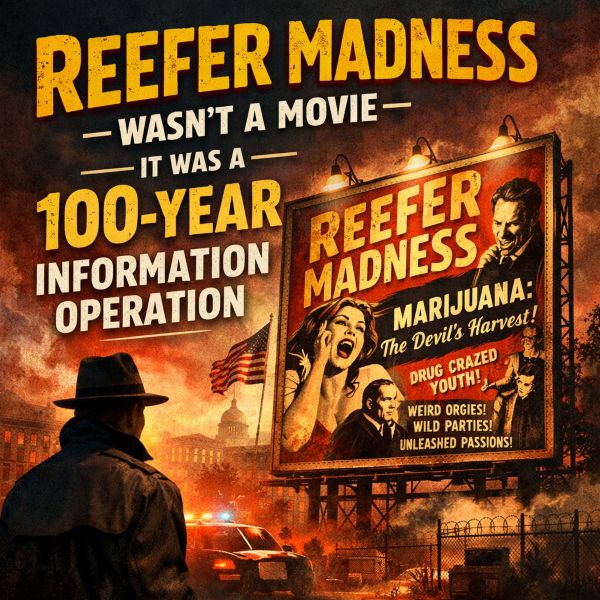
There’s a comfortable lie Americans like to tell themselves: that we are too smart, too informed, too free to be manipulated at scale. That propaganda is something that happens in other countries, to other people, under other flags. Then you dig up a grainy black-and-white relic like Reefer Madness and realize—no, we ran one of the most effective information operations in modern history… on ourselves.
And it worked so well it took nearly a century to unwind.
Welcome to fifth-generation warfare before it had a name.
At its core, Fifth-generation warfare isn’t about bombs, bullets, or even battlefield maneuver. It’s about narrative dominance. You don’t destroy your opponent—you shape how entire populations perceive reality. If you get that right, the population will enforce your objectives for you. No occupation required.
That’s exactly what happened in 1930s America.
After Prohibition collapsed, the federal apparatus needed a new moral crusade. Enter Harry J. Anslinger and the Federal Bureau of Narcotics. But instead of leading with data, they led with something far more powerful: story.
Cannabis wasn’t framed as a substance. It was framed as a threat.
A cultural, moral, and existential threat.
The messaging was simple and relentless: marijuana turns normal people into violent, insane predators. It destroys families. It erodes society. It is the gateway to chaos. That narrative was injected into newspapers, reinforced by authority figures, and immortalized in film. Reefer Madness wasn’t entertainment—it was amplification. A cinematic psyop dressed up as a cautionary tale.
Here’s the part most people miss: the law didn’t create the fear. The fear created the law.
Once the narrative took hold, policy followed like a formality. The 1937 Marihuana Tax Act didn’t have to convince the public—it rode a wave of manufactured consensus. By the time legislation hit, the American people were already primed to accept it. That’s the hallmark of effective information operations: when coercion becomes unnecessary.
From there, the narrative hardened.
Decade after decade, it embedded itself into institutions—schools, law enforcement, medicine, media. Cannabis was classified alongside the most dangerous drugs on earth. Generations were raised with the same baseline assumption: this is bad, this is dangerous, this is immoral. Not because they researched it. Because they inherited it.
That’s Phase IV of fifth-gen warfare: cultural lock-in.
Once a narrative reaches that stage, it becomes self-sustaining. Parents teach it to children. Teachers reinforce it. Laws codify it. Media echoes it. The original architects can disappear, and the system continues running. The story becomes “truth” not because it’s proven, but because it’s never seriously questioned.
And here’s the operational reality: once you reach that level of penetration, reversal is no longer a policy problem. It’s a generational one.
Because you’re not just changing laws—you’re trying to unwind belief.
That’s why it took nearly 100 years.
Starting in the 1970s, cracks began to form. Ironically, Reefer Madness itself resurfaced—not as a warning, but as satire. People began to see the absurdity. Research challenged old assumptions. States experimented with medical legalization. Then recreational. Slowly, the narrative began to shift.
But “slowly” is doing a lot of work there.
Because every step forward had to fight against decades of conditioning. Voters hesitated. Politicians hedged. Institutions resisted. Even as legalization spread, stigma lingered. That’s the residue of a successful information campaign—it doesn’t disappear when the facts change.
It decays over time.
Today, cannabis is legal in large parts of the United States. It’s a multi-billion-dollar industry. Tax revenue flows. Arrests drop. The same society that once treated it as a civilizational threat now regulates and profits from it.
That’s not just a policy shift. That’s a narrative reversal.
And it took a century.
So what’s the lesson?
It’s not about cannabis.
It’s about understanding the weapon system.
If you can:
- Inject a compelling narrative
- Attach it to authority
- Reinforce it through culture
- Codify it in law
You can reshape reality for generations.
And if you want to reverse it?
You’re not flipping a switch. You’re fighting an entrenched belief structure that has had decades to root itself into identity, morality, and social norms. That’s not a campaign measured in months or years. That’s a long war measured in lifetimes.
Reefer Madness wasn’t a mistake. It was a proof of concept.
A demonstration that in the modern era, the most decisive battles aren’t fought on physical terrain—but in the human mind. And once you win there, the rest follows.
The uncomfortable truth is this: if it worked once, it can work again.
Different issue. Different narrative. Same playbook.
And the next time, you may not get 100 years to figure it out.
If you enjoyed this article, then please REPOST or SHARE with others; encourage them to follow AFNN. If you’d like to become a citizen contributor for AFNN, contact us at managingeditor@afnn.us Help keep us ad-free by donating here.
Substack: AmericanFreeNewsNetworkSubstack
TruthSocial:@AFNN_USA
Facebook: https://m.facebook.com/afnnusa
Telegram: https://t.me/joinchat/2_-GAzcXmIRjODNh
Twitter: https://twitter.com/AfnnUsa
GETTR: https://gettr.com/user/AFNN_USA
CloutHub: @AFNN_USA