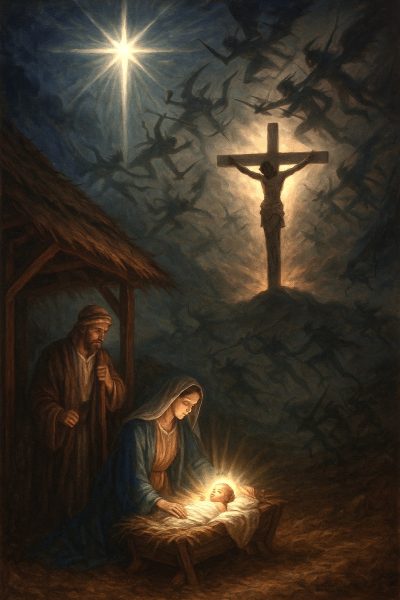
Three Part AFNN series: The Heavens, the Crucifixion, and the End of the Powers’ Claim
Part I: The Sky Knew a King Was Coming
Christians don’t need gimmicks to believe the Bible—but we do need to stop reading it like modern people who assume the universe is silent. The biblical authors didn’t. In the ancient world, the heavens weren’t just pretty lights; they were a billboard of authority, order, and omen. That’s why Matthew’s account of the Magi isn’t a Hallmark moment. It’s an intelligence leak. Foreign elite sky-watchers saw something they interpreted as royal, and it moved them toward Judea.
Michael Heiser pushed Christians to recover that ancient mindset without becoming weird. He didn’t argue that astrology is “true” in a Christian sense; he argued that ancient people—including the Magi class—believed the heavens carried meaning and they acted accordingly. And in that world, certain kinds of celestial events were widely read as “a king has been born.” The Magi weren’t stargazing romantics. They were trained analysts operating in the symbolic language of empires.
This is where the discussion gets spicy: Heiser publicly stated he believes Jesus was born September 11, 3 BC, and he also openly admitted that this wasn’t his original research—he was leaning on arguments from E. L. Martin and related astronomical reconstruction efforts. You can agree or disagree with the specific date, but you can’t honestly dismiss the point behind it: the nativity is presented as a moment that rippled beyond Israel, and the ancient world had ways of “hearing” that ripple.
If that date makes modern people recoil, that reaction is usually emotional, not historical. “September 11” is a modern label. The ancients weren’t thinking in our Gregorian calendar. What matters—if you’re trying to read Matthew like a first-century person—is whether there were credible sky-signals that an eastern scholar-priest class would interpret as kingship in Judea. That’s a legitimate historical question, not a conspiracy hobby.
Here’s the bigger issue: Christians have been trained to treat the supernatural as embarrassing. Heiser wouldn’t let you do that. He insisted that the Bible’s worldview includes hostile “powers” and “authorities,” and that God’s plan is not merely individual salvation but cosmic reclamation. In that framework, it makes perfect sense that the arrival of the Messiah would be marked in a way that triggers attention in the very arena ancient nations believed was tied to rule and fate.
So no, this is not about “pagan religions knew Christmas first.” That’s sloppy. What is true is that the Bible assumes a world where the nations are entangled with spiritual realities—and that a Gentile class of heaven-readers showing up in Matthew is not an accident. It’s a plot point. The King arrived, and the sky-language of the empires noticed.
Coming in Part 2: why Paul says the powers didn’t understand the plan—and how the crucifixion became the most costly intelligence failure in the history of the unseen realm.
⸻
This is Part 1 of a 3 part series. Links below become active as each segment is published and on the dates indicated:
December 16-Part I: The Sky Knew a King Was Coming
December 17-Part II: The Cross as the War Plan the Powers Misread
December 18-Part III: Christmas, Calendars, and the Myth That “Pagans Invented It”
If you enjoyed this article, then please REPOST or SHARE with others; encourage them to follow AFNN. If you’d like to become a citizen contributor for AFNN, contact us at managingeditor@afnn.us Help keep us ad-free by donating here.
Substack: American Free News Network Substack
Truth Social: @AFNN_USA
Facebook: https://m.facebook.com/afnnusa
Telegram: https://t.me/joinchat/2_-GAzcXmIRjODNh
Twitter: https://twitter.com/AfnnUsa
GETTR: https://gettr.com/user/AFNN_USA
CloutHub: @AFNN_USA
1 thought on “Christmas as an Act of War; Part I”