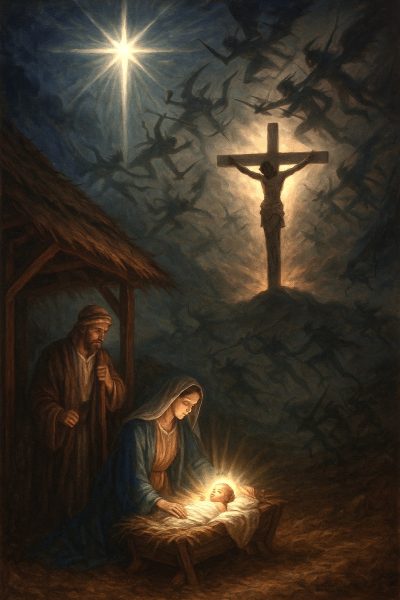
Three Part AFNN series: The Heavens, the Crucifixion, and the End of the Powers’ Claim
Part II: The Cross as the War Plan the Powers Misread
If you want to understand Christmas like the New Testament does, you don’t start with December 25. You start with war. Not the kind fought with steel and blood—though those always show up eventually—but the kind Paul talks about: rulers, authorities, cosmic powers, spiritual forces. Heiser consistently reminded readers that “spiritual warfare” in the Bible is not about chasing demons around the living room. It’s about the advance of God’s kingdom against hostile powers through truth, holiness, and the gospel.
That’s why the cross can’t be reduced to “an unfortunate execution that became a happy ending.” Paul calls it a defeat for the powers precisely because it looked like their victory. The New Testament’s logic is brutal: if the “rulers of this age” had understood what was happening, they never would have pushed the Messiah toward crucifixion. They wanted Him dead. They just didn’t understand what death would do.
This is the part modern readers miss because we’ve been taught to picture evil as stupid. Biblical evil isn’t stupid. It’s arrogant. It’s strategic. It’s real. The powers—whatever you think the precise identity of “rulers” is in each passage—are presented as intelligences that scheme. That’s why Paul can talk about “the schemes of the devil” and still tell believers the fight is primarily truth, endurance, and proclamation, not theatrics.
And here’s the switch: the powers tried to eliminate the heir, assuming elimination equals victory. The cross looked like public humiliation and finality. But in the biblical storyline, the cross is the trap door. The resurrection is the release of the verdict. The enthronement language in Paul—Christ seated above every ruler and authority—isn’t poetry. It’s a transfer of jurisdiction.
In Heiser’s wider framework, this is why Christmas matters: the incarnation is the insertion of the rightful King into occupied territory. The powers are not merely “tempting individual sinners”; they are attempting to maintain illegitimate administration over the nations. When the King arrives, they react the way rebellious rulers always react: discredit, destroy, bury, move on.
But the gospel message is that the cross didn’t bury Him—it exposed them. It didn’t erase Him—it disarmed them. The powers played the move they thought always works: kill the threat. Christianity says that move detonated in their hands.
So if you’re looking for “clues,” stop hunting modern date-coincidences like a nervous hobbyist. The real clue is theological and historical: the New Testament insists the powers miscalculated. They read the situation wrong. They thought they were winning. The cross was the moment they learned they weren’t.
Coming in Part 3: Christmas, calendars, and the truth about December 25—how to affirm the Bible without swallowing internet myths.
⸻
This is Part 2 of a 3 part series. Links below become active as each segment is published and on the dates indicated:
December 16-Part I: The Sky Knew a King Was Coming
December 17-Part II: The Cross as the War Plan the Powers Misread
December 18-Part III: Christmas, Calendars, and the Myth That “Pagans Invented It”
If you enjoyed this article, then please REPOST or SHARE with others; encourage them to follow AFNN. If you’d like to become a citizen contributor for AFNN, contact us at managingeditor@afnn.us Help keep us ad-free by donating here.
Substack: American Free News Network Substack
Truth Social: @AFNN_USA
Facebook: https://m.facebook.com/afnnusa
Telegram: https://t.me/joinchat/2_-GAzcXmIRjODNh
Twitter: https://twitter.com/AfnnUsa
GETTR: https://gettr.com/user/AFNN_USA
CloutHub: @AFNN_USA