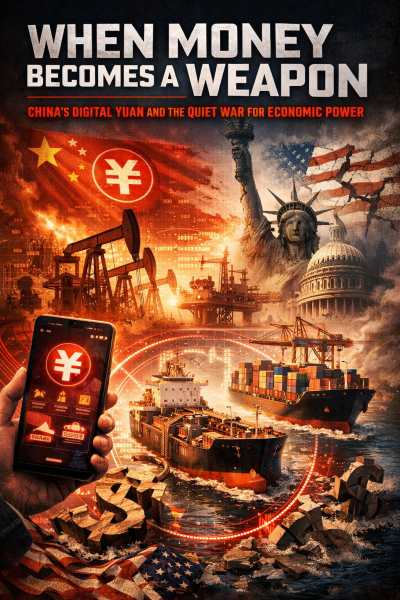
Central bank digital currencies sound like a boring geeky iPhone app upgrade, something dreamed up by economists who wear bow ties and argue about footnotes. In reality, a CBDC is not a payment app. It’s a geopolitical instrument. It’s money redesigned for a world where economic activity, surveillance, sanctions, and national security are no longer separate conversations—but the same one.
To understand why this matters, you have to strip away the marketing. A CBDC is not “digital cash.” Cash is anonymous, final, and indifferent. A CBDC is programmable, trackable, and conditional. It is issued directly by a central bank, lives on state-controlled rails, and behaves exactly as policy requires it to behave. That makes it extremely attractive to governments that prefer obedience over ambiguity.
No one understands this better than China.
China is not debating whether to build a CBDC. It already has one. The digital yuan—e-CNY—is live, legal tender, and issued by the People’s Bank of China. It has been rolled out across cities, integrated into major payment platforms, used in transportation, retail, and increasingly in large-scale settlement experiments. While U.S. officials hold hearings and issue FAQs, China has been training an entire population to treat state-issued digital money as normal.
That alone would be noteworthy. But the real story starts when the digital yuan leaves China’s borders.
China is the world’s largest importer of energy and raw materials. Oil, gas, metals, grain—these aren’t side hustles, they’re lifelines. Traditionally, those resources are priced and settled in U.S. dollars, forcing every major commodity trade through a dollar-centric financial system. That system is enforced by U.S. banks, U.S. regulations, and U.S. sanctions power. It’s one of the quiet pillars of American global influence.
China is trying to route around it.
By experimenting with settling oil and other resource purchases using digital yuan rails, China isn’t trying to “kill the dollar” overnight. That’s a cartoon version of reality. What it’s doing instead is far more dangerous to U.S. interests: offering an alternative plumbing system. A way to trade outside SWIFT. Outside U.S. correspondent banks. Outside the reach of American regulators and financial pressure.
If you’re a country that’s been sanctioned, threatened, or simply annoyed by Washington, that’s appealing. If you’re a resource exporter who wants access to China’s massive market without dollar exposure, that’s leverage. And if you’re Beijing, it’s a strategic two-for-one: tighter control at home and optionality abroad.
Meanwhile, the United States is still arguing about definitions.
The Federal Reserve insists it’s “not close” to issuing a CBDC, which is technically true and strategically irrelevant. The U.S. has done studies, pilots, white papers, and reassurance tours, all while inflation chewed up purchasing power and debt ballooned into the stratosphere. The dollar still dominates global trade, but dominance is a habit, not a law of physics. Habits erode when alternatives appear and trust weakens.
China’s CBDC is one such alternative.
This is where economics and national security collide. Money is not just a medium of exchange; it’s an enforcement mechanism. Whoever controls settlement controls leverage. Whoever controls leverage can reward friends, punish enemies, and shape behavior without firing a shot. The U.S. learned this lesson through sanctions. China learned it by watching the U.S. use them.
A digital yuan used in commodity trade doesn’t need to replace the dollar everywhere to matter. It just needs to work well enough, often enough, in enough critical sectors to chip away at dollar demand. Less dollar demand means fewer dollars recycled into U.S. debt markets. Fewer recycled dollars mean higher borrowing costs. Higher borrowing costs mean less fiscal room. That’s not abstract economics—that’s strategic pressure.
And it guarantees friction.
The United States cannot view China’s CBDC push as a neutral technical development any more than it would view a new missile system as “just engineering.” This is competition over who sets the rules of trade, finance, and compliance in the 21st century. China wants a world where money moves on systems it influences, observes, and ultimately controls. The U.S. prefers a world where the dollar remains the default and economic power flows through institutions it helped build.
Those visions are incompatible.
The satirical part is that this collision is happening while Americans argue about whether a CBDC is “convenient” or “creepy,” as if the decision will be made by consumer preference. China didn’t wait for vibes. It built infrastructure. It aligned money with state power. And it is now testing how far that power can travel.
Economic activity has always been a component of national security. What’s new is how directly it’s being weaponized through code. A world where oil can be bought outside the dollar, on programmable state money, is a world where influence shifts quietly, transaction by transaction.
This won’t cause a crisis tomorrow. It will cause tension forever. And when future historians look back at the moment the ground started moving under the global financial system, they won’t point to a war or a speech. They’ll point to when money stopped being neutral—and everyone pretended it was just an app update.
If you enjoyed this article, then please REPOST or SHARE with others; encourage them to follow AFNN. If you’d like to become a citizen contributor for AFNN, contact us at managingeditor@afnn.us Help keep us ad-free by donating here.
Substack: American Free News Network Substack
Truth Social: @AFNN_USA
Facebook: https://m.facebook.com/afnnusa
Telegram: https://t.me/joinchat/2_-GAzcXmIRjODNh
Twitter: https://twitter.com/AfnnUsa
GETTR: https://gettr.com/user/AFNN_USA
CloutHub: @AFNN_USA