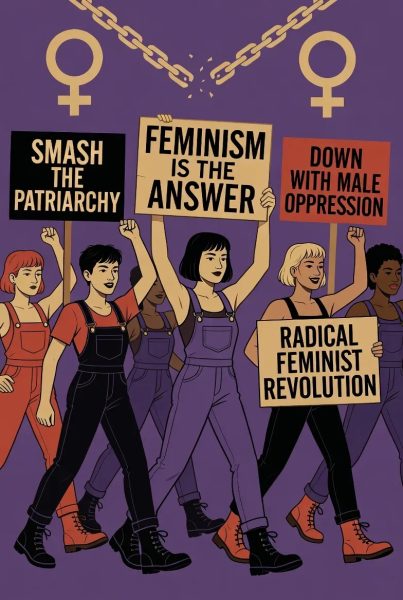
Feminism has been a curse on the American body politic since it merged with Marxist critical theory concepts in the 1960s, long after the woman’s suffrage movement led the passage of the 19th Amendment (women’s right to vote). It has been in the vanguard of the leftwing cultural revolution that has divided America – and men and women – for six decades while destroying the hopes and dreams of two generations of young women who absorbed the radical ideology at the cost of human happiness and fulfillment.
There is one fatal flaw that the feminist (and Marxist) theorists have failed to address, but which the glaring results of DEI have borne out: pursuing equality on the basis of a numbers game is a fool’s errand.
Let us examine the premise in detail.
THE ORIGINS OF FEMINISM
The Frankfurt School, formally the Institute for Social Research (founded 1923 in Germany), developed critical theory as a neo-Marxist project under Max Horkheimer, Theodor Adorno, and others. Exiled to the U.S. during the Nazi era, it blended Marxism with Freudian psychoanalysis to analyze culture, ideology, the family, and authoritarianism as mechanisms of domination—beyond orthodox economic class struggle.
Early intersections with gender were limited and androcentric, but Erich Fromm (a psychoanalyst affiliated in the 1930s) offered proto-feminist insights in essays on matriarchy and patriarchy. He portrayed patriarchal structures as psychologically repressive and linked them to capitalist alienation, anticipating later syntheses of Marxism, psychoanalysis, and feminism.
The deeper tie emerged in the 1960s with second-wave feminism. Herbert Marcuse, a Frankfurt émigré and New Left icon, explicitly connected critical theory to women’s liberation in works like Eros and Civilization (1955) and essays such as “Marxism and Feminism” (1974). He celebrated the women’s movement as a subversive force against “performance principle” capitalism, advocating sexual and cultural revolution to dismantle repressive norms.
Radical feminists like Shulamith Firestone (The Dialectic of Sex, 1970) adapted dialectical materialism to frame patriarchy—not just class—as the root oppression, echoing critical theory’s cultural focus. This was the genesis of the radicalization that has motivated the National Organization for Women and other radical organizations ever since.
Later generations of Frankfurt-inspired thinkers (e.g., Nancy Fraser, Seyla Benhabib) integrated feminism into critical theory, critiquing its gender-blind spots while using its tools for emancipatory analysis of intersectional injustice. Thus, while not the origin of feminism, the Frankfurt School supplied intellectual scaffolding—ideology critique, family deconstruction, and anti-capitalist liberation—for radical and academic feminism’s evolution from liberal reform to systemic cultural overhaul.
NOT A NUMBERS GAME
The premise of the title and subtitle is a pointed critique of a core assumption in much of modern feminism (particularly its equity-focused or institutional variants): that persistent gender imbalances in fields like STEM, leadership, or high-paying technical careers are primarily the result of systemic discrimination, patriarchy, or socialization, and can therefore be “fixed” by engineering numerical parity through quotas, targeted encouragement programs, affirmative action, or cultural pressure to close representation gaps.
This framing is fatally flawed because it treats the issue as a simple “numbers game”—count heads, identify underrepresentation, attribute it to bias, and mandate equal outcomes—while ignoring robust evidence that men and women, on average, have meaningfully different vocational interests, preferences, and relative cognitive strengths. These differences lead to divergent career choices even (and especially) under conditions of high gender equality and equal opportunity.
Forcing parity in outcomes doesn’t address root causes rooted in biology, psychology, and free choice; it can instead produce inefficiency, resentment, lower satisfaction, and policy failures. Equal opportunity does not produce equal outcomes when people are free to follow their preferences.
CORE EVIDENCE: THE GENDER-EQUALITY PARADOX
Large-scale international data consistently shows the opposite of what a pure-discrimination model predicts. In countries with higher gender equality (as measured by the World Economic Forum’s Global Gender Gap Index), women are less likely to pursue STEM degrees and careers—not more. More specifically, occupational sorting reflects preferences, at least partly:
- Women disproportionately choose healthcare, education, and social work; men disproportionately choose engineering, finance, and trades
- Cross-cultural data from Scandinavian countries — among the most gender-equal societies on earth — actually show more occupational segregation by gender than less equal societies, not less (this is called the Gender-Equality Paradox, studied by psychologist David Geary and others)
- This suggests that when external constraints are removed, innate preference differences may become more expressed, not less
Furthermore:
- A seminal 2018 study by psychologists Gijsbert Stoet and David C. Geary analyzed PISA data from 472,242 adolescents across 67 countries. Girls performed as well as or better than boys in science in most nations and were often more capable of college-level STEM work overall. Yet the gender gap in STEM enrollment and graduation widened with greater national gender equality. High-equality nations like Finland, Sweden, and Norway have some of the lowest percentages of women in STEM, while lower-equality countries like Algeria, Turkey, and the UAE have higher female STEM participation (e.g., ~41% in Algeria).
- A 2022 follow-up by the same researchers using 2018 PISA data (473,260 adolescents across 80 nations) examined career aspirations directly. In every single country, more boys than girls aspired to “things-oriented” occupations (e.g., mechanic, engineer, carpenter—STEM-heavy), with ratios around 4:1 in many Western nations. Conversely, girls outnumbered boys ~3:1 in aspiring to “people-oriented” occupations (e.g., teacher, doctor, nurse). These gaps were larger in more egalitarian societies.
The explanation aligns with preferences over discrimination: In wealthy, equal societies with strong social safety nets, women can afford to choose careers matching their stronger average interest in people-oriented work. In less equal or poorer contexts, STEM offers reliable high pay and security, so more women select it regardless of intrinsic interest.
The pattern replicates across related data on economic preferences (Falk & Hermle, 2018) and holds in UN/UNESCO reports acknowledging higher female STEM participation in certain non-Western contexts. The paradox extends beyond STEM to personality traits and values, which also diverge more in egalitarian nations—consistent with the idea that greater freedom reveals underlying differences rather than erasing them.
CORE EVIDENCE: SEX DIFFERENCES IN VOCATIONAL INTERESTS (“PEOPLE VS THINGS”)
Decades of psychology research document large, stable, cross-cultural sex differences in interests that directly predict occupational segregation.
- A major meta-analysis of 503,188 people across 47 interest inventories (Su, Rounds, & Armstrong, 2009) found men strongly prefer “things-oriented” work (d = 0.93 on the Things-People dimension), while women prefer “people-oriented” work. Men scored higher on Realistic interests (d = 0.84; e.g., engineering, mechanics) and Investigative (d = 0.26); women higher on Social (d = -0.68; e.g., teaching, counseling) and Artistic. Engineering interests showed an especially large gap (d = 1.11). These differences help explain why women dominate biology/medicine/veterinary science (more “living things”) but are underrepresented in physics/computer science/engineering (more “inorganic things”).
- Related work (Lippa, 1998/2010) confirms “very large” gaps on the People-Things dimension (d ≈ 1.18), consistent across cultures and time—suggesting partial biological roots rather than pure socialization. These appear early, link to prenatal androgen exposure, and predict real-world choices like Swiss apprenticeships, where women overwhelmingly select people-oriented roles and men things-oriented ones.
Interests are among the strongest predictors of career choice—stronger than many socialization factors. Only about 15-20% of women have the same level of “things” interest as the average man, so expecting 50/50 representation in things-heavy fields ignores the data.
WHY THIS IS A “FATAL FLAW”
Feminism’s numbers-game approach misdiagnoses the problem (preferences + biology + choice ≠ oppression) and prescribes mismatched solutions (quotas, “girls in STEM” campaigns that don’t change underlying distributions much). It overlooks:
- Women already dominate many high-status, high-pay fields aligned with their average preferences (e.g., medicine, law, psychology, education, HR).
- Similar gaps exist in reverse (few men in nursing/teaching), yet these receive less feminist focus.
- Blank-slate assumptions ignore evolutionary psychology, twin studies, and hormone research showing these patterns aren’t infinitely malleable.
The result? Policies that may push some individuals into mismatched careers (higher dropout, lower satisfaction), fuel backlash when outcomes don’t equalize, and divert attention from actual barriers (e.g., work-family tradeoffs, where women on average prioritize flexibility more).
CONCLUDING THOUGHTS
This doesn’t mean discrimination never occurs or that individuals should be stereotyped—averages never dictate personal potential. It does mean treating disparities as automatic proof of “systemic sexism” (and demanding numerical fixes) is empirically untenable. And implementing policies with the force of law that mandate addressing these disparities is unwise and foments unnecessary division in society. This has been the disastrous nature of the DEI “experiment” during the Biden regime, which has ruined lives and careers and exposed the foolhardy notion that DEI hires automatically have the experience and savvy to succeed when promoted beyond their competence.
Radical feminists and their allies in the Democrat Party fail to understand (probably purposely) that true equality of opportunity (the only thing that really matters!) already exists in many domains; the remaining gaps largely reflect what people choose when free to do so.
Feminism’s fatal flaw is refusing to grapple with that reality while continuing to push for equality of numbers. We have seen the human wreckage wrought in America by their misguided ideological pursuit of “equality of numbers” over merit and experience and family and children. Time to end it once and for all.
The end
StuinSD is a reader-supported publication. To receive new posts and support his work, consider becoming a free or paid subscriber.
This article originally appeared in Stu Cvrk’s Substack. Reprinted here with permission
If you enjoyed this article, then please REPOST or SHARE with others; encourage them to follow AFNN. If you’d like to become a citizen contributor for AFNN, contact us at managingeditor@afnn.us Help keep us ad-free by donating here.
Substack: American Free News Network Substack
Truth Social: @AFNN_USA
Facebook: https://m.facebook.com/afnnusa
Telegram: https://t.me/joinchat/2_-GAzcXmIRjODNh
Twitter: https://twitter.com/AfnnUsa
GETTR: https://gettr.com/user/AFNN_USA
CloutHub: @AFNN_USA