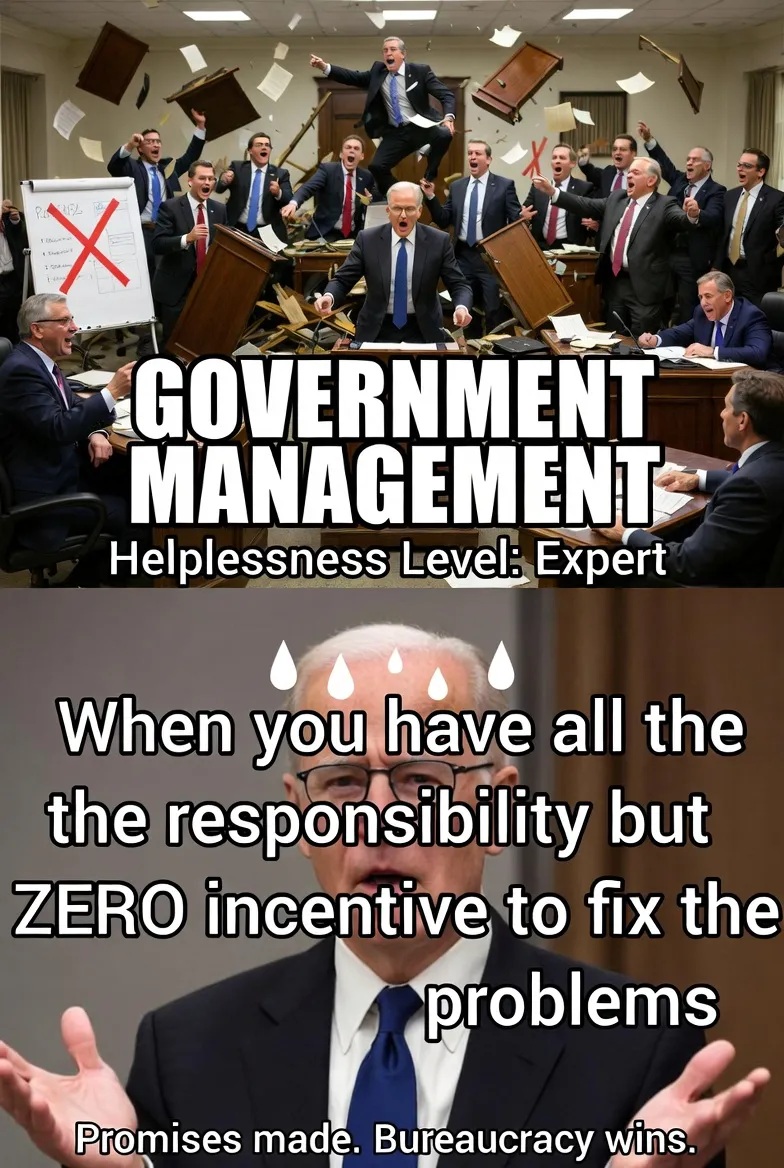
The political economy of deliberate inaction
Managed helplessness is a political and institutional strategy in which those in power deliberately frame solvable problems as hopelessly complex, systemic, or intractable — not because solutions are genuinely unavailable, but because sustained unsolvability serves their interests.
By burying accountability in bureaucratic language, multi-stakeholder processes, and perpetual study, politicians insulate themselves from responsibility for failure while maintaining authority over the problem and the resources attached to it. The constituents who suffer the problem are conditioned, over time, to expect nothing — which is precisely what they receive. The Democrats have perfected this strategy over the last 60+ years, and their allies in the legacy media and academia have helped amplify the messaging.
Let us examine this in some detail.
THE CORE MECHANISM
From a constitutional conservative perspective, managed helplessness is a sophistication racket. The governing class has discovered that complexity is a currency. The more impenetrable a problem sounds, the more indispensable the expert class becomes, and the less accountable any individual official need be. This is the political weaponization of epistemology: if no one can truly understand the problem, no one can truly be blamed for it.
The Founders understood this danger intuitively. They designed a constitutional republic specifically to force accountability through limited, enumerated powers. A government that can only do defined things can be held responsible when those defined things fail. The modern administrative state inverts this entirely — diffusing responsibility across so many agencies, commissions, task forces, and stakeholder processes that accountability evaporates completely.
THE PSYCHOLOGICAL ARCHITECTURE
The psychological architecture forms the basis for conditioning people to get comfortable with their helplessness. Below are the elements of the architecture.
Complexity as a Shield
When a mayor says crime is “a multifactor systemic challenge rooted in historical inequities,” he has done something psychologically brilliant and morally cowardly at the same time. He has replaced a tractable question — did you deploy adequate policing, prosecute offenders, enforce existing law? — with an intractable one. You can fail at tractable questions. You cannot fail at intractable ones. You can only work toward them, indefinitely, with funding.
This exploits a genuine cognitive tendency in voters: people find it harder to assign blame when causation is diffuse. Political consultants know this. Complexity language is field-tested. It works.
When the Obama administration’s border enforcement collapsed under the 2014 unaccompanied minor surge — with over 68,000 children arriving in a single year — officials responded not with enforcement measures but with task forces, interagency coordination committees, and root-cause frameworks focused on Central American “push factors.” The tractable question — are you enforcing immigration law? — was replaced with an intractable one about regional poverty and violence, ensuring that no official was responsible for the specific, measurable failure occurring in real time.
Learned Helplessness by Proxy
The psychologist Martin Seligman’s concept of learned helplessness — where repeated exposure to uncontrollable outcomes causes subjects to stop trying even when control becomes possible — has been essentially manufactured and outsourced to the public. Politicians don’t become helpless themselves. They perform helplessness while retaining full power, and in doing so they induce it in constituents. The citizen who hears that homelessness, crime, school failure, and infrastructure decay are all “deeply complex systemic issues” eventually stops believing that elections change anything. This suits certain incumbents perfectly.
The Biden administration’s handling of urban crime surges between 2020 and 2023 was a clinical demonstration of this technique. Rather than affirming the capacity of law enforcement to restore order — a message that would have created accountability — administration officials and aligned mayors consistently described rising violence as the downstream consequence of poverty, racism, and pandemic stress, conditions so vast and historical that no police chief or prosecutor could reasonably be expected to address them. Citizens in high-crime neighborhoods, having been told repeatedly that their suffering had no actionable cause, were left with no political lever to pull.
The Overton Shrink
Normal political accountability requires a shared belief that problems are solvable and that leaders are responsible for solving them. Managed helplessness steadily shrinks this window. Once a problem is successfully reframed as structural rather than managerial, demanding a solution sounds naive. The critic who says “just enforce the law” or “just build the road” is mocked as someone who doesn’t understand the complexity. Sophistication becomes a barrier to entry for demanding results.
The Obama administration’s response to chronically failing urban public schools perfected this technique. When Chicago, Detroit, and Baltimore continued posting catastrophic graduation rates and literacy scores despite decades of increased federal spending, the systemic complexity framework — segregation’s legacy, concentrated poverty, underfunding — was consistently deployed to make the demand for measurable improvement sound unsophisticated, even cruel.
Reform-minded critics who pointed to successful charter school models or demanded outcome accountability were dismissed as people who simply didn’t grasp how deep the problem went, effectively shrinking the Overton window until institutional failure became the accepted baseline.
THE POLITICAL ECONOMY
“Political economy” refers to the intersection of political power and economic incentives — specifically, how the two systems shape and reinforce each other. The term asks a simple but revealing question: who benefits, and how? The core elements are summarized below.
Permanent Problems as Fundraising Infrastructure
A solved problem is a dead donor base. This is the iron logic that constitutional conservatives argue has corrupted the nonprofit-political complex. Civil rights organizations, anti-poverty foundations, public health bureaucracies, and advocacy NGOs share a structural interest in the persistence of the problems they were founded to address. This isn’t necessarily conscious cynicism in every case — institutions genuinely come to believe their own frameworks — but the incentive is unambiguous. Chronic problems generate chronic funding. Urgency without resolution is the optimal fundraising condition.
The Obama administration’s signature climate initiative, the Green Climate Fund, committed $3 billion in U.S. contributions to address global warming in developing nations — a pledge made with great fanfare but structured around indefinite, multi-decade timelines with no enforceable outcome benchmarks. Similarly, the Biden administration’s Justice40 initiative directed 40 percent of federal climate investments toward “disadvantaged communities,” generating an enormous ecosystem of grant-writing, compliance consulting, and advocacy organizations whose operational existence depended entirely on the problem remaining too large and complex to close.
The Ratchet Effect
Crisis language, once introduced, ratchets in one direction. Emergency powers granted are rarely rescinded. Task forces created rarely sunset. Every failure of a government program becomes an argument for a larger government program. The constitutional conservative critique here is essentially structural: the enumerated powers framework was designed as a check on exactly this dynamic. When government is limited to specific functions, failure has consequences. When government can claim jurisdiction over any “systemic” problem, failure merely justifies expansion.
The Biden administration’s student loan crisis management is a precise illustration. Having inherited a student debt problem partly produced by decades of federally subsidized loan expansion that inflated tuition costs, the administration’s solution was not to address the underlying federal subsidy mechanism but to propose broad debt cancellation — which, when blocked by the Supreme Court, became the basis for a series of narrower administrative forgiveness programs, each generating fresh crisis language justifying the next. The federal government’s role in creating the problem through guaranteed lending was never seriously examined; each intervention simply demanded a larger subsequent one.
Consultant-Class Capture
The managed helplessness model requires a priesthood — people fluent enough in the complexity language to administer it. This has generated an enormous consultant and NGO ecosystem that mediates between public money and public problems while solving neither. City governments pay millions for “homeless strategy reports” that recommend more spending and more reports. School districts hire “equity consultants” while reading scores decline. The consultants are not frauds in the crude sense — they believe their frameworks. But they are structurally insulated from outcome accountability in a way that a private contractor building a road is not. If the road falls down, someone is liable. If the “root causes” strategy fails, the root causes were simply deeper than anticipated.
During the Obama years, the Department of Education’s Office for Civil Rights expanded dramatically, issuing guidance documents — not laws, not regulations, but guidance — that effectively directed schools nationwide on discipline, Title IX procedures, and special education in ways that created vast compliance consulting industries.
When Biden’s Education Department layered additional equity-framework requirements onto federal grant applications, the practical effect was that districts needed specialized staff or outside consultants simply to apply for money nominally intended for students, institutionalizing a consultant class with a direct financial stake in the perpetuation of the regulatory complexity that employed them.
SPECIFIC MECHANISMS IN ACTION
“It’s Always Been This Way” is perhaps the most constitutionally offensive of these evasions, because the entire American founding was premised on the rejection of this argument. The Declaration of Independence is not a document that accepts historical inevitability. It is a document that holds leaders accountable for specific failures — a list of charges against a king who had made exactly this argument: that hierarchy, disorder, and inequity were simply the nature of things. “It’s always been this way” is the argument of the Loyalist, dressed in progressive language.
When critics raised alarms about chronically low workforce participation rates among prime-age men throughout the Obama recovery — rates that never returned to pre-2008 levels despite years of claimed economic progress — administration economists consistently framed the phenomenon as a long-running structural trend predating the administration, a “secular” shift rather than a policy failure, effectively using historical continuity as a shield against accountability for an ongoing and worsening condition.
“We Need More Data” is the bureaucratic cousin — a delay tactic that has achieved the status of epistemic virtue. San Francisco spent years conducting “studies” on open-air drug markets while residents photographed them from their windows. The information was not the bottleneck. Will was. Data collection, in these contexts, is not science. It is the performance of due diligence as a substitute for decision.
The Biden administration’s response to the fentanyl crisis followed this template with tragic precision: as overdose deaths surpassed 100,000 annually, the administration commissioned studies, convened working groups, and issued national drug control strategies running to hundreds of pages, while declining for years to designate Mexican cartels as foreign terrorist organizations — a concrete enforcement tool — on the grounds that the diplomatic and systemic implications required further assessment.
“Stakeholder Engagement” ritualizes paralysis. Every major infrastructure project, policing reform, or zoning change now requires exhaustive multi-year consultation processes that give veto power to the most organized opponents while diffusing accountability for delay across a “process.” The constitutional conservative notes that representative government was specifically designed to solve this problem: you elect someone, they decide, they are held accountable. Stakeholder processes replace electoral accountability with process accountability — and processes, unlike politicians, cannot be voted out.
The Biden administration’s celebrated Infrastructure Investment and Jobs Act, passed in 2021 with bipartisan fanfare, had by 2023 obligated only a fraction of its total appropriations, with major projects stalled in environmental review, community consultation, and interagency coordination processes so elaborate that administration officials pointed to the existence of the process as evidence of progress rather than to anything actually built.
“This Will Take a Generation” is the temporal equivalent of “it’s too complex” — unfalsifiable by design, since no single official will serve long enough to be held responsible for a generational commitment. It is the political promise that costs nothing because it can never be collected.
Both the Obama and Biden administrations relied heavily on generational framing for their most ambitious initiatives: the Affordable Care Act’s coverage and cost-reduction promises were routinely described as requiring a decade or more to fully materialize, and Biden’s climate agenda was explicitly framed around 2030 and 2050 targets — horizons so distant that the officials making the commitments would be long out of office before any accounting was possible, and any shortfall could be attributed to the insufficient commitment of their successors.
CONCLUDING THOUGHTS: THE CONSTITUTIONAL CONSERVATIVE DIAGNOSIS
The Founders were not naive about human nature. Federalist No. 51 is essentially a treatise on the assumption that those in power will abuse it if structure does not prevent them. The constitutional architecture — separation of powers, enumerated limitations, federalism, regular elections — was designed to make managed helplessness expensive. If your power is limited to specific functions, you cannot hide behind systemic complexity. You either built the post road or you didn’t.
What has happened over the past century, in the conservative analysis, is that the administrative state has dissolved the connection between authority and accountability that the Constitution was designed to enforce. Power has been delegated to agencies, distributed across jurisdictions, laundered through public-private partnerships, and insulated behind civil service protections — all while the language of democratic accountability is maintained in elections that increasingly choose between competing managers of a system that neither candidate controls, and neither will be held responsible for.
The solution, in this framework, is not better-intentioned leaders. It is structural: restore enumerated limits, enforce sunset provisions, require outcome-based metrics with genuine consequences, return functions to the level of government closest to the citizen, and strip the complexity language of its accountability-evasion function by demanding that officials answer not for effort but for results.
The cynic’s deepest trick is convincing the public that demanding results is unsophisticated. The constitutional conservative’s reply is that demanding results is the entire point of self-government.
To minimize (if not eliminate) managed helplessness from the US political class, the challenge for Americans is to take America First concepts to the next level – to follow the example of President Trump in actually solving problems expeditiously, as opposed to kicking the cans down the road as has been the DC modus operandi for the last 60+ years.
And that means kicking as many Democrats and NeverTrumper Republicans to the curb in 2026 primaries and the November general election. The more problem-solving outsiders like Trump who replace the political class the better.
The end.
If you enjoyed this article, then please REPOST or SHARE with others; encourage them to follow AFNN. If you’d like to become a citizen contributor for AFNN, contact us at managingeditor@afnn.us Help keep us ad-free by donating here.
Substack: AmericanFreeNewsNetworkSubstack
TruthSocial:@AFNN_USA
Facebook: https://m.facebook.com/afnnusa
Telegram: https://t.me/joinchat/2_-GAzcXmIRjODNh
Twitter: https://twitter.com/AfnnUsa
GETTR: https://gettr.com/user/AFNN_USA
CloutHub: @AFNN_USA