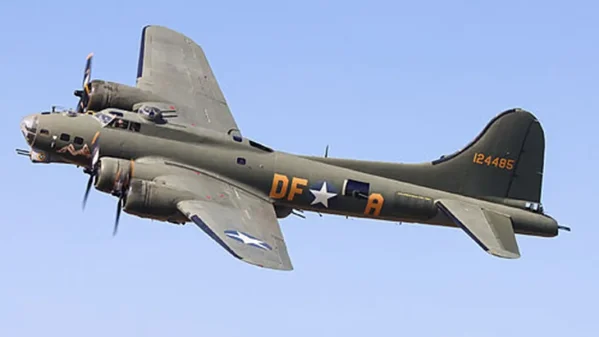
Born and raised in Yelm, Washington, my father-in-law, Martin Johannes (“Jack”) Gruber, Jr. (1915 – 2013), was perhaps the oldest active B17 pilot in WWII’s European Theater. Due to his age, the US Army Air Corp almost did not allow him to enlist: At age 27 he became the oldest recruit pilot in the 447th Bomber Group. After his training to fly a B17 Flying Fortress, they sent him to England in November 1943.
LIFE EXPECTANCY WAS SHORT
Jack’s first bombing mission, on January 4, 1944, was over Kiel, Germany and his last was on May 13, 1944 over Osnabruck, Germany. Each bombing raid had 12 to 16 bombers. Each bomber had a crew of ten and life expectancy was short. Being assigned to a heavy bomber crew was statistically one of the most dangerous assignments in the entire military, seeing casualty rates that rivaled or exceeded front-line infantry. Out of roughly 135,000 American aircrew who saw combat in Europe, about 26,000 were killed (a 19.3% fatality rate) and another 23,000 became POWs. Although it was against regulations, Jack carried a .22 Luger, German made semi-automatic, on his bombing raids. Had he found himself on the ground, he would have used it to prevent becoming a Prisoner Of War. He gifted the Luger to me.
His crew was nine boys aged 18-20. Since Jack was much older, they called him the “Old Man.”
From Jack’s journal:
“April 13. Augsberg again. Briefed at 7am, take off at 10, returned 6pm – a long haul. We hit bad flak shortly after crossing the French coast. We were flying (squadron position) #3 in the lead Squadron. They really had us spotted – 21,000 ft but they had us – Bill Johnson lost 2 engines 6 men wounded. He made it back to England and bailed his men out. Bill couldn’t get out and was killed – swell fellow, big good-looking Swede from Minneapolis. He was #4 – Lowry in #7 had 3 men wounded at the same time and returned to base.
Flak over the target was intense and accurate. That’s where Rock got hit – both legs; the right one looked like it was shattered but found out that the bone was okay – Swadley was good on the first aid – got a tourniquet on it and gave Rock a shot of morphine – Rock never did pass out – talked and joked all the way back over for 3 hours – going to be tough without him – he was always good for a laugh.”
“May 10 – Went into London – had a hell of a big time with the boys – came back feeling fine and ready to hit that last one – glad we took the pass – we missed another rough one – WE ARE KNOWN AS A LUCKY CREW ALL OVER THE BASE.”
DITCHED PLANE IN ENGLISH CHANNEL
“April XX (Date in his diary is not clear.) – “My Gal” was with Engineering again (she had perhaps, all told, 15 engine replacements during our flying together). The crew and I were using another craft to fly to Berlin. . . . We had used so much fuel just getting into Germany and we didn’t want the mission to be useless. We broke formation and dumped our bombs. Now to get back with not enough fuel. These kids were counting on me to get us back.
We dumped everything we could. I released the ball touret^ to lighten our load. We could see the water but were not going to make it all the way back to base. I knew we were going to have to ditch the plane in the Channel. We radioed the base and told them we weren’t going to make it.
The British flew at night while we flew in the day. Because so many planes were going down the British had ships posted to pick up men from downed aircraft. I had the crew scrunched back in the radio room (a place they were getting more familiar with). We had life rafts aboard so got them inflated but while getting them out of the plane they caught the rudder and punctured. The crew jumped anyway, getting wet.
Once the plane was down I crawled out onto the wing and we were met and picked up by a British ship who had our co-ordinates. I learned about black rum that day. The men who were wet were given blankets and we all got mugs of strong black rum which the British kept on board for just such occasions.
Felt bad about dumping some other guy’s plane but glad it wasn’t ‘My Gal.’”
KEEPING AMERICA FREE HAD MANY RISKS
Jack named his plane “My Gal” after his wife, my husband’s mother. He signed up for 31 combat missions over Germany but did 33 without losing a man or a plane. When his combat missions were finished, he refused to return home until all his men were already stateside. He accomplished this by volunteering to shuttle supplies & planes throughout England, Ireland & Scotland, totaling over 100 flights. He returned to the United States on August 4, 1944, having spent nine months in Europe.
Jack was meticulous about maintenance of his aircraft, including keeping the interior of the plane free of oil residue. Several months after he returned to America his aircraft exploded, killing the entire crew. The explosion was believed to be caused by a spark which ignited oil residue inside the cabin which, in turn, reached the fuel tanks. The enemy was not the only risk America’s fighting men faced in World War II.
Honorably discharged July 26, 1945, just days after his 30th birthday, with the rank of captain (which he received May 5, 1944), Jack was awarded the Distinguished Flying Cross, the Air Medal with four Oak Leaf Clusters and the European-African-Middle Eastern Campaign Ribbon with one bronze star.
“END OF TOUR, May 13, 1944:” (The final entry in Jack’s journal) After he described his last mission Jack wrote: “I can’t explain the way I feel – a tremendous relief; the knowledge that I will see my wife and family again is like having your life handed to you – like a reprieve from a death sentence.”
Check me out on X @dianelgruber.
No Other People Enjoy The Rights & Freedoms Our Bill Of Rights Protects
“Oh, you can’t say that, Mrs. Gruber! You will disappear!” said Dorcas in her broken English. This writer & husband were teaching English in Taiwan in the 1970s, at a girls’ c…
I Pledge My Life, My Fortune, My Sacred Honor

This time of year, I think of what the 56 brave British subjects gave us 249 years ago. On the fourth of July, 1776 thirteen united colonies declared themselves to be free and independent states. We were no longer the ugly stepchildren of the British Empire. We were AMERICANS!
^A ball turret (often misspelled as touret) was a spherical, rotatable plexiglass and metal gun turret built into the underside of certain World War II bomber aircraft, most famously the B-17 Flying Fortress. Designed to defend the vulnerable belly of the plane from enemy fighter attacks, it remains one of the most iconic, and claustrophobic, combat stations in military history.
Because the turret hung down beneath the fuselage, it created massive aerodynamic drag and risked scraping the ground during a crash landing. To alleviate this, the turret was designed so it could occasionally be manually cranked around to align the hatch with the cabin floor, allowing the gunner to climb out into the main body of the aircraft before a belly landing or if the plane needed to lighten its load.
The author, Diane L. Gruber, is a First Amendment advocate who writes for Substack. She calls her Substack newsletter America First Re-Ignited. Follow me on X @DianeLGruber.
If you enjoyed this article, then please REPOST or SHARE with others; encourage them to follow AFNN. If you’d like to become a citizen contributor for AFNN, contact us at managingeditor@afnn.us. Help keep us ad-free by donating here.
Substack: American Free News Network Substack
Truth Social: @AFNN_USA
Facebook: https://m.facebook.com/afnnusa
Telegram: https://t.me/joinchat/2_-GAzcXmIRjODNh
Twitter: https://twitter.com/AfnnUsa
GETTR: https://gettr.com/user/AFNN_USA
CloutHub: @AFNN_USA
Patriot.Online: @AFNN
GREAT article! Real heroes:) I felt like I was there when I read this…
these MEN: 18 going on 40
Thank you!!!