Trump returned from China waving press releases like a fisherman holding up a photograph of the one that got away. The headlines promised “historic deals,” “renewed cooperation,” and “strong leadership.” But once the confetti settled and the red carpets were rolled back into storage, the scoreboard looked painfully familiar: China kept the leverage, America got promises, and the president who campaigned as a wrecking ball against Beijing came home sounding like a Chamber of Commerce intern.
For years, Trump built his political brand on the idea that China had been eating America’s lunch. He was right about that. Beijing hollowed out U.S. manufacturing, manipulated markets, stole intellectual property, and used our own appetite for cheap consumer junk to finance its rise. Trump thundered that he alone would stand up to the Chinese Communist Party. Supporters expected a geopolitical Mike Tyson. What they got was a man smiling for cameras while Xi Jinping quietly walked off with the belt, the gloves, and probably the ring ropes.
Start with farmland. Trump and his allies spent years warning that Chinese entities were buying U.S. agricultural land, including parcels near military installations and critical infrastructure. The concern was not paranoia. Land near bases can offer surveillance opportunities and strategic access. Yet after this latest visit, Trump appeared to soften his position, citing the potential effect on land values and American farmers. Translation: national security is apparently negotiable if the bidding gets high enough. Nothing says “America First” like letting a strategic competitor shop for acreage beside sensitive facilities while we assure ourselves it is just a real estate transaction.
Then there is the student issue. Trump has indicated support for allowing very large numbers of Chinese students to continue studying in the United States. To be clear, many Chinese students are hardworking and talented, and most are here to get an education. But Beijing also maintains aggressive influence and intelligence operations, and sensitive research environments are obvious targets. Trump once spoke as though he understood that the competition with China is technological as much as economic. Yet after the China trip, the message sounded more like, “Welcome back, tuition checks.” Apparently the road to strategic dominance runs through the university bursar’s office.
And then there is Taiwan, the geopolitical equivalent of the smoke detector in the world’s most flammable house. Taiwan sits at the center of semiconductor production and Indo-Pacific security. It is the line Beijing wants to erase and the line Washington claims it will help defend. If Trump was going to prove his toughness, this was the moment to extract some meaningful restraint or at least a clearer commitment to stability. Instead, no major change emerged. China did not renounce coercion, reduce military pressure, or offer any substantive concession. Xi got the prestige of hosting a U.S. president while preserving every strategic option he already had. In poker terms, Trump showed his cards and Xi didn’t even have to raise.
The administration touted increased Chinese purchases of agricultural products. We have seen this movie before. China promises to buy more soybeans, corn, and energy products. American officials declare victory. Farmers are told relief is on the way. Then reality arrives, wearing steel-toed boots and carrying a spreadsheet. Some purchases happen, some do not, and the underlying structural problems remain untouched. It is the diplomatic version of being paid in Monopoly money and told to be grateful.
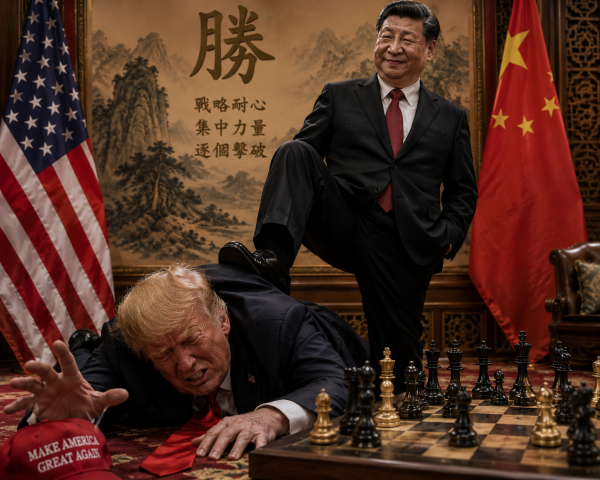
This is the central problem with Trump’s China strategy. His rhetoric is often thunderous, but the outcomes are too frequently transactional and temporary. He talks like Patton and negotiates like a casino owner trying to keep the whales at the table. The Chinese Communist Party understands patience, leverage, and long-term planning. They are playing Go. Washington is still arguing over who gets credit for moving a checker.
Trump’s defenders will say he reduced tensions, reopened dialogue, and secured opportunities for American exporters. Fair enough. Dialogue is better than escalation, and farmers prefer purchase orders to slogans. But that is not what was promised. The promise was a fundamental reset in which America would stop being the world’s economic punching bag. Instead, we received another round of headline management and ceremonial optimism.
China did what it always does. It offered symbolic concessions, protected its core interests, and let American politicians declare success for domestic consumption. Xi Jinping did not need to win dramatically. He only needed to leave the board unchanged. Mission accomplished.
Trump campaigned as the man who would stare down Beijing and make it blink. After this visit, it is hard to escape the conclusion that the dragon did not blink at all. It smiled, signed a few nonbinding understandings, and sent the president home with a stack of glossy folders and a story to tell.
All bark and no bite is harsh, but sometimes the truth deserves a sharp set of teeth. Trump went to China promising to tame the dragon. He came back with soybean promises, tuition receipts, and a reminder that in great power competition, applause is not the same thing as victory.
If you enjoyed this article, then please REPOST or SHARE with others; encourage them to follow AFNN. If you’d like to become a citizen contributor for AFNN, contact us at managingeditor@afnn.us Help keep us ad-free by donating here.
Substack: American Free News Network Substack
Truth Social: @AFNN_USA
Facebook: https://m.facebook.com/afnnusa
Telegram: https://t.me/joinchat/2_-GAzcXmIRjODNh
Twitter: https://twitter.com/AfnnUsa
GETTR: https://gettr.com/user/AFNN_USA
CloutHub: @AFNN_USA
I find it interesting people credit China with incredible foresight and expert high level strategic planning when their nation is a developing catastrophe due to abysmal government policies. The population is collapsing due to a one child policy that destroyed their society and unbalanced their male/female population ratio. Pollution of their air and water is out of control, and the country is facing a tremendous water shortage issue. That shortage is caused by the fact much of their ground water is so contaminated it cannot even be used to irrigate crops. Their science so “advanced” they allowed a deadly virus to escape laboratory containment and kill millions across the world, not to mention in their own country. As demonstrated in Iran recently, their vaunted, military technology pales in comparison to ours. Most of China’s close neighbors hate and distrust them. China’s debt GDP ratio is significantly worse than ours because they have spent massive amounts of money they could not afford in the long run. The Three Gorges dam is a looming disaster both economically and environmentally. China is a threat to the United States and almost every country it does business with, but it is not some unstoppable juggernaut that we should constantly fear. Wariness and healthy suspicion are warranted. Paranoia is not.