The support network includes NGOs and Mexican consulates
This is Part II of a two-part series that is analyzing the La Reconquista movement. It calls for the cultural, demographic, or political “reclamation” of the U.S. Southwest, which Mexico lost after the Mexican-American War.
Part I discussed the movement’s origins and history, ideological core, and its organization in the U.S. This part covers the movement and Mexican consulates in the U.S., Reconquista goals and tactics employed, the movement’s ties to the U.S. political left and Democrat Party, foreign support and NGO networks, and a discussion of possible future scenarios and their potential for success.
THE MEXICAN GOVERNMENT AND ITS CONSULAR NETWORK
This dimension of the Reconquista movement has received the most recent and most serious documented attention, largely through investigative journalist Peter Schweizer’s 2026 book, The Invisible Coup: How American Elites and Foreign Powers Use Immigration as a Weapon, which debuted at #1 on the New York Times bestseller list.
With more than 50 consulates in the U.S. today, Schweizer writes that the Mexican government “is blatantly interfering in our domestic politics, working with American political advisors to turn legal and illegal migrants inside the U.S. into a political force to wield for their benefit.”
The Mexican government sends about a million textbooks to American schools every year to teach its version of U.S. history, among other subjects — an effort Schweizer argues is not meant to help assimilate Mexican migrants to American life.
On protest mobilization, Schweizer documents a sustained pattern: Mexico, working with its domestic allies, has staged successful mass protests. During the spring of 2007, hundreds of thousands of protesters took to the streets across America in multiple marches, carrying Mexican, Salvadoran, Guatemalan, or Dominican flags. An astonishing 3.5 million to 5 million people participated in the marches in twenty cities over a couple of months. It worked: the bill raising illegal immigration to a felony died in the Senate.
The pattern has continued into the Trump era. A Mexican consular official was documented in 2025 going on video chats with other officials, bragging that he was going around the country “organizing the militancy” — his phrase — to resist Trump’s deportation policies. Schweizer has called for reducing the number of Mexican consulates in the U.S. by 90 percent.
The Mexican government launched TV Migrante, a channel dedicated to giving voice to migrants, in March 2025, available across Mexico and in the U.S. on digital platforms and some cable packages.
The strategy uses Latin American immigration, organized and influenced by state-based Mexican consulates, to encourage political activity and support the election of individuals sympathetic to the cause.
Mexico’s government has denied these characterizations. The Mexican Embassy published a statement insisting all its activities were conducted with “strict political neutrality” and that its sprawling network of over 50 consulates was necessary to help Americans. President Claudia Sheinbaum stated: “I categorically deny any involvement or attempt by Mexico to interfere in the internal affairs of the United States.” Schweizer has already been asked to testify at a Senate hearing in March on several of his book’s most significant revelations.
Why does Mexico have so many consulates? Mexico’s network of 50+ U.S. consulates is the largest of any foreign nation in the United States by a wide margin. The official explanation is the size of the Mexican-origin diaspora — over 37 million people of Mexican descent live in the U.S. — generating genuine demand for consular services: passports, legal assistance, community programs, protection of detained nationals. The contested question is whether those functions are cover for, or have expanded beyond, conventional diplomacy into domestic political mobilization.
STATED GOALS AND TACTICS
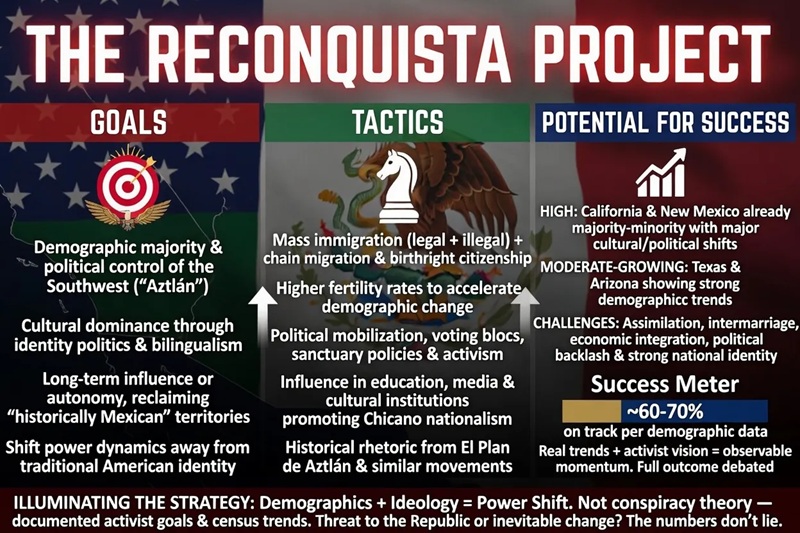
The stated goals of the Reconquista movement — to the extent it can be said to have unified goals — range by faction:
- MEChA and radical nationalists: Formal creation of “Aztlán,” secession from the United States, and eventual annexation to Mexico or formation of an independent Chicano state
- Moderate Chicano nationalists: Cultural sovereignty, political self-determination, and legal recognition of indigenous claims to the Southwest — short of formal secession
- Mainstream Latino advocacy groups: Immigration reform, amnesty for undocumented residents, expanded civil rights protections, and electoral influence
- Mexican government (per critics): Demographic leverage, political influence over U.S. immigration policy, and protection of Mexican nationals living in the U.S.
Key tactics across the spectrum:
Demographic expansion: Between 2022 and 2023, the Hispanic population accounted for just under 71% of overall U.S. population growth, driven primarily by Hispanic births. Population growth is the foundational demographic reality, and most of it requires no deliberate strategy — it is the natural result of a young, high-birth-rate community. U.S.
Birthright citizenship: The 14th Amendment grants citizenship to all persons born on U.S. soil (unless/until the US Supreme Court rules that “birthright citizenship” is unconstitutional). Critics describe births to undocumented mothers as “anchor babies” that establish legal footholds; defenders note most are the children of long-resident families and have no meaningful tie to any reconquest ideology.
“Dreamers”/DACA: The Deferred Action for Childhood Arrivals program protects from deportation those brought illegally to the U.S. as children. It has created a politically sympathetic class of long-resident non-citizens whose status has become a major legislative flashpoint.
Naturalization drives: The Mexican Consul General in Los Angeles advised Mexicans who were not U.S. citizens to become citizens so they could vote in the United States to defend the interests of Mexico, pledging to work with the citizenship efforts of NGOs like LULAC, MALDEF, and CHIRLA.
Protest mobilization: Large-scale organized protests have repeatedly succeeded in blocking or weakening immigration enforcement legislation, as documented above.
Litigation: MALDEF and allied legal organizations systematically challenge deportation orders, immigration enforcement actions, and restrictionist legislation in federal courts.
Educational influence: Beyond Mexico’s textbook programs, Chicano Studies and Mexican American Studies curricula in U.S. universities and some K–12 schools teach frameworks — including Aztlán, the concept of stolen land, and indigenous sovereignty — that are broadly consistent with the cultural premises of Reconquista ideology, even when they stop far short of endorsing separatism.
Electoral politics: Latinos are the largest racial or ethnic group in both California and Texas. More than half of young Californians — 51.5% of those 24 and under — are Latino. As this cohort ages into full electoral participation, the political transformation of the Southwest accelerates regardless of any coordinated strategy.
ALIGNMENT WITH THE POLITICAL LEFT AND DEMOCRAT PARTY
The alignment between Latino advocacy organizations and the Democrat Party is extensive, documented, and mutually reinforcing:
- Democrats have consistently opposed aggressive interior deportation enforcement and supported sanctuary policies
- Democrats have championed DACA, amnesty proposals, and pathways to citizenship
- Latino advocacy organizations — CHIRLA, MALDEF, LULAC, UnidosUS — donate to, lobby for, and mobilize voters on behalf of Democratic candidates
- Labor unions (especially SEIU), the ACLU, and progressive activist networks consistently align with immigrant rights organizations on enforcement issues
- Left-wing academic frameworks (critical race theory, decolonization discourse, indigenous land rights) provide intellectual scaffolding that overlaps with, though is distinct from, Reconquista ideology
The relationship is transactional as much as ideological: Democrats benefit from an expanding Latino voter base; advocacy organizations benefit from Democratic opposition to enforcement. Whether it also reflects a shared ideological vision — as Schweizer and conservative critics argue — or is simply standard coalition politics, is the central contested question.
FOREIGN SUPPORT AND NGO NETWORKS
Mexican political leaders are taking the Reconquista project seriously. Additionally, Schweizer presents extensive evidence that senior Mexican government officials, all the way up to the presidency, openly discuss the colonization of large parts of the U.S.
Beyond Mexico, the broader network includes:
- Sao Paulo Forum: A Latin American leftist political forum that connects Mexico’s ruling Morena party with other regional socialist and progressive movements. Schweizer’s book documents its role in coordinating cross-border political strategy.
- Progressive International: A global network connecting left-wing political parties and movements, with significant Latin American membership.
- Catholic Church: Pope Francis, who long had a Marxist reputation, was an advocate for open borders, and the Catholic Church’s institutional support for immigrant communities — particularly in the Southwest — provides both practical infrastructure and moral legitimacy to the movement.
- Mexican ruling party (Morena): An arm of Sheinbaum’s radical leftist political party Morena responded to Schweizer’s book, attacking him personally on social media. Morena’s international chapters operate inside the U.S., including in New York.
LIKELIHOOD OF SUCCESS – BY POSSIBLE SCENARIO
Four possible scenarios are presented below along with an estimation of the probability of success.
Scenario A — Literal territorial reconquest (military or legal secession): Probability: Effectively zero in any foreseeable timeframe. No credible Mexican government official has formally proposed military reconquest. The U.S. military and legal system present insurmountable obstacles. Most Mexican-Americans — the vast majority of whom are U.S.-born, integrated, and civically engaged — have no demonstrable desire for annexation to Mexico or secession from the United States. Even MEChA’s most radical chapters have never progressed beyond rhetoric.
Scenario B — Cultural and demographic transformation of the Southwest: This is already substantially underway and is irreversible in the near term regardless of any deliberate political strategy. Between 2000 and 2024, the U.S. Latino population nearly doubled, rising from 35.3 million to 68 million. The Southwest will become majority-minority, with Latinos as the plurality or majority group in much of it, driven overwhelmingly by births rather than immigration. This reshapes culture, language, local politics, and policy priorities — but through democratic demography, not conquest.
Scenario C — Political leverage and policy control through organized diaspora influence: This is already succeeding on a meaningful scale. The combination of consular organizing, domestic advocacy networks, electoral mobilization, and litigation has repeatedly blocked or weakened immigration enforcement, driven amnesty legislation, and shaped immigration jurisprudence. The demographic trajectory ensures this influence grows over time.
Scenario D — Foreign interference in U.S. domestic politics via consular network: This is the most live and legally serious question as of 2026. Schweizer’s documented evidence of consular officials organizing political resistance to U.S. federal enforcement — if it meets the legal threshold for illegal foreign interference — could trigger serious diplomatic consequences, including consulate closures. Senate hearings are underway. The outcome is uncertain.
CONCLUDING THOUGHTS
La Reconquista is best understood not as a single unified movement but as a layered phenomenon with distinct components that share demographic premises but differ sharply in goals and methods:
At its fringe, it is a documented radical ideology espousing racial separatism and, in its most extreme expressions, ethnic cleansing — rhetoric that is real, recorded, and deeply troubling, but that commands no mass popular support even within Latino communities.
At its institutional level, it is a sophisticated network of advocacy organizations, legal groups, consular officials, and political allies that has demonstrated genuine effectiveness in shaping U.S. immigration policy through protest, litigation, and electoral mobilization.
At its demographic level, it is simply the natural consequence of population growth — a community of 68 million people whose numbers, youth, and geographic concentration in the Southwest will inevitably reshape American political life, with or without any deliberate strategy.
The most defensible conclusion is that a coordinated effort to use immigration as political leverage — involving Mexican consulates, domestic advocacy organizations, and sympathetic U.S. political actors — is real and documented. This is exactly what Americans have become aghast at while observing the open borders years of the Biden regime during which millions of illegal aliens were granted taxpayer-funded welfare benefits and the right to vote in certain Democrat-controlled jurisdictions.
A formal plan for territorial reconquest is not supported by credible evidence although activists in the movement and even Mexican officials leak these long-term intentions from time to time (followed by “official denials”). Note that secession as a result of demographic shifts is simply territorial reconquest by another name.
Regardless, the demographic transformation of the American Southwest is happening. Rapid mass deportation of illegal aliens is the only policy that can slow the process and enable full assimilation of any new arrivals who are allowed to remain in the U.S.
The end.
StuinSD is a reader-supported publication. To receive new posts and support his work, consider becoming a free or paid subscriber.
This article originally appeared in Stu Cvrk’s Substack. Reprinted here with permission
If you enjoyed this article, then please REPOST or SHARE with others; encourage them to follow AFNN. If you’d like to become a citizen contributor for AFNN, contact us at managingeditor@afnn.us Help keep us ad-free by donating here.
Substack: American Free News Network Substack
Truth Social: @AFNN_USA
Facebook: https://m.facebook.com/afnnusa
Telegram: https://t.me/joinchat/2_-GAzcXmIRjODNh
Twitter: https://twitter.com/AfnnUsa
GETTR: https://gettr.com/user/AFNN_USA
CloutHub: @AFNN_USA