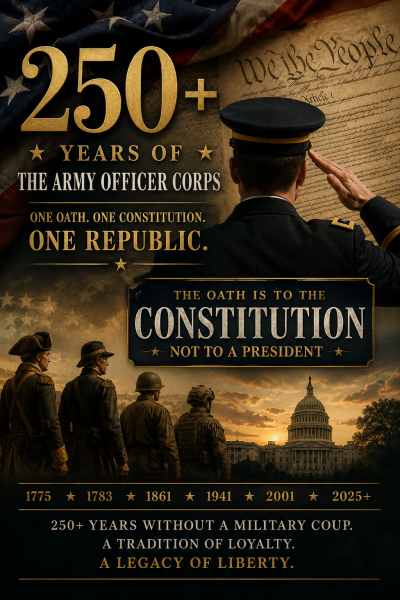
For more than 250 years, the United States has accomplished something almost unheard of in world history.
The American military has never overthrown the government it was created to defend.
Empires have fallen to ambitious generals. Republics have become dictatorships after military takeovers. Across Europe, Africa, Asia, and Latin America, history is littered with examples of armies deciding they knew better than elected leaders.
The United States took a different path.
The reason isn’t that American officers are somehow morally superior to every other nation’s. It isn’t because we’re immune to politics or human ambition. It is because our Founders built something revolutionary into the very fabric of military service.
An American officer does not swear an oath to a king.
He does not swear an oath to a president.
He does not swear an oath to a political party.
He swears an oath to the Constitution of the United States.
That simple distinction has protected our republic for nearly two and a half centuries.
Every commissioned officer promises to “support and defend the Constitution of the United States against all enemies, foreign and domestic,” and to bear “true faith and allegiance to the same.” Read the oath carefully. The object of our loyalty is not a person. It is not an administration. It is not even the Army itself.
It is the Constitution.
The Founders understood history. They had lived under a monarchy where soldiers ultimately served a king. They knew that republics often die when armies become personally loyal to rulers instead of the law. So they created a constitutional system in which the military would belong to the nation rather than to any individual.
They also solved what appears to be a paradox.
The very Constitution officers swear to defend establishes civilian control of the military. Article II names the President as Commander in Chief. Congress raises and supports the Army. Civilian leaders set national policy. Military leaders execute lawful orders.
Notice that word: lawful.
That single word explains the relationship between the oath and the chain of command. Officers obey lawful orders not because they have sworn loyalty to a president, but because the Constitution itself grants lawful civilian authority over the armed forces. Our obedience is rooted in the Constitution, not in personalities.
This principle has survived every test America has faced.
George Washington voluntarily resigned his commission after winning the Revolutionary War, astonishing a world accustomed to victorious generals becoming kings. Abraham Lincoln replaced generals repeatedly during the Civil War until he found commanders who could execute his strategy. Harry Truman relieved Douglas MacArthur during the Korean War. Barack Obama relieved Stanley McChrystal. Other presidents have reassigned or retired senior commanders when they believed new leadership was needed.
Some of those decisions remain controversial today.
That isn’t the point.
The point is that the Army obeyed the constitutional process every single time.
Generals saluted.
The chain of command continued.
The republic endured.
That is exactly what the Founders intended.
Today, debates continue whenever a President or Secretary of Defense (War) replaces senior military leaders. Some view such actions as necessary reform. Others view them as political mistakes. Those are legitimate debates in a constitutional republic.
But they should never be confused with a constitutional crisis simply because a general was relieved.
Four-star generals serve in positions of trust and confidence. They are not elected officials. They do not possess independent political authority. Civilian leaders have the constitutional power to appoint them, reassign them, or replace them. That authority is not a flaw in our system—it is one of its greatest safeguards.
Having worn the uniform for more than two decades, I can say that this principle is drilled into officers from the very beginning. Whether at West Point, ROTC, or Officer Candidate School, young leaders are taught that their loyalty belongs first to the Constitution. Every promotion, every new assignment, every reenlistment of that commitment reinforces the same idea.
Presidents will come and go.
Cabinets will change.
Political parties will rise and fall.
Generals will retire.
The Constitution remains.
That may be one of the least appreciated reasons America has remained a constitutional republic for nearly 250 years. Our military has extraordinary power, yet it has consistently remained subordinate to civilian authority because its officers understand where their allegiance truly lies.
Not with a man.
Not with a party.
With the Constitution.
Perhaps that is the greatest tradition the American officer corps has ever preserved—not simply winning wars abroad, but ensuring that liberty at home survives every transfer of power.
If you enjoyed this article, then please REPOST or SHARE with others; encourage them to follow AFNN. If you’d like to become a citizen contributor for AFNN, contact us at managingeditor@afnn.us Help keep us ad-free by donating here.
Substack: American Free News Network Substack
Truth Social: @AFNN_USA
Facebook: https://m.facebook.com/afnnusa
Telegram: https://t.me/joinchat/2_-GAzcXmIRjODNh
Twitter: https://twitter.com/AfnnUsa
GETTR: https://gettr.com/user/AFNN_USA
CloutHub: @AFNN_USA