Ignore the similarities to our collective peril
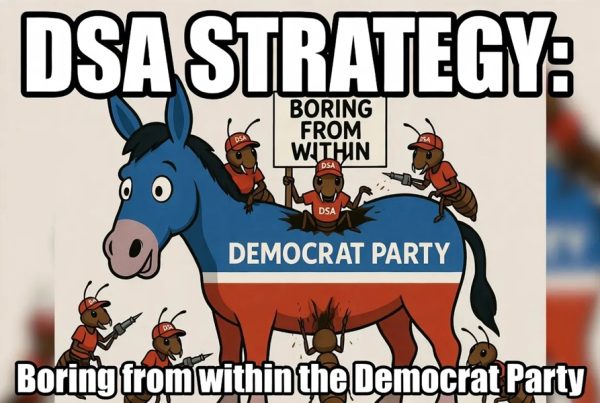
This is the second part of a two-part analysis that examines a specific historical claim: that the decades-long push of Democratic Socialists of America inside the Democrat Party follows the same “boring from within” logic the Bolsheviks used against the Socialist Revolutionaries and Mensheviks in 1917 — a small, disciplined vanguard using a broader coalition’s legitimacy and infrastructure to gain position, growing more candid about maximalist goals as it consolidates power, with no intention of remaining merely one faction among many.
Part I examined the Bolshevik precedent, the DSA parallel, what’s genuinely similar between the two. This part discusses what’s genuinely different (especially tactics), possibilities for DSA success or failure, and speculation on whether the DSA endgame will ultimately end in Bolshevik-style violence and revolution rather than a clean electoral outcome.
This is where the analogy needs real qualification because the differences are as load-bearing as the similarities:
No armed seizure of the state. The Bolsheviks took power through an actual coup executed by armed Red Guards against a sitting government, followed by suppression of a competing, popularly-elected body (the Constituent Assembly) by force. The DSA’s entire strategy, to date, runs through primary elections, ballot access, and legislative votes — it is winning inside the constitutional system, not overthrowing it. Whether its stated end-state (subordinating the courts and executive to Congress, abolishing the Senate) is compatible with the constitutional order is a fair question to raise, but the method of pursuit is categorically different from 1917. At least that’s the state of affairs now. This could easily change if Antifa and DSA combine forces in pursuit of their common objective (destruction of the American constitutional republic).
No single-party terminus (yet). Bolshevik Russia moved to formal one-party rule and criminalized rival socialist parties within about four years. Nothing analogous exists in the DSA project — it operates as a faction contesting Democrat primaries, and multiple other factions (Third Way–style moderates, the Working Families Party, Justice Democrats) continue to compete openly for the same terrain, sometimes against each other rather than in lockstep with DSA. The Washington Monthly’s reporting on 2026 primary results specifically notes DSA-aligned insurgents have had less success knocking off true Democrat moderates in primaries to date — the “capture” is real but partial and contested, not consolidated. But it’s early, as this is the first election cycle in which DSA has fielded more than a few challengers in Democrat primaries across the US. How many Americans even knew of their existence in 2024?
Media and information environment. 1917 organizing ran through pamphlets, party newspapers (Pravda), and physical agitation in barracks and factories. The 2026 version runs through an entirely different tactical stack: social-media-native candidates (Mamdani’s campaign was heavily short-form-video driven), live streamers with large followings functioning as movement media (e.g., socialist streamer Hasan Piker weighing in on primary strategy in real time), small-dollar digital fundraising (ActBlue) replacing the need for a mass-membership newspaper, and data-driven low-turnout-primary targeting that lets a relatively small organized bloc flip a seat that a mass movement would have needed far more bodies to contest in 1917. That said, there are many pundits in the legacy media who are sympathetic to DSA goals and objectives, and their reach is considerably greater than the broadsheets exploited by the Bolsheviks. The pro-Democrat media probably believe they are helping the Democrat Party by favorably reporting on the DSA!
Legal/institutional channel work replaces street seizure. The 1917 model culminated in physical control of ministries, telegraph offices, and rail stations. The DSA model culminates in winning mayoralties, state legislative seats, and Congressional primaries — and then using those offices to reshape policy from within (e.g., reported pressure from DSA on Mamdani’s NYPD staffing plans). Power is being acquired seat by seat under existing electoral law, not through a rupture. But the race is not yet run, and the potential absorption of Antifa elements and BLM remnants would provide the street muscle to achieve some dramatic takeovers of public buildings. Again, it’s early in the game.
Funding structure is diffuse and largely legal philanthropy, not a foreign-state-backed party apparatus. The Bolsheviks received documented German funding to destabilize wartime Russia. The DSA-adjacent funding ecosystem (Soros-linked foundations, Tides, Arabella Advisors’ New Venture Fund, donor-advised funds) is domestic and works through the 501(c)(3)/(c)(4) tax code — legally gray in specific instances (the Stop Cop City indictment being the sharpest example) but structurally different from a foreign intelligence subsidy. It’s accurate to call this network deliberately opaque; it’s not accurate, on current public evidence, to call it a unified top-down command structure the way the Bolshevik party was. That said, the Soros ecosystem could be considered the “first among equals.” Note: DSA-adjacent organizations funded by Neville Singham would qualify as “foreign-backed funding sources” although there are no known formal ties between the likes of the Neville-funded Party for Socialism and Liberty (PSL) and DSA at this time.
The “prisons less necessary” vs. Gulag question. DSA co-chair Ashik Siddique’s public position is explicitly non-carceral and abolitionist-adjacent, the rhetorical opposite of Bolshevik state terror. Whether that stated position would survive contact with actual state power is a legitimate speculative question — but as of today it should be labeled speculation, not documented fact. Note: the one characteristic that all Marxists share is their ability to lie with impunity and then change positions to advance their political agenda at the drop of a hat. Note that Vladimir Illych Lenin was good at lying, too.
POSSIBILITIES FOR DSA SUCCESS OR FAILURE
This section is, of course, purely conjecture. That said, the possibilities are real.
Paths to further consolidation:
- Continued low-turnout primary targeting against aging or complacent incumbents (the model that worked against DeGette, Goldman, Espaillat).
- Building a genuine bench through the “farm system” — school board and city council wins converting into state legislative and Congressional power over the next two cycles.
- A charismatic, media-fluent standard-bearer (Mamdani nationally, in the mold of AOC in 2018) who normalizes the brand faster than opposition research can define it negatively.
- Democrat establishment paralysis — leadership vacuum post-Pelosi, and the “big tent” framing from figures like Rep. Vincente Gonzalez, suggests the party has not settled on a strategy to contain the faction.
Paths to failure or containment:
- The DSA’s own internal fractures are real and documented — the carceral-abolition and “real democracy” (court/Senate abolition) planks passed by narrow or contested margins, and minor non-player character (NPC) members themselves flagged that whole caucuses felt unrepresented in drafting. A “big tent” containing Bernie-style reformists, Maoists, and Marxist Unity Group members is a coalition-management problem, not a monolith. Will the Republican Party develop a coherent strategy to counter the DSA communists? It hasn’t happened yet.
- Electability ceiling: Washington Monthly‘s analysis found DSA-style insurgents have underperformed against genuine moderates outside deep-blue districts; a radicalized platform released just months before the midterms is a gift to Republican messaging (Speaker Johnson has already been reading planks aloud at conservative conferences) and a genuine liability in swing districts, where Republican ads writing themselves from DSA slogans like “abolish the Senate” and “public ownership of the largest corporations” could cost Democrats the House.
- A Third Way-style internal counter-mobilization: a Washington Post piece explicitly calls for the party establishment to organize against the DSA rather than accommodate it — the opposite of the Menshevik/SR failure to take the Bolsheviks seriously as an existential threat until too late. The problem here is that those mythical “Democrat moderates” are invisible at this point – to the extent that there are any extant!
- Historical base-rate skepticism: American third-force/insurgent movements such as the Tea Party movement have repeatedly captured a party’s energy and base without achieving the total, permanent institutional lock-in the Bolsheviks did — the US constitutional and federalist structure, with staggered elections, primaries open to intra-party contestation, and no soviet-style unicameral national assembly to seize, makes a Bolshevik-style irreversible consolidation structurally much harder, whatever the DSA’s platform aspires to.
CONCLUDING THOUGHTS
The Bolshevik analogy illuminates tactics — patient infiltration, use-and-discard of coalition partners, growing candor about radical goals as power consolidates — better than it predicts outcome. 1917 Russia had a collapsing autocracy, a war-exhausted army, and no entrenched two-century constitutional order to work around; 2026 America has none of those conditions although there are any number of leftwing organizations, donors, and street activists who would love to create them.
The most defensible version of the comparison is: DSA is running a “boring from within” strategy against the Democrat Party with real, documented success at the primary level and increasing candor about maximalist goals — not that DSA is on a Bolshevik-style trajectory toward an irreversible, armed, one-party seizure of the American state. At least at this point, but the potential for an end state similar to what the Bolsheviks achieved is definitely there.
The DSA’s electoral strategy and the Antifa/BLM-network/other street-protest ecosystem plausibly function this way — distinct organizations, overlapping personnel and causes (e.g., Gaza, anti-ICE, anti-police), a shared ultimate horizon (the “post-capitalist” framing common across the space), with the street element providing disruptive pressure from which the electoral element can benefit without formally owning it. Whether that amounts to a coordinated strategy or a loosely correlated ideological milieu that happens to move together is genuinely unresolved at this point.
The risk scenario that must be mentioned. Could all this end in Bolshevik-style violence and coup/revolution rather than a clean electoral outcome? The honest answer is it’s a live possibility rather than a documented trajectory, so far. The conditions that made 1917 escalate to armed seizure — state collapse, war exhaustion, a security vacuum — don’t currently exist in the US, which is the strongest reason to discount a literal repeat. But a scenario in which DSA’s institutional wins are backstopped by an escalating, foreign-linked, financially opaque street-protest apparatus that normalizes political violence as tactically acceptable is not far-fetched based on what has transpired to date. It is, in fact, closer to the actual historical Bolshevik playbook (legal politics plus an extralegal enforcement arm) than a pure electoralism-only reading of the DSA would suggest.
That scenario remains a key risk to monitor at this point. Will most of the American electorate conclude that, left unchecked, the continuing pot-stirring by DSA and the street activists could morph into something that approaches what happened in 1917? That is precisely the empirical question the 2026 midterms and the 2028 presidential primary will test.
The end.
StuinSD is a reader-supported publication. To receive new posts and support his work, consider becoming a free or paid subscriber.
This article originally appeared in Stu Cvrk’s Substack. Reprinted here with permission
If you enjoyed this article, then please REPOST or SHARE with others; encourage them to follow AFNN. If you’d like to become a citizen contributor for AFNN, contact us at managingeditor@afnn.us Help keep us ad-free by donating here.
Substack: American Free News Network Substack
Truth Social: @AFNN_USA
Facebook: https://m.facebook.com/afnnusa
Telegram: https://t.me/joinchat/2_-GAzcXmIRjODNh
Twitter: https://twitter.com/AfnnUsa
GETTR: https://gettr.com/user/AFNN_USA
CloutHub: @AFNN_USA