After Japan attacked Pearl Harbor, Americans legitimately feared an invasion of the homeland. The threat of living under a military dictatorship, heightened our appreciation of – and determination to defend – our freedom. But in 21st century America, the United States is the sole superpower, and the likelihood of a foreign invasion seems remote.
Perhaps that’s why we take our freedom for granted – because we don’t sense it at risk. Unfortunately, our sense of security has blinded us to a much more insidious risk to our freedom – a government which we allowed to grow, far beyond anything our founders envisioned.
The men who risked everything to bequeath freedom to us, understood that freedom wanes as government grows. That’s why they gave us the 10th Amendment – to keep the government small.
During my elementary school years (way back in the pre-internet 60s), we were taught that boys will be boys, girls can get pregnant (because boys will be boys), socialism is bad, and freedom is what makes us exceptional. Now most schools teach that every problem needs a government solution.
This “government needs to solve every problem” mindset has given us an explosion of government overhead, with a correspondingly negative impact on our freedom.
Per USAFacts, Our government currently employes about 2.9 million civilians, not including state and local government employees. To feed that monster the federal budget has grown to an astronomical 7.3 trillion dollars per year. (per The Treasury Department) – about 2 trillion of which is borrowed annually against our children’s future. It would require the gold of 12 Fort Knox’s just to pay the federal government’s bills – every year!
There have been endless articles about the downside of runaway government burden. But the burden on our economy isn’t the biggest problem created by our spendaholic Congress – though it is the most visible. The federal budget is also a measure of our government’s size. That should concern us because freedom wanes as government grows. As our government grows, the thing that makes America exceptional shrinks – our individual freedom to manage our affairs. The true cost of government would be better stated in terms of freedom lost, than dollars spent – though that’s considerably harder to quantify.
Let’s look at how our government spends that 7 trillion bucks. Our millions of “public servants”
- Ensure national security;
- Provide disaster relief;
- Manage infrastructure;
- Maintain social safety nets;
- And create, administer, and enforce laws and regulations.
It’s that last regulatory function that creates a problem for our freedom, and it has become one of the most intrusive functions of government.
Each law or regulation is an instance where a decision has been taken out of our hands. Therefore, each is also an infringement on our freedom.
For example: Government regulation of interstate commerce eventually led to the loss of freedom in virtually all forms of commerce. The Wickard v. Filburn Supreme Court decision said any product which could cross state lines, may be regulated by the government as “interstate”, even if it didn’t cross state lines. That granted the government total control over commerce – which the regulatory state has used with enthusiasm. With that one judicial (mis)interpretation, regulatory overreach metastasized into every aspect of our lives.
When the government regulated emissions, we lost the freedom of product choice. Now the government dictates what cars, toilets, appliances, and even light bulbs we’re allowed to buy – in the name of environmentalism.
When the government regulated health insurance, we lost the freedom to choose how we interacted with our doctors. Thanks to Obamacare, healthcare has become far less personal, far more costly, and offers far fewer options for us to choose between – in the name of affordability.
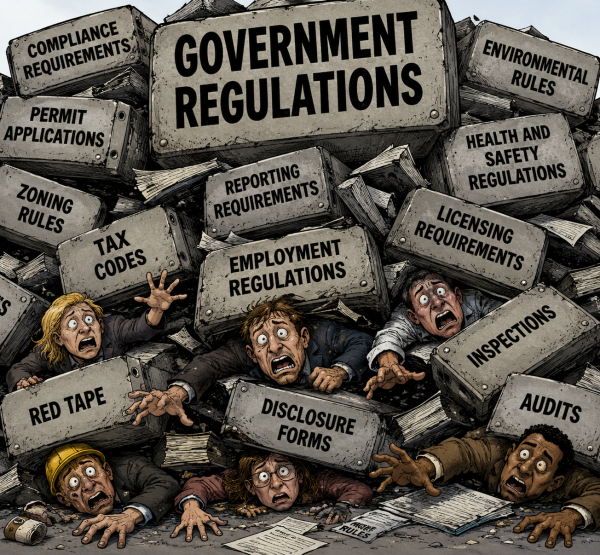
Government regulations have metastasized throughout almost every aspect of our lives: education, transportation, land use, employment, banking, securities, consumer products, self-defense, environmental protection, utilities, food, trade, medical treatment, and on, and on, and on.
Federal regulations are organized into the Code of Federal Regulations, which is over 190,000 pages long, and covers 50 different subject matter areas – and that doesn’t include state and local regulations. Each regulation represents a decision we are no longer empowered to make. Granted, each is only a small sliver taken away from our ability to manage our own affairs. But a couple of hundred thousand pages of regulations contain a whole lot of slivers shaved from our freedom. Big government advocates, on both sides of the aisle, have been slowly whittling away our freedom – with our consent.
The George Washington University Center for Regulatory Studies, estimates that 279,000 federal employees are employed to administer our regulatory regimen. That’s an army the size of France’s, whose mission is to curtail our freedom – and it has no intention of surrendering.
I acknowledge that some regulations are a reasonable tradeoff – a little splinter of freedom lost, for a substantial benefit.
Few would argue the need for clean air and water, and would accept a small encroachment on our property freedom to get it. But after we assigned a few thousand people to regulate our environment, we should have expected that they might get a bit … over-enthusiastic. Our regulators went from restricting us from dumping carcinogens into the water, to issuing regulations on the gas we exhale – which they cleverly called our “carbon footprint,” rather than our “breath.” That’s how good intentions morph into autocratic overreach.
Since freedom wanes as government grows, the only way to prevent the government from regulating our freedom into extinction, is to limit the size of our government – the number of people authorized to make decisions on our behalf.
But having failed to do that, ours is a government which is spending billions of dollars annually, to regulate us into servitude. Big government advocates argue that it’s for the common good. But “common good” is just a less offensive term for “collectivism” – placing the needs of the commune above the rights of the individual. “Common good” is the antithesis of individual liberty.
It turns out the Gipper was right. At the height of our malaise doldrums, President Reagan said: “Government is not the solution to our problem; government is the problem.” I think the old cowboy (actor) was onto something. We should have paid closer attention
How long will we retain some semblance of freedom? That’s hard to say, but on our current trajectory we will eventually join Canada and most of Europe – free only to serve the “common good,” not ourselves; subjects, not free men. We can fix this mess by:
- Imposing term limits – so elected office is no longer a career.
- Establishing fiscal restraint – so government growth is not the norm.
- Overturning bad judicial decisions – to prevent the government from “interpreting” us into servitude.
- Returning power to the states and the people – as our founders intended.
All things which Convention of States Action seeks to accomplish with an Article V convention.
[Image generated by ChatGPT]
This article appeared previously on American Thinker.
Author Bio: John Green is a political refugee from Minnesota, now on strike in Galt’s Gulch – which the locals call Idaho. He is a retired engineer who spent much of his career applying engineering principles to organizational development (yes, really). He has written for The American Spectator, Convention of States Action, and American Free News Network. He can be reached at greenjeg@gmail.com.
If you enjoyed this article, then please REPOST or SHARE with others; encourage them to follow AFNN. If you’d like to become a citizen contributor for AFNN, contact us at managingeditor@afnn.us Help keep us ad-free by donating here.
Substack: American Free News Network Substack
Truth Social: @AFNN_USA
Facebook: https://m.facebook.com/afnnusa
Telegram: https://t.me/joinchat/2_-GAzcXmIRjODNh
Twitter: https://twitter.com/AfnnUsa
GETTR: https://gettr.com/u