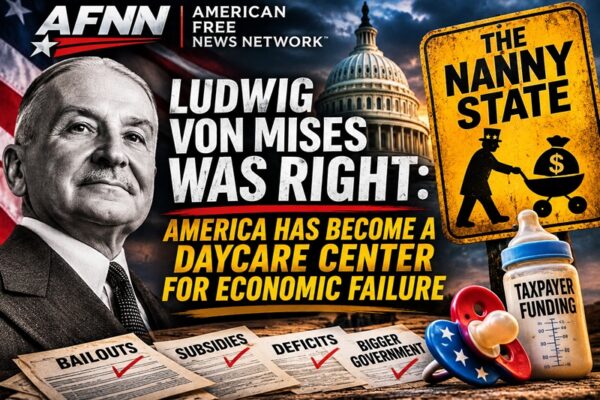
One hundred years ago, an Austrian economist warned that government couldn’t repeal economic reality. A century later, Washington is still trying—and sending taxpayers the bill.
Ludwig von Mises figured out something a century ago that apparently requires an advanced economics degree, three congressional committees, and two functioning brain cells to understand: You cannot subsidize failure indefinitely and expect success.
Born in the Austro-Hungarian Empire and intellectually forged in Vienna, Mises watched governments experiment with economic fantasies while ordinary citizens paid the price. In 1920, he explained why socialist central planning couldn’t rationally allocate resources without genuine market prices. His argument was devastatingly simple. Without prices reflecting supply, demand, scarcity, and individual choices, bureaucrats are essentially throwing darts at an economic dartboard while blindfolded.
Naturally, politicians loved the idea.
Fast-forward to America in 2026, where we’ve developed something resembling capitalism wearing a socialist Halloween costume. We still have private property, businesses, entrepreneurs, and competition. But increasingly, when somebody makes a terrible financial decision, Uncle Sam arrives with a taxpayer-funded diaper bag.
Banks make reckless bets? Bailout.
Corporations mismanage themselves into bankruptcy? Emergency assistance.
Politicians spend money they don’t have? Borrow another trillion.
Citizens demand government protection from every imaginable inconvenience? Congratulations, you’ve qualified for another federal program.
Welcome to the American Nanny State, where everybody gets a participation trophy and somebody else gets the invoice.
Capitalism Without Consequences Isn’t Capitalism
Mises understood that profit and loss weren’t cruel inventions dreamed up by cigar-smoking industrialists. They were information. Profit tells us resources are being used in ways customers value. Loss tells us something needs to change.
Remove the possibility of failure, and you remove one of capitalism’s most important corrective mechanisms.
Imagine running a shooting competition where everybody receives a perfect score regardless of where their bullets land. Nobody improves, nobody learns, and eventually somebody declares the target discriminatory.
That’s essentially what happens when government repeatedly shields politically favored institutions from economic consequences.
And here’s the particularly delicious hypocrisy: Americans are lectured about personal responsibility by politicians who haven’t balanced a federal budget in decades.
Apparently, accountability is something the peasants practice.
Show Me One Successful Socialist Paradise
Here’s a challenge for America’s aspiring central planners: name one fully socialist, centrally planned country that delivered sustained prosperity, political freedom, and widespread consumer abundance comparable to successful market economies.
The Soviet Union? Collapsed.
Mao’s China? Catastrophic economic experiments, followed by market-oriented reforms that helped unleash extraordinary growth.
Cuba? Decades of shortages and economic hardship.
Venezuela? An oil-rich country whose disastrous economic management helped produce hyperinflation, scarcity, and mass emigration.
Then somebody inevitably shouts, “What about Sweden?”
Excellent question. Sweden, Denmark, and Norway are prosperous welfare states built around private enterprise, competitive markets, and extensive taxation. They’re mixed economies, not examples of abolishing private ownership and market pricing.
A safety net isn’t automatically socialism. Neither is a public school or a fire department. Words still mean things, despite Washington’s determined campaign against that concept.
The real question is whether government helps people recover from hardship or constructs permanent systems that reward dependency, political favoritism, and institutional incompetence.
The Forgotten Virtue of Failure
Failure isn’t always injustice. Sometimes it’s education.
A bankrupt business teaches lessons. A bad investment imposes discipline. A foolish government program should be terminated, not renamed, expanded, and handed another billion dollars.
Of course, civilized societies should protect vulnerable citizens and help people facing genuine hardship. But compassion without accountability eventually becomes an expensive mechanism for manufacturing more problems.
Mises understood something modern politicians desperately avoid: economic reality doesn’t care about campaign promises.
America doesn’t need another government agency promising to protect everybody from everything. We need competition, honest prices, responsible spending, and the courage to let unsuccessful ideas die.
Because the alternative isn’t some glorious workers’ paradise. It’s a permanent economic daycare center administered by bureaucrats who couldn’t run a lemonade stand without a federal grant.
Mises warned us in 1920. More than a century later, we’re still debating whether consequences should apply to everyone—or just the taxpayers financing everybody else’s mistakes.
And if we can’t figure that out with two functioning brain cells, perhaps we deserve the nanny state we’re building.
If you enjoyed this article, then please REPOST or SHARE with others; encourage them to follow AFNN. If you’d like to become a citizen contributor for AFNN, contact us at managingeditor@afnn.us Help keep us ad-free by donating here.
Substack: American Free News Network Substack
Truth Social: @AFNN_USA
Facebook: https://m.facebook.com/afnnusa
Telegram: https://t.me/joinchat/2_-GAzcXmIRjODNh
Twitter: https://twitter.com/AfnnUsa
GETTR: https://gettr.com/user/AFNN_USA
CloutHub: @AFNN_USA