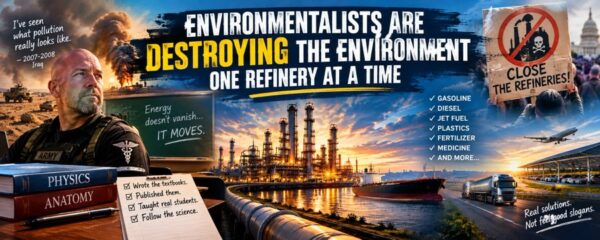
I teach Physics. I also teach Anatomy. I did not inherit somebody else’s curriculum and read it off a slide. I wrote the textbooks. Both of them. I published them. So when somebody wags a finger at me and says “follow the science,” I want you to understand that I am not borrowing that phrase from a bumper sticker at the co-op. I have sat at my kitchen table at midnight, chapter by chapter, turning thermodynamics and energy transfer into something a tired sixteen-year-old in a high-need district can actually use. I have sourced it, checked it, and rewritten it when the kids told me it made no sense.
I also spent 2007 and 2008 in Iraq as an Army medic, breathing smoke from burn pits that nobody back home was counting. Trash, plastics, fuel, medical waste, all going up in open flames, and for years the official answer was that it was fine. So forgive me if I get a little personal about pollution that happens “somewhere else” and conveniently never makes it onto anyone’s ledger. I have lived downwind of an uncounted smokestack. I know exactly what it smells like when the people in charge decide not to look.
So when the climate movement tells me oil is the enemy, a refinery is a moral crime, and the only grown-up position is to shut the plants down and feel good about it, I do not panic. I go to the energy tables. I go to the shipping lanes. I go to the literature. And what I find there is nothing like what they are selling you.
We use oil. We need oil. Gasoline, diesel, jet fuel, plastics, asphalt, fertilizer feedstock, the IV bags I used to hang as a medic, the insulin pens, the syringes, the running shoes of every protester who ever marched against a pipeline. The modern world runs on refined petroleum. That is arithmetic, not a conspiracy. The oil sitting in the ground was never the problem. What we do with it after we pull it out is the whole ballgame.
THE PHYSICS THEY KEEP SKIPPING
Energy does not vanish because a governor held a press conference. It moves. Crude oil is a dense package of chemical potential energy, and you have two choices. You can refine it here, under rules you wrote, in equipment you can inspect, next to a regulator you can sue. Or you can put it on a ship, burn heavy bunker fuel for weeks, and refine it in a country that has never heard of your recycling pledge. Either way the carbon still exists. The only question on the table is whether you want the cleaner process or the dirtier one.
In my classroom we call that a mass-balance problem. What goes in has to come out somewhere. You can move it, you can hide it, you can put it in a different column, but you cannot make it disappear. Any student who turned in a lab report claiming otherwise would get a zero and a conversation with me after class.
Scale is where the movement really loses the plot. A brand-new hydrotreater and a 1970s cracking unit are different machines. A pipeline and a Very Large Crude Carrier are different transport systems. A parking lot under a solar canopy and a naked black asphalt lot are different surfaces. Lumping them all together is the firefly-and-the-sun mistake. A firefly and the sun are both light sources. Technically true! But if I told you that firefly in your backyard was going to give you a sunburn, you would look at me like my elevator stopped a few floors short of the penthouse. And yet that is the exact level of proportional reasoning being used to write national energy policy. It keeps me up at night. Not the oil. The reasoning.
THE REFINERY PROBLEM
A modern refinery looks nothing like the cartoon plant activists still draw on their protest signs, the one with the skull and crossbones floating out of the stack. New and upgraded facilities use better catalysts, better hydrotreating, better sulfur recovery, tighter NOx controls, and fenceline monitoring that did not even exist when most of today’s fleet was built. They make ultra-low-sulfur gasoline and diesel. They pull the sulfur out and sell it instead of sending it up the stack. They turn out a cleaner barrel with less pollution per gallon than the aging plants they would replace.
The technology moved forward. The protest signs stayed in 1975.
Instead of building those plants here, we have watched our capacity shrink. U.S. operable atmospheric distillation capacity peaked at about 18.98 million barrels per calendar day on January 1, 2020. By January 1, 2026, it was about 18.16 million. After Valero’s Benicia plant in California stopped refining in early 2026, the mid-year run rate is closer to a 900,000-barrel-per-day loss from the peak. You could fuel an entire metro area on what we gave away. That is not a rounding error. That is a missing city.
As of January 1, 2026, EIA counted 130 operable refineries, two fewer than the year before. LyondellBasell shut its Houston plant (263,776 barrels a day) in March 2025. Phillips 66 shut Los Angeles (138,700 barrels a day) in October 2025. Valero Benicia (145,000 barrels a day) followed. The West Coast lost a meaningful slice of its own supply, and there is almost no pipeline to bring replacement product over from the Gulf Coast. So the replacement shows up the only way it can. By boat.
The newest refinery in the United States with significant downstream capacity is still Marathon’s Garyville plant in Louisiana. It came online in 1977. I want you to think about what else was new in 1977. Star Wars. The Apple II. Disco. We have added barrels since then by stretching old steel: Exxon upgraded Beaumont, Motiva expanded Port Arthur, and a small 45,000-barrel plant opened in Galveston in 2022. None of that replaces a complex West Coast refinery. We have been patching a 1970s car with duct tape and bragging about the mileage.
Why no new plants? Environmental groups fought the permits. Lawsuits, protests, “sacrifice zone” slogans, and years of delay made new construction nearly impossible in a lot of places. The Brownsville project on the Texas coast has been opposed for more than seven years. Industry people call projects like that zombies, because they never quite die and never quite live. And the same folks who sued them into the grave act genuinely shocked when the gasoline still has to come from somewhere. That is a level of surprise usually reserved for somebody who is one sandwich short of a picnic and just found out the picnic needed sandwiches.
So what happens to the oil we refuse to refine?
It goes on a boat.
THE SHIPPING EMISSIONS NOBODY COUNTS
A crude tanker does not run on good intentions and oat milk. It burns bunker fuel, the heavy sludge left at the bottom of the barrel after the useful fractions have already been pulled off. Those ships cross entire oceans. A gasoline cargo from Singapore to California spends roughly three to four weeks on the water. The emissions are real: carbon dioxide, sulfur oxides, soot.
And here is where the accounting gets creative. Under the UN’s own greenhouse gas reporting rules, fuel burned by ships on international voyages does not count toward any nation’s total. None. The smoke goes into the same atmosphere we all share, but on paper it belongs to nobody. So a state can shut down a refinery, import the gallon from across the Pacific, and its emissions chart goes DOWN while the planet’s actual emissions go UP. The pollution happens. The spreadsheet stays spotless.
If one of my students pulled that on a lab report, I would call it what it is. Cooking the data.
A 2023 study in Nature Communications that mapped carbon intensity from the well to the refinery entrance found a massive spread depending on the route, from a few kilograms of CO2-equivalent per barrel to well over a hundred, with a volume-weighted global average around 50.5 kilograms before the crude ever reaches the plant. Transport is a real chunk of that. Crude hauled from the Arabian Gulf to North America is a very different animal than a short pipeline run from the Permian to the Gulf Coast. Distance drives the number. That is physics, not a talking point.
On land, a well-run pipeline is the grown-up way to move crude. We have more than 200,000 miles of oil pipeline in this country, and almost all the domestic crude that stays home rides in it. A tanker is what you use after you have decided not to refine the oil where you produced it. The moment you refuse to refine it here, you have volunteered for the ocean.
Now, a sharp critic will jump in and say the tanker is small potatoes next to the tailpipe. Burning the gasoline in cars puts out far more carbon than hauling it across the ocean, often by a factor of ten or more. Fair enough. They are right about the ratio and dead wrong about the conclusion. Closing the refinery did not shrink a single tailpipe. Demand never moved. Every gallon still gets burned in a car in Los Angeles. All the closure did was bolt an ocean voyage onto the front end, one that no country has to put on its books. Nothing got cut. It just got moved to a different column, and the new column happens to be invisible.
THE CALIFORNIA EXPERIMENT
California is the lab report, and the results are in.
The state throttled its own oil production, closed or converted its refineries, and then discovered, to the apparent astonishment of everyone in Sacramento, that people in California still drive cars. After the Phillips 66 Los Angeles shutdown, analysts warned the state could end up importing as much as 17 percent of its gasoline. The tankers on the other end of that trip come from South Korea, Singapore, India, Japan, the Middle East, Britain, and the Netherlands. Add one typhoon, one war, or one problem in a canal, and your “climate policy” becomes a two-hour line at the pump in Fresno.
Most of the crude that still gets refined in California already arrives by ship from foreign fields. Foreign barrels make up more than 60 percent of the state’s crude supply, and roughly a third of that comes from Iraq and Saudi Arabia. Iraq. I have been to Iraq. I promise you their oil fields are not held to Kern County standards.
So the sequence goes like this. Restrict the local oil field. Restrict the local refinery. Import the crude from the Persian Gulf. Or skip the crude entirely and import the finished gallon from Asia. Then walk up to a podium and call it climate action.
And the fenceline communities, the ones they claim to be fighting for? California refiners operate under some of the strictest air rules on the planet. The substitute plants overseas do not. You did not eliminate the benzene. You mailed the smokestack to a zip code that does not vote in your primary. Somewhere there is a kid in Asia breathing what a kid in Richmond or Wilmington used to breathe under much tighter controls, and nobody in Sacramento will ever have to look at him.
What is next? The same California governor who spent years treating refiners like cartel bosses turns around and practically begs them not to leave the state… wait, I was just told he already did that in 2025. And then signed a bill to open up more drilling in Kern County. The lights are on in Sacramento, but I am not convinced anyone is home.
Quinn’s Law Number Sixteen: liberals view the world the way they think it should be, not the way it is. In the world they imagine, you can close the refinery and the gasoline stops being necessary. In the real world, the gasoline gets on a boat.
KEYSTONE, AND BIDEN’S AUTOPEN
If you want the whole disaster in a single signature, go back to January 20, 2021. On day one, Biden’s Autopen revoked the permit for the Keystone XL pipeline, a line designed to carry about 830,000 barrels a day from our closest ally. The oil did not stay in the ground because of that signature. Canada kept producing it. It just moved by other means, including rail cars, which burn more fuel per barrel and have a lovely habit of derailing near rivers. Then, in January 2024, Biden’s Autopen paused new approvals for natural gas export terminals, the same gas our allies in Europe were using to replace coal and Russian supply.
Kill the pipe, keep the oil, ship it the dirty way, and call it a victory. You could not design a policy that more perfectly missed its own target if you were throwing darts with a blindfold on in the wrong room.
THE EXPORT-IMPORT PARADOX
The United States is now one of the largest crude producers on Earth, pumping roughly 13.6 to 13.8 million barrels a day. We exported about 4.0 million barrels a day of crude in 2025, which is eighty-five times the 2011 level. We export refined products too. And we STILL import finished fuel on the coasts that closed their own plants.
Think about how dumb that is at the molecular level. We pull light, tight oil out of Texas and North Dakota. Some of it cannot be processed efficiently in older domestic units that were built for heavier crude. So instead of building units that match the oil we actually produce, we load the barrel on a tanker, sail it to Europe or Asia or Nigeria’s new Dangote complex, and then in some markets we buy finished gasoline back. Every extra sea mile is fuel burned so that a domestic permit could be denied.
That is not “keeping it in the ground.” That is paying twice, once in bunker fuel and once at the pump, to feel virtuous about a plant that never got built. Anybody who can look at that loop and call it environmentalism is not the sharpest turbine blade on the wind farm.
WHAT A NEW REFINERY ACTUALLY DOES
I need to be precise here, because the word “refinery” has been turned into a Halloween mask.
Crude oil is a soup of hydrocarbon chains of different lengths. Atmospheric distillation is basically boiling that soup and catching the cuts as they come off at different temperatures: gases, naphtha, kerosene, diesel, and the heavy residue at the bottom. That part is nineteenth-century chemistry. Everything that makes a modern plant cleaner happens after that.
Hydrotreating slams hydrogen onto sulfur, nitrogen, and some aromatics so they can be pulled out before the fuel ever reaches your tank. That is how you get 10-ppm sulfur gasoline instead of the stuff that used to turn city rain acidic. Fluid catalytic cracking breaks heavy molecules into gasoline-sized molecules. Sulfur recovery units take hydrogen sulfide, a gas that will kill you, and turn it into yellow elemental sulfur that gets sold for fertilizer. Selective catalytic reduction knocks down NOx. Electrostatic precipitators catch fine catalyst dust that older cracking units used to throw into the air by the ton.
Consent decrees in the 2000s forced many existing U.S. plants to cut sulfur dioxide and NOx from their cracking units. Fenceline benzene monitoring cut the number of refineries over EPA’s action level roughly in half from 2020 to 2023. So the claim that refineries “cannot be cleaned up” is flat wrong. They can be, and they have been, as long as you keep them here where you can keep tightening the bolts.
A brand-new plant starts with all those controls built in instead of welded onto 1960s steel. Heaters and boilers at many of the biggest U.S. refineries are decades old. One review of the top twenty greenhouse-gas-emitting refineries found most of their heaters had aged past peak efficiency. Replacing that fleet is how you cut fuel burned per barrel. Refusing to permit the replacement is how you lock in the old heaters, and then complain about the emissions from the old heaters you forced everyone to keep.
As a paramedic, I used to tell patients who would not take their medicine that I could not help them if they refused the treatment and then called 911 about the symptoms. Same principle. You want less pollution per gallon? Then you want the NEWEST plant, not the oldest one still standing because the new one got sued into an early grave.
QUINN’S LAW NUMBER ONE, IN THREE ACTS
Jim Quinn’s first Law of Liberalism says liberalism always generates the exact opposite of its stated intent. I have never seen a cleaner demonstration of it than energy policy.
They said they were protecting the planet. They blocked the cleaner domestic plants, forced barrels onto dirty ships, and moved the refining to countries with weaker standards. Total emissions did not go away. They just moved somewhere the cameras do not follow.
They said they were protecting fenceline communities. They exported the stack. The neighborhood next to an American refinery at least has the Clean Air Act, a state agency, and a courtroom. The neighborhood next to the substitute plant overseas often has none of those things.
They said they were fighting high prices. Closing capacity while demand is still sitting there is how you get a crack spread that reads like a ransom note. Plants have been running near 95 to 100 percent utilization. There is no spare tank in the system. When one West Coast plant dies, the next cargo is weeks away. That is not greedy oil companies “refusing to refine.” That is a system with no slack left in it, and the people who removed the slack are the ones holding the protest signs.
ELECTRIC CARS: COAL CARS WITH A BETTER PUBLICIST
Now let us talk about the shiny solution they want to sell you instead of gasoline.
An electric car does not run on electricity the way a fish runs on water. It runs on whatever was burned, spun, or split at the power plant on the other end of the cord. The electrons do not come out of the wall socket by magic. I have had to explain that to fifteen-year-olds. I did not expect to have to explain it to senators.
About 60 percent of U.S. electricity still comes from burning fossil fuels, mostly natural gas and coal. In West Virginia and Wyoming, coal has supplied the vast majority of the power. Here in the Midwest, including my home state of Ohio, coal still carries a big share of the load. And in China, which builds most of the world’s batteries and is putting more EVs on the road than anyone, coal generates somewhere around 60 percent of the electricity. Plug a car into that grid and you are driving a coal car with a smug bumper sticker.
Then do the physics, because nobody at the car show will. A coal plant turns only about a third of the energy in the coal into electricity. The rest goes up the stack and into the river as waste heat. Lose some more on the transmission lines. Lose some more charging the battery. By the time the energy reaches the wheels, a coal-charged EV is not dramatically better on efficiency than a good gasoline engine. The tailpipe did not disappear. It got moved a few counties away, to a place with a tall smokestack and fewer news cameras.
And that is before we talk about building the battery. Manufacturing an EV battery is so energy-intensive that the car rolls off the line already carrying a bigger carbon debt than a comparable gas car. It has to be driven for a while to pay that debt off. On a cleaner grid, that break-even point comes sooner. On a coal-heavy grid, it can take years of driving, and some owners trade the car in before they ever get there.
One more physics fact they leave off the brochure: EVs are heavy. Batteries can add hundreds of pounds, and on the big electric pickups, well over a thousand. More mass means more force on the tires and the road, which means more tire wear and more rubber particles shed into the air and the storm drains. Newton’s second law does not take a day off because the car has a green badge on the back.
I am not telling anyone they cannot buy an EV. Buy whatever you want; it is a free country. I am telling you that an electric car is only as clean as the power plant it plugs into and the mine its battery came from. And that mine is where the real story is.
THE MINE THEY WILL NEVER VISIT
Every EV battery starts as a hole in the ground. Usually a hole in somebody else’s ground.
Roughly 70 percent of the world’s cobalt comes from the Democratic Republic of the Congo. A large share of it has been dug by hand in “artisanal” mines, which is a pretty word for men and children crawling into unsupported tunnels with shovels and bare hands. Amnesty International documented children as young as seven hauling cobalt ore, breathing the dust with no masks and no protection, for a dollar or two a day. Tunnels collapse. People die. Nobody counts them either. As a medic, I have seen what crushing injuries do to a human body, and I cannot square that picture with a Hollywood celebrity bragging about his zero-emission SUV on the red carpet.
Then there is lithium. A lot of it comes out of the high salt flats of Chile and Argentina, where brine is pumped out of the ground and left to evaporate in giant ponds. Hundreds of thousands of gallons of brine get evaporated for every ton of lithium, plus fresh water for processing, in one of the driest places on Earth, right next to indigenous farming communities who were already short on water. Much of the rest is hard-rock ore dug out of open pits in Australia and then shipped to China for processing.
And China is the real punchline. China refines the majority of the world’s lithium chemicals and the large majority of its cobalt, largely with coal power, under environmental rules that would get an American plant manager arrested. So the “clean” car goes like this: dig the cobalt with child labor in Africa, pump the lithium out of a desert in South America, ship all of it across the ocean on bunker fuel, refine it in China with coal, build the battery with more coal, ship the car back across the ocean on more bunker fuel, and charge it in Ohio off, you guessed it, coal. Then put a leaf on the badge.
Now here is the part that would be funny if it were not so predictable. We have lithium in this country. Nevada has one of the largest known deposits in North America at Thacker Pass. We could mine it under American labor law and American environmental rules. Environmental groups sued to stop it.
What is next? Environmentalists demand we all drive EVs, then sue to block the domestic lithium mine that would make the batteries… wait, I was just told they already did.
Same pattern as the refineries. Block it here, where the rules are strict, and then import it from places where the rules do not exist. The emissions and the human suffering are still there. They are just out of frame. Quinn’s Law Number One, again: the exact opposite of the stated intent, every single time. At this point, the people cheering it on are about two lithium cells short of a battery pack.
THIS IS A NATIONAL DEFENSE PROBLEM, NOT JUST A GAS-PRICE PROBLEM
There is an old saying in the Army: amateurs talk tactics, professionals talk logistics. Wars are won or lost on fuel. Tanks, trucks, generators, helicopters, jets, and ships all run on refined petroleum, and the Department of Defense is one of the largest single consumers of oil on the planet. You cannot fight a war on a press release.
I learned that lesson in Iraq. Every soldier over there knew the fuel convoys were rolling targets. An Army-commissioned study found that in Afghanistan in 2007, there was roughly one American casualty for every 24 fuel convoys, and about one for every 39 in Iraq. Every gallon that had to be hauled a long way through hostile territory had a price measured in blood. So when someone in Washington decides it is fine to make our own fuel supply depend on a long, vulnerable supply line, I take it personally. I have seen what that bill looks like.
Now look at what we have done at home. We have closed West Coast refineries, the ones closest to the Pacific, which is exactly where every military planner in the country is worried about the next big fight. The replacement gasoline and jet fuel now comes by tanker from South Korea, Singapore, Japan, and India. Look at a map. In a conflict over Taiwan or the South China Sea, those shipping lanes would be the first thing contested. We have arranged to buy our fuel from inside the danger zone.
We have done this before, and it did not go well. In the first half of 1942, German U-boats sank tanker after tanker right off our own East Coast, close enough that people on the beach could watch them burn. The country’s answer was to build the Big Inch and Little Big Inch pipelines from Texas to the Northeast, fast, so the fuel could move where submarines could not reach it. Our grandparents learned that a tanker is a target and a pipeline is not. Our current leaders are unlearning it on purpose.
It gets worse. We do not even have enough American-flagged tankers to move military fuel in a war. Congress created a Tanker Security Program in 2021 to pay a handful of U.S.-flagged tankers to stay available, because the shortage had become a real problem for military sealift planners. And the Strategic Petroleum Reserve everyone likes to talk about holds CRUDE oil, not gasoline or jet fuel. Crude is useless to a fighter jet. It has to go through a refinery first. Every refinery we close makes the reserve less useful in the exact emergency it was built for. For good measure, the Northeast Gasoline Supply Reserve, the one stockpile of actual finished gasoline, was sold off in 2024.
Then there are the minerals. The same Chinese refineries processing the world’s lithium and cobalt also dominate the processing of rare earth elements that go into fighter jets, guided missiles, radar, night vision, and the batteries in a soldier’s gear. China has already shown it is willing to restrict exports of critical minerals when it wants leverage, which it did with gallium and germanium in 2023 and with rare earths after that. So while environmental groups sue to block lithium mining in Nevada, our weapons supply chain runs straight through the country we are most likely to have to deter.
Let me put it in terms a staff officer would use. We have closed our own fuel production closest to the likely theater, made ourselves dependent on tankers passing through contested waters, left ourselves short of ships to carry the fuel, kept a reserve that needs the refineries we are closing, and handed our main rival a choke hold on the minerals our weapons need. If an enemy general had drawn up that plan, we would call it brilliant. We did it to ourselves and called it climate policy. What is next, letting a Chinese company buy farmland right next to one of our Air Force bases… wait, I was just told one already did, a few miles from Grand Forks Air Force Base in North Dakota, in 2022.
Nobody who has ever stood in a fuel line at a forward operating base would sign off on this. It takes a very special kind of thick-as-a-brick to look at a supply chain that runs through Beijing and call it security.
THE MENU THEY WILL NOT ORDER
I have been writing the same list on my whiteboard for years. Parking-lot solar. Light-colored metal roofs. Multi-level garages. Tidal power. Wave power. The Pickens Plan. Nuclear. Yucca Mountain. Offshore platforms that become reefs when the well runs dry. Every item on that list is either commercially available, well documented, or already running in some other country.
The movement that claims to own “the science” acts like none of it exists. That is not an accident. None of those items require you to suffer, and none of them photograph as nicely as a shuttered refinery with a crowd cheering in front of it.
ALBEDO. THE WORD THEY WILL NOT SAY.
In Physics, albedo is the reflectivity of a surface: how much incoming sunlight bounces back into space versus how much gets absorbed and turned into heat. Fresh snow sits around 0.85. Dark asphalt sits around 0.05 to 0.10. That means asphalt soaks up 90 to 95 percent of the sunlight that hits it and radiates it back out as heat. Hand any student in my class an infrared thermometer, send them outside in August, and have them point it at the parking lot and then at the grass next to it. They will come back sweating, with better data than half the op-eds in this country.
We have somewhere between 800 million and 1 billion parking spaces in the United States. The overwhelming majority are open black asphalt, sitting there all day long as solar heat collectors that produce nothing useful. That is a measurable piece of the urban heat island effect, the very same local heating the climate movement points to as proof of doom.
The off-the-shelf fix is a solar canopy. Put a roof of panels over the lot. You shade the asphalt, cut the heat at the surface, and generate electricity while you are at it. Cars stay cooler, so drivers run the AC less. Nearby buildings need less cooling. Israel does it. Germany does it. Japan does it. The Netherlands does it. We have done it here and there, piecemeal, but never at scale, because it is not dramatic enough for a rally.
Same physics, different surface: swap dark asphalt shingles for metal or light-colored roofing. A cool roof can run 50 to 60 degrees Fahrenheit cooler on a sunny afternoon and cut cooling costs somewhere around 10 to 25 percent. That is immediate, local relief. No treaty. No trillion-dollar bill that nobody in Congress read.
Build parking garages instead of sprawling surface lots. One multi-level garage on a small footprint replaces several open lots. Less black surface, less heat, less stormwater runoff. Put canopies on the top deck and you have handled albedo, power generation, and land use in a single structure. That is middle-school geometry. We are choosing not to do it.
Now for my favorite part. I call it the driveway test.
Every summer, when your car is baking in a parking lot, you do not stand there trying to reduce the carbon output of the minivan two spaces down so your dashboard will cool off. You put up a windshield reflector. You, personally, in your own driveway, understand albedo well enough to act on it the instant it is YOUR steering wheel that is too hot to touch. You do not wait for a global emissions treaty to keep your seatbelt buckle from branding a mark on your thigh. You bounce the sunlight away before it ever becomes heat. That is the entire albedo argument, folded up in the back seat of your car, and somehow it evaporates the second somebody steps behind a podium instead of a windshield.
And here is the part that should embarrass anyone with a science degree hanging on the wall. Scraping productive farmland and forest to lay down dark solar panels trades a living carbon sink for more heat-absorbing surface. You are ripping out plants that were turning CO2 into oxygen through photosynthesis and replacing them with a flat dark collector. Put the panels on the pavement we already poured. Let the fields keep doing what fields have been doing since Genesis.
Persian engineers figured out the passive version of this thousands of years ago with no electricity at all: wind-catcher towers called badgirs pulled air down into buildings and cut indoor temperatures by double digits, and domed yakhchals stored winter ice deep into the desert summer. We have that knowledge sitting in the history books and do not use it, because nobody can cut a ribbon on a breeze.
THE PICKENS PLAN. AN OILMAN HANDED THEM THE HOMEWORK.
In 2008, T. Boone Pickens, a Texas oilman and not some climate nonprofit, put a plan on the table. Use the wind corridor running from Texas up into Canada for power generation. Shift natural gas out of some of that power generation and into heavy trucking, where it could replace imported diesel. Build the transmission lines. Do it on a schedule measured in years instead of slogans.
He was talking about taking a real bite out of oil imports with fuel we already have under our feet. And there is a chemistry lesson hiding in there that the movement refuses to learn. Natural gas is mostly methane. Burn it, and you get carbon dioxide and water. Leave it unburned and leaking, and it is methane, which the IPCC itself rates at more than eighty times as potent as CO2 over twenty years. Combustion converts the worse greenhouse gas into the less-bad one. You reduce the total warming effect by destroying the more dangerous molecule. That is not a conservative talking point. That is a balanced chemical equation, the kind my students write on the board in the first month of school.
The climate movement has spent years trying to ban the very fuel that performs that conversion, and in the process it leaves the worse gas leaking into the air in the name of fighting greenhouse gases. Quinn’s Law Number One, demonstrated with a single molecule.
Washington ignored the Pickens Plan because it was practical, it came from the wrong kind of person, and it did not need a villain. A real transition plan sat on the desk. They chose the press conference. Some people are just not playing with a full deck, and some are playing with a full deck and hoping you do not count the cards.
THE OCEAN, AND THE VIEW FROM THE BEACH HOUSE
Tides are not weather. They are gravity. The Moon and the Sun set a schedule you can calculate to the minute a thousand years from now, and the tide never calls in sick. Scotland already runs commercial tidal turbines in the Pentland Firth. Senator Ed Markey (
) has represented the New England coast for about fifty years and has produced approximately nothing at scale on the one renewable that does not care about the forecast. I have had students go from diapers to grandchildren in less time than it has taken Massachusetts to put a turbine in its own tide.
Offshore wind has its own problem, and it lives on the deck of a beach house. The same zip codes on Nantucket and Cape Cod that lecture Ohio about sacrifice will hire three law firms to stop a project that might interrupt the sunset at cocktail hour. There is also a real physics issue the press releases skip: large spinning turbines scatter radar and create clutter for air-defense and air-traffic systems, which is why the Pentagon reviews projects near military airspace. If your movement only wants the renewable that cannot be seen from a donor’s porch and cannot be reviewed by a radar engineer, you do not have an energy policy. You have a zoning board.
OFFSHORE DRILLING AND THE REEF THEY PRETEND IS NOT THERE
The ocean floor leaks petroleum all by itself. That is geology, not an industry press release. The National Research Council estimated natural seeps put tens of millions of gallons of oil into North American waters every single year, with no ribbon-cutting and no protest. Responsible offshore production captures oil that would otherwise be seeping out of the rock anyway. That part of the ledger never makes it onto the sign.
Then there is the structure itself. A platform standing in the water is hard surface in a part of the ocean that usually has none. Algae and invertebrates settle on it. Small fish show up to eat them. Big fish show up to eat the small fish. Congress passed the National Fishing Enhancement Act in 1984, and the Rigs-to-Reefs program followed. More than 600 retired platforms have been turned into reefs in the Gulf. A typical eight-leg jacket is home to somewhere around 12,000 to 14,000 fish.
Off California, a peer-reviewed study in the Proceedings of the National Academy of Sciences found oil and gas platforms had the highest fish production per square meter of seafloor of any marine habitat that had been measured. Higher than coral reefs. Higher than estuaries. Young bocaccio rockfish, a species that was in serious trouble, have used those jackets as nurseries. Rip the steel out completely and you wipe out that habitat. Leave most of it standing and you keep most of the fish.
And the movement that chains itself to a rig to “save the ocean” is often the same one demanding the steel get cut off at the seafloor so the fish can go back to living on a flat, empty bottom. Follow the science, they said. They just never said which direction.
THE PIPELINE AND THE CARIBOU
When the Trans-Alaska Pipeline and the North Slope fields went in, the country was told it would be a death sentence for the caribou. The Central Arctic Herd was a few thousand animals in the mid-1970s. It grew through four decades of oilfield expansion and peaked around 68,000 in 2010. It dropped later, because caribou herds rise and fall with hard winters, predators, and food, not just a pipe. The extinction they predicted never showed up. The animals kept using the range.
Cows with calves do avoid the corridor somewhat in summer. That is a management fact, not a funeral. Elevated sections, crossing structures, and smarter field layouts got built because biologists were out on the tundra doing real work instead of printing posters. The pipe is still there. So are the caribou.
A pipeline is also the least dramatic way to move crude over land. If you want fewer tanker miles, you want the pipe. The same people who fight the pipe then import the gallon by ship and call the ship climate policy. Adding a cute caribou to the PowerPoint does not fix the math.
NUCLEAR AND YUCCA. THE ONE ZERO-CARBON SOURCE THEY CANNOT STAND.
France gets roughly 70 percent of its electricity from nuclear power and sits among the lowest per-capita carbon emitters in the industrialized world. Zero CO2 in operation. It runs whether the wind dies or the sky goes gray for a week. Per unit of energy produced, its death rate sits right down there with wind and solar, and it is hundreds of times safer than coal. That is the data, not my opinion.
We have Yucca Mountain in Nevada: volcanic rock, studied for decades, designated under federal law as the permanent repository for spent fuel. Congress starved it of funding. The waste did not vanish. Tens of thousands of metric tons of spent fuel are still sitting at reactor sites scattered around the country, next to actual towns, because the geology mattered less than a campaign stop in Las Vegas. Finland is building its repository. We turned a finished scientific site into a political prop and then went on TV to complain that nuclear power “has no waste solution.” That is like hiding your own car keys and then blaming the car for not starting.
New reactors and small modular designs exist, on paper here and in steel overseas. The American bottleneck is not physics. It is a permitting culture that can stall a reactor exactly the way it stalls a refinery, then point at the stall as proof the technology failed.
You cannot tell me carbon is an existential crisis and then spend fifty years blocking the densest zero-carbon power source humanity has ever built. That argument would not survive the first quiz in my freshman physics class, and I grade on a pretty generous curve.
FOREST MANAGEMENT, SINCE WE ARE LISTING THINGS THEY WILL NOT DO
They talk about “raging wildfires” and then spend decades treating every controlled burn and timber-thinning project like a crime scene. Dead fuel piles up on the forest floor year after year. When the fire finally comes, it burns hotter and faster and dumps enormous amounts of carbon into the sky. A 2022 study out of UCLA estimated that California’s 2020 wildfire season alone released roughly twice the greenhouse gases the state had cut from its entire economy between 2003 and 2019. Sixteen years of sacrifice, gone in a single bad summer.
The lawsuit reflex that blocks a thinning project is the same reflex that blocks a refinery, a pipeline, and a reactor. Different poster. Same result. Just ask the people of Paradise.
THE RECYCLING BIN: A MORALITY PLAY WITH A BLUE LID
Look at the recycling symbol. Three arrows: Reduce, Reuse, Recycle, in that order, for a reason. Recycling was supposed to be the last resort. Somewhere along the way the movement forgot the first two arrows and turned the third one into a religion. Rinse the yogurt cup, feel absolved, buy forty more.
For decades, America loaded its plastic “recycling” onto container ships bound for China. In 2018, China said no more, so the bales got rerouted to Malaysia, Vietnam, Indonesia, and Turkey, where investigators found plenty of it dumped in fields, burned in the open air, or washed into rivers. You rinsed that peanut butter jar so it could be set on fire in someone else’s village, after a ship burned bunker fuel hauling it there. Sound familiar? It is the refinery story again, with a blue bin instead of a smokestack. Researchers put the real U.S. plastic recycling rate at around 5 or 6 percent.
Glass and aluminum actually earn their spot. Glass can be remelted over and over without losing quality, and recycling aluminum saves around 95 percent of the energy of making it from ore. Plain paper and cardboard can go right in the backyard compost pile and turn back into soil. The rest is mostly theater.
So here is my radical, extremist proposal: go back to the first two arrows. Buy less junk. Buy things that last. Refill the water bottle, keep the glass jars, fix the lawn mower. My grandparents did that without a government grant, and so has every soldier who ever kept a piece of gear running with 100-mph tape and a prayer. Keeping a paid-off truck on the road another decade may well do the planet more good than trading it for a new EV with a mined, shipped, coal-refined battery, but nobody hands out tax credits for “kept the old Ford running.” It is just common sense.
AND NOW, THE PRIVATE JET PROBLEM
I will keep this short, because the absurdity does most of the work for me.
Every year, representatives from the nations of the world gather at a climate summit to discuss how YOU need to shrink your carbon footprint. At COP26 in Glasgow in 2021, estimates put the private jet arrivals at around 400. Four hundred. Then the passengers climbed out, walked into conference rooms, and talked about your pickup truck, your gas stove, and your thermostat.
Every one of those summits could be held on a video call. We all learned how to use Zoom in 2020, including the grandmas at my church. The fact that they refuse to is the clearest signal you will ever get that this movement is about the performance of caring, not the substance of it. Picture four hundred cardiologists flying private to a resort to discuss how their patients need to eat less bacon, then ordering the bacon-wrapped scallops at the banquet.
I do not want to hear one more lecture about my carbon footprint from a single one of them until they lead by example. Fly commercial. Coach. Middle seat, between a teething toddler and a guy eating tuna out of a can. Then drive home in the same used economy car they want the rest of us stuck in. Do that for one full year, and then maybe, MAYBE, I will start listening, you hypocrites.
In fact, I have a modest proposal. Every future climate summit should require delegates to arrive using only the transportation they recommend for everyone else. Bicycle, bus, or sailboat. If the summit is in Egypt and you are coming from Washington, you had better start pedaling in March. It is just common sense.
Quinn’s Law Number Five: when liberalism conflicts with reality, reality must give way. They sincerely believe the rules are for you and not for them. That is not environmentalism. That is aristocracy with a recycling logo.
WHERE THE MONEY WENT, AND WHO DID NOT GET ANY
This is the part that gets me, personally.
The so-called Inflation Reduction Act was sold with roughly $369 billion in climate and energy spending. Hundreds of billions of your tax dollars, for subsidies and credits, much of it flowing to people who could already afford a new electric SUV and a solar roof.
Meanwhile, there is a bill sitting in the House right now called the Major Richard Star Act, H.R. 2102. It would stop the government from clawing back the military retirement pay of combat-wounded veterans who were medically retired because their injuries cut their careers short. The Congressional Budget Office scored it at $9.75 billion over ten years. That is a rounding error on the climate money. It has hundreds of cosponsors in both parties, and it still has not been brought to the floor. There is a discharge petition, H.Res. 1247, to force the vote.
I am a medically retired soldier. I have watched brothers and sisters who bled for this country get told there is no money for them, while Congress found a few hundred billion for tax credits on luxury cars. If your representative cosponsored H.R. 2102, call their office and ask them one simple question: when are you going to sign H.Res. 1247 and back up your name with your vote? All talk, no action is not a policy.
Quinn’s Law Number Twenty-Five: liberals are great at giving away other people’s money. They just never seem to give it to the people who actually earned it.
PUT THE HOMEWORK ON ONE PAGE
If emissions, heat, and habitat were the real test, the assignment would look like this.
Build modern refineries here, with the best available controls. Match the units to the light, tight oil we actually produce, so we stop shipping crude overseas that we could process at home. Keep crude in pipelines instead of tankers wherever the map allows. Count the full lifecycle, from the well to the pipe or ship to the plant to your tank, instead of pretending emissions stop existing once a ship leaves the harbor.
Cover the parking lots with solar canopies. Build the garages. Swap the dark roofs for light ones. Let the fields keep doing photosynthesis.
Run the Pickens playbook: wind where the wind actually blows, natural gas in the heavy trucks, less imported diesel, and burn the methane instead of letting it leak.
Put tidal machines in the water that already moves on a schedule.
Drill offshore where the rock is already leaking oil, and leave the platform standing as a reef when the well is done.
Build the reactors. Open a real repository instead of storing spent fuel in fifty backyards.
Thin the forests before the next Paradise burns.
Treat fuel and minerals as national defense. Keep refining capacity on the West Coast, near the Pacific, where the military would need it. Keep the reserve useful by keeping the refineries that turn crude into jet fuel.
Mine the lithium at home, under American labor law and American environmental rules, instead of buying it from child-dug pits and coal-fired refineries overseas. And be honest that an EV is only as clean as the plug and the mine.
Remember the first two arrows. Reduce. Reuse. Recycle the glass and aluminum, compost the paper, and stop shipping plastic to other countries to be burned.
Hold the summit on a laptop.
None of that requires you to live in the dark or give up your truck. All of it requires the movement to give up the one thing it refuses to part with: the performance.
They are not failing to do these things because the engineering is hard. They are failing because a parking canopy does not produce a villain. A tidal turbine does not produce a beach-house lawsuit they can fundraise off of. A new refinery does not produce a chant, and a nuclear plant does not produce a donor email with a sad polar bear on it.
Quinn’s Law Number Two fits here like a glove: if you want to know what they are up to, pay attention to what they accuse conservatives of doing. They accuse us of “ignoring the science” while they stand on a stage describing a crisis without naming a single mechanism that survives contact with a textbook. They accuse us of sacrificing communities while they export the smokestack. They accuse us of not caring about the ocean while they demand the steel holding up an entire fish nursery get cut off at the seafloor. Some of these folks could not pour water out of a boot if the instructions were printed on the heel.
THE BOTTOM LINE
The science does not care about your feelings, your lawsuit, your private jet, or your bumper sticker. It cares about scale, mechanism, and where the molecules actually go.
The molecules are going on a boat. The heat is sitting on black asphalt they will not cover. The methane is leaking out of systems they will not permit anyone to fix. The tide runs on a schedule they will not use. The cobalt is coming out of a hand-dug tunnel in the Congo. The lithium mine in Nevada is tied up in court. The plastic in the blue bin is burning in someone else’s country. The reactor is the one tool they refuse to pick up. The jet fuel for a Pacific fight would have to come by tanker through the Pacific. The spent fuel is sitting in a pool next to somebody’s town because Yucca got turned into a campaign prop. The caribou are still there. The reef is made of the platform they want torn out.
Every single one of those outcomes was chosen by someone.
I think about my students, a lot of whom come from families where a jump of a dollar a gallon means somebody skips a meal or misses a shift because the car sat empty. Those kids do not own beach houses. Their parents do not fly private to Glasgow. They are the ones who pay for every feel-good decision made in a conference room they will never be invited into.
So do the smart things. Permit the clean plants. Cover the lots. Swap the roofs. Build the garages. Run the Pickens framework. Drop the tidal generators in the water. Leave the platforms as reefs. Open Yucca, or an honest replacement. And for the love of the four and a half billion years this planet has spun without a single climate summit, hold the next conference on Zoom.
But what do I know? I am only a Physics and Anatomy teacher who wrote the textbooks, still grades the homework, and cannot stop doing the arithmetic, even when it ruins a perfectly good panic.
SOURCES, FOR THE “SOURCE?” CROWD
I know someone will ask, so I kept a list: EIA, Refinery Capacity Report (Jan. 1, 2026) and EIA data on 2025 U.S. crude production and exports Dixit et al., “Carbon intensity of global crude oil trading and market policy implications,” Nature Communications, 2023 IPCC and UNFCCC inventory guidelines: international bunker fuels reported separately and excluded from national totals Environmental Integrity Project, 2024 analysis of EPA refinery benzene fenceline data (12 refineries over the action level in 2020, 6 in 2023) Claisse et al., Proceedings of the National Academy of Sciences, 2014: fish production on California oil platforms Bureau of Safety and Environmental Enforcement, Rigs-to-Reefs program National Research Council, Oil in the Sea III (2003): natural seeps Alaska Department of Fish and Game, Central Arctic Caribou Herd surveys IPCC Sixth Assessment Report: methane’s 20-year warming potential Jerrett et al., Environmental Pollution, 2022: California’s 2020 wildfire emissions vs. 2003-2019 reductions Amnesty International, “This Is What We Die For” (2016): cobalt mining in the DRC Beyond Plastics and The Last Beach Cleanup, 2022: U.S. plastic recycling rate Army Environmental Policy Institute, “Sustain the Mission Project” (2009): casualties per fuel convoy in Iraq and Afghanistan Maritime Administration, Tanker Security Program (FY2021 NDAA) Department of Energy, Northeast Gasoline Supply Reserve sale (2024) Congressional Budget Office cost estimate, Major Richard Star Act;
, H.R. 2102 and H.Res. 1247 (119th Congress)
IF THIS ARTICLE MADE YOU THINK: LIKE this article so the algorithm shows it to people who need to read it. SHARE this — every share really helps get the word out. Use it. COMMENT below with your take. What are you paying at the pump right now, and is your state still refining its own fuel or shipping it in from halfway around the world? Tell me.
And if you want MORE of this — the data, the history, the science, the stories — JOIN Bski’s Classroom community or follow me on YouTube. Even better, subscribe to my account; it is about the cost of a cup of coffee per month. That is it. Your support keeps this classroom open, and I promise I will never run out of material as long as the left keeps trying to out-dumb itself
 Mike Borowski is a medically retired Army combat medic with 23 years of service, including a combat deployment to Iraq, and a high school Anatomy and Physics teacher at a high-need Career Technical district in Northeast Ohio — where he also wrote and published the textbooks for both courses. He runs “Bski’s Classroom,” a platform dedicated to cutting through political noise with data, history, and the kind of blunt honesty that comes from someone who has seen both war and the American classroom up close.
—
X (Twitter): x.com/BskiMike22802
Substack: substack.com/@bskimike22802
YouTube: www.youtube.com/@BskiMike22802
AFNN: https://afnn.us/author/mikeborowski/
If you enjoyed this article, then please REPOST or SHARE with others; encourage them to follow AFNN. If you’d like to become a citizen contributor for AFNN, contact us at managingeditor@afnn.us Help keep us ad-free by donating here.
Substack: American Free News Network Substack
Truth Social: @AFNN_USA
Facebook: https://m.facebook.com/afnnusa
Telegram: https://t.me/joinchat/2_-GAzcXmIRjODNh
Twitter: https://twitter.com/AfnnUsa
GETTR: https://gettr.com/user/AFNN_USA
CloutHub: @AFNN_USA