Being a Finnish-American from Michigan’s Upper Peninsula comes with certain inherited obligations. You eat things nobody else can pronounce, understand that coffee is practically a sacrament, and eventually discover that your family history has tentacles stretching across an ocean into places you’ve barely heard of.
One of those places is Karelia.
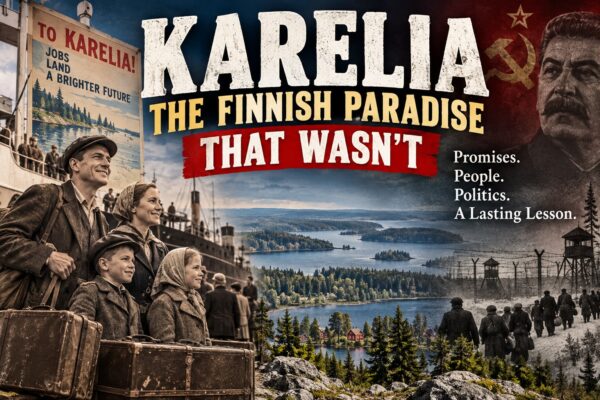
I grew up hearing pieces of the story. Finns had gone to Russia because they were promised something approaching a land of milk and honey—a new society where working people would finally get a fair shake.
Then they got there.
Turns out the milk was scarce, the honey was government property, and eventually the guy asking why there wasn’t any honey would disappear.
The real history is even stranger.
Karelia sits along Finland’s eastern frontier, a vast country of forests and lakes inhabited for centuries by Karelians, a Finnic people closely related linguistically and culturally to Finns. After the Russian Revolution, much of eastern Karelia became part of the Soviet Union.
Then came the Great Depression.
By the early 1930s, thousands of Finnish immigrants and their descendants were living across Michigan, Minnesota, Wisconsin, Ontario and elsewhere in North America. Many were working-class people. Mining and logging communities had been hammered by unemployment. Families who had crossed the Atlantic looking for opportunity suddenly found themselves standing in bread lines.
Soviet Karelia offered an alternative.
Come east.
There will be jobs.
Bring your skills. Bring your equipment. Help us build something new.
A Finnish-speaking socialist society was being constructed right next door to Finland. Skilled Finnish-American lumbermen, mechanics, miners, farmers and machinists were exactly the people Soviet Karelia needed.
The resulting migration became known as “Karelian Fever.”
During the early 1930s, thousands of Finns from the United States and Canada packed their belongings and headed for the Soviet Union. Some even brought machinery, tools, vehicles and savings with them.
Think about that for a moment.
These weren’t necessarily idiots or wild-eyed revolutionaries. Many were ordinary people living through an economic catastrophe. America appeared to have failed them. Someone else was offering employment, security and a chance to build a better world.
That’s important because hindsight makes history ridiculously easy.
We know how Stalin’s Soviet Union ends.
They didn’t.
At first, some of the newcomers were treated relatively well because they possessed skills the Soviets desperately needed. But the promised paradise increasingly collided with Soviet reality: shortages, bureaucracy, political control and a government that was becoming progressively more suspicious of anyone with foreign connections.
And Finnish-Americans had foreign connections written all over them.
They spoke Finnish. They had relatives in America. They received foreign mail. Some had American passports. They knew what life outside the Soviet Union looked like.
Under Stalin, yesterday’s prized immigrant could become tomorrow’s suspected spy.
During the Great Terror of 1937–38, Finns were arrested throughout Soviet Karelia. Finnish institutions were closed or suppressed. People disappeared into prisons and labor camps. Others were executed.
Some ended up in mass graves.
The dream of a Finnish socialist Karelia effectively died with them.
And here’s the part of the story I find most fascinating.
Look at Karelia today.
The Republic of Karelia still exists inside Russia. The forests are still there. The lakes are still there. The old Finnic place names and traditions haven’t completely vanished.
But the people changed.
Karelians now constitute only a small percentage of the population. Ethnic Finns are smaller still. Russian is dominant.
A place that was once overwhelmingly associated with a Finnic cultural world was gradually absorbed into a much larger Russian one.
Karelia survived on the map while much of the Karelia that had existed in people’s heads disappeared.
There’s a lesson there considerably bigger than communism.
Civilizations are not just pieces of dirt.
They’re people.
They’re language, churches, songs, recipes, cemeteries, stories, customs and grandmothers telling children things that happened before they were born.
Lose enough of those people and eventually the map can retain the same name while describing something very different.
There’s another lesson.
Whenever somebody promises paradise, check the return policy.
Human beings are perpetually susceptible to the idea that somewhere over the horizon somebody has finally designed a system without greed, corruption, suffering or stupidity.
Unfortunately, every system eventually gets staffed by humans.
The Finnish-Americans who caught Karelian Fever weren’t uniquely gullible. They were doing something humans have done forever: looking across the fence during difficult times and wondering whether the grass really was greener.
Some discovered that it wasn’t.
Some managed to leave.
Others discovered that authoritarian governments don’t always let disappointed customers check out.
And some paid with their lives.
Maybe that’s why this obscure chapter of Finnish-American history matters.
Karelia teaches us that economic desperation makes grand promises enormously powerful. It teaches us that governments can value people for their usefulness one year and fear them for their independence the next. It teaches us that cultures can disappear without the geography disappearing with them.
Most importantly, it teaches something every Finn probably already suspects:
If someone promises you unlimited prosperity, perfect equality and a workers’ paradise, keep one hand on your wallet and the other on your passport.
And maybe don’t sell the house back in Michigan just yet. SISU
If you enjoyed this article, then please REPOST or SHARE with others; encourage them to follow AFNN. If you’d like to become a citizen contributor for AFNN, contact us at managingeditor@afnn.us Help keep us ad-free by donating here.
Substack: American Free News Network Substack
Truth Social: @AFNN_USA
Facebook: https://m.facebook.
Telegram: https://t.me/
Twitter: https://twitter.com/AfnnUsa
GETTR: https://gettr.com/user/AFNN_
CloutHub: @AFNN_USA