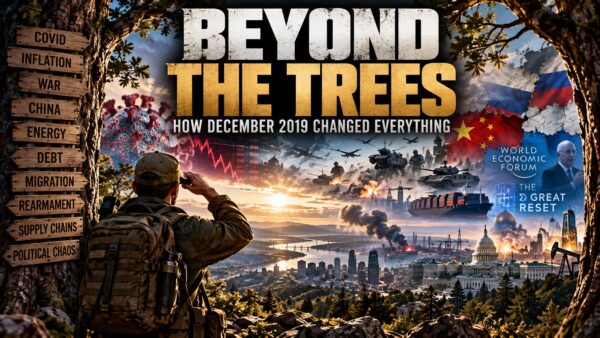
There is an old saying that sometimes you can’t see the forest for the trees.
Welcome to modern politics.
Every morning we grab our phones and immediately get smacked in the teeth with another tree branch.
Trump said something. Congress did something. Russia bombed something. Iran threatened something. China sanctioned something. The market moved. Gas now costs thirty cents more. Somebody posted something stupid, and by lunchtime half the country is furious.
Tomorrow we’ll do it again.
We have become experts and skillful at battling over trees.
Maybe it’s time to look at the forest.
Zoom out—not five minutes, but five or six years.
Start around December 2019.
COVID arrives. Borders close. Businesses shut down. Schools empty. Governments spend trillions. Supply chains break. Central banks respond aggressively. Remote work explodes. Public trust gets hammered.
And here’s the part we sometimes forget: ideas about fundamentally changing the global economic system were already floating around before COVID.
In 2016, Danish politician Ida Auken published a World Economic Forum thought experiment imagining 2030 in which she owned nothing and products had largely become services. It wasn’t a government plan, and Klaus Schwab didn’t write the infamous line. But the concept was publicly being discussed years before COVID.
Then COVID arrived.
And in June 2020, Schwab and the World Economic Forum launched an initiative literally called “The Great Reset,” arguing that the pandemic presented an opportunity to rethink economic and social systems.
None of that proves COVID was engineered to accomplish those objectives.
It proves something more useful:
The crisis became an accelerator. Never, let a crisis go to waste…
And we never really recovered before the next crisis arrived.
Inflation.
Higher interest rates.
Russia invades Ukraine.
Europe rearms.
NATO is weak.
Energy becomes a weapon.
Sanctions become weapons.
The Middle East erupts.
America and China increasingly compete over semiconductors, manufacturing, artificial intelligence, critical minerals and Taiwan.
Meanwhile countries begin reshoring factories, protecting strategic industries, increasing defense spending and reorganizing supply chains around allies.
Look at each event individually and you get the evening news.
Look at them together and you might be looking at history.
That’s the forest.
Maybe historians will call this period the Great Reset.
Maybe they’ll call it the collapse of the post-Cold War order.
Maybe they’ll decide World War III didn’t begin with mushroom clouds or some president standing behind a podium declaring war. Maybe it began gradually—with proxy wars, drones, cyberattacks, sanctions, financial warfare, information operations, competing economic blocs and occasional conventional fighting. Frogs in the pot of boiling water, unaware.
Maybe those aren’t even different descriptions.
Maybe the Great Reset and World War III are simply two ways of describing the same historical transition: one international order dying while another struggles to replace it.
That is why our obsession with daily politics can become so dangerous.
Presidents matter. Elections matter. Congress matters.
But history is bigger than politicians.
Fifty years from now, historians may care considerably less about whatever political outrage dominated Tuesday afternoon. They’ll ask larger questions.
When did globalization begin breaking apart?
When did nations start organizing their economies AGAIN around security instead of efficiency?
When did countries begin choosing sides again?
When did ordinary people begin behaving as though the old system wasn’t coming back?
That’s where the interesting indicators appear.
People move.
Money moves.
Factories move.
Supply chains move.
Governments stockpile.
Defense budgets grow.
Countries search for alternative currencies and trading arrangements.
Those aren’t tweets.
Those are structural changes.
And that’s why December 2019 may eventually become such an important date.
COVID didn’t create every problem we’re experiencing today. Russia, China, debt, distrust, globalization and geopolitical competition were already there.
COVID simply flipped over the table.
Everything that wasn’t firmly attached started moving.
Six years later, we’re still waiting for everything to settle down.
Maybe it won’t.
Maybe we’re standing three feet from an oak tree arguing about the bark while the entire forest behind us is catching on fire.
And someday historians may wonder how we were so stupid we didn’t see it happening.
The answer may be embarrassingly simple.
We were too busy watching the trees.
If you enjoyed this article, then please REPOST or SHARE with others; encourage them to follow AFNN. If you’d like to become a citizen contributor for AFNN, contact us at managingeditor@afnn.us Help keep us ad-free by donating here.
Substack: American Free News Network Substack
Truth Social: @AFNN_USA
Facebook: https://m.facebook.
Telegram: https://t.me/
Twitter: https://twitter.com/AfnnUsa
GETTR: https://gettr.com/user/AFNN_
CloutHub: @AFNN_USA